
An Alabama Non-Disclosure Agreement (NDA) is a contractual tool to protect confidential business information, trade secrets, and proprietary materials while aligning with Alabama statutory and case-law principles. Unlike California’s near-total ban on non-compete restraints, Alabama courts routinely enforce reasonable restrictive covenants and expect NDAs to be tailored, clear, and time-limited. Two statutory anchors to keep in mind: the Alabama Uniform Trade Secrets Act (UTSA), codified at Ala. Code § 8-27-1 et seq., and the six-year statute of limitations for written contracts (Ala. Code § 6-2-34).
What Is an Alabama NDA?
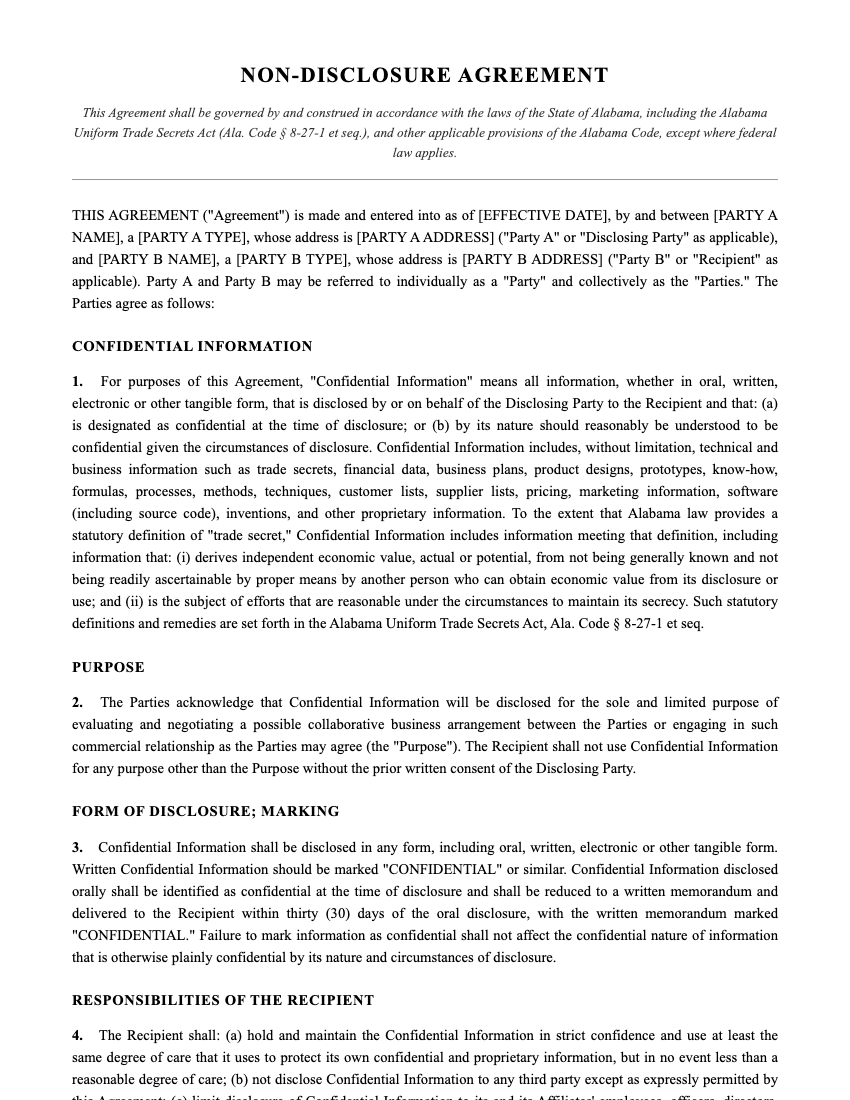
Definition: An Alabama Non-Disclosure Agreement is a written contract in which a Receiving Party agrees to keep certain identified information confidential and to use it only for a limited, agreed purpose. Trade secret protection in Alabama follows the UTSA framework (Ala. Code § 8-27-1 et seq.), which protects information that derives independent economic value from not being publicly known and is subject to reasonable efforts to keep it secret.
In Alabama, NDAs coexist with enforceable non-compete and no-hire covenants. That means an NDA can—and often should—focus on confidentiality, permitted uses, and remedies, while separate restrictive covenants (if appropriate) must be reasonable in scope, duration, and geography to survive court scrutiny.
For a complete guide to NDA terms, duration, and standard exclusions, see our NDA Agreement Guide.
Why "Generic" NDAs Are Dangerous in Alabama
Using an out-of-state template without local edits creates three major risks in Alabama:
- Overbroad restraints disguised as confidentiality. Alabama courts will enforce reasonable restraints when negotiated; burying a broad prohibition on post‑employment competition inside an NDA can create unintended liability and bargaining issues. If you intend to restrict future employment, execute a clear, stand-alone covenant supported by adequate consideration.
- Missing survival and limitation language. Alabama’s six-year statute of limitations for written contracts (Ala. Code § 6-2-34) means breach claims can arise years later. Conversely, trade secret claims under UTSA often focus on discovery dates—so your NDA should specify survival periods and limitation waivers where permissible to limit exposure.
- Failure to define trade secrets vs. confidential information. UTSA protection lasts as long as secrecy is maintained; general business information should have a fixed confidentiality term (commonly 2–5 years). Calling everything a "trade secret" invites judicial pushback and weakens enforcement.
Paradigm-shifting insight (Alabama): Because Alabama enforces reasonable restrictive covenants, the pivotal risk isn’t that NDAs will be void (as in California), but that a poorly drafted NDA will be interpreted as creating a restrictive covenant you never intended. In Alabama, clarity is everything: separately label confidentiality obligations, non-compete clauses, and non-solicit/no-hire provisions. Doing so preserves enforceability and reduces litigation risk.
Real development to note
Alabama codified a UTSA-style protection in its statutes (see Ala. Code § 8-27-1 et seq.), aligning state law with the national model. Practitioners in Alabama therefore treat trade-secret protection under the statutory UTSA standards while drafting NDAs that also respect contract-limit rules such as Ala. Code § 6-2-34 (six-year limitations period for written contracts).
What’s Included in This Template? (Key Clauses)
- Purpose/Permitted Use: Narrowly define the reason the Receiving Party may access the information (e.g., "evaluating a distribution agreement for Product X").
- Definition of Confidential Information vs. Trade Secrets: Two-tier approach—(A) general confidential information (2–5 year protection), (B) trade secrets (protected as long as they remain secret per Ala. Code § 8-27-1 et seq.).
- Exclusions: Public information, pre-existing knowledge, independently developed materials, and compelled disclosure carve-outs.
- Non-Competition and Non-Solicit Carve-Outs: Explicitly separate these into standalone covenants if intended. In Alabama, reasonableness (time, scope, geography) and consideration are decisive.
- Remedies and Equitable Relief: Injunctive relief clause (UTSA and state courts frequently grant injunctive relief for misappropriation).
- Limitations and Survival: Set specific survival periods for confidentiality, and align remedies with Alabama’s written-contract rules (Ala. Code § 6-2-34).
- Electronic Signature and Execution: Reference Alabama’s adoption of electronic signature rules (UETA) so e-signing is acceptable.
Mutual vs. Unilateral Options
- One-Way (Unilateral): Use when only one party discloses—investor pitches, contractor work-for-hire, vendor disclosures.
- Mutual (Two-Way): Use for joint ventures, M&A due diligence, partnerships.
Choosing the wrong form can either weaken protection or introduce unintended mutual obligations (including giving the Receiving Party reciprocal injunctive rights).
Who Needs This Document?
- Tech Startups: Protect software, algorithms, and customer data during fundraising and hiring.
- Manufacturers & Suppliers: Keep CAD files, BOMs, and specifications secure when working with vendors.
- Service Firms: Protect client lists and pricing strategies—Alabama courts will enforce narrowly tailored covenants.
- Employers: Use as part of an employment package, with standalone non-compete/no-solicit provisions where appropriate.
How to Execute a Valid Alabama NDA
Step 1: Choose the right form — One-Way vs. Mutual and separate any restrictive covenant you intend to enforce.
Step 2: Define the Purpose and Scope — Narrow-purpose language avoids disputes about permitted use.
Step 3: Mark and Maintain Secrecy — Label materials "CONFIDENTIAL," control access, and record disclosure logs; UTSA protection requires "reasonable efforts" to maintain secrecy.
Step 4: Sign and Date Before Disclosing — Alabama recognizes electronic signatures (UETA). Get a signed agreement in place before any confidential material is sent.
Already Getting NDAs From Clients?
When reviewing incoming NDAs, look for all three red flags: (1) unintended non-compete language embedded in the confidentiality provisions, (2) overly long or indefinite confidentiality periods for non–trade secret info, and (3) missing definitions that would let the other party claim very broad rights.
an AI contract review tool can quickly flag these Alabama-specific risks, compare clauses against Ala. Code standards, and suggest edits—saving time and lowering litigation exposure.
Related NDA Templates
Get the Template
Sign up for our newsletter to receive the template.
Frequently Asked Questions

About Designer Content
Designer Content creates practical legal document resources for landlords, contractors, and small business owners. We simplify complex legal concepts into actionable guidance. Connect with us on LinkedIn.