
A Master Services Agreement (MSA) in Angola is a B2B parent contract that sets the baseline legal rules for a services relationship, allowing each project to be detailed in Statements of Work (SOWs) without renegotiating everything. For SMEs, consultants, and freelancers, a well-drafted MSA helps reduce disputes over payments, deliverables, liability, and intellectual property. In Angola, a good template must reflect rules of the Civil Code (such as interest and limitation periods) and data protection obligations. It should also provide for a realistic dispute resolution mechanism in Luanda.
Definition: An Angolan Master Services Agreement (MSA) is a framework agreement entered into between service provider and client to govern, on an ongoing basis, multiple services and projects. The MSA sets general terms—payments, acceptance, confidentiality, limitation of liability, intellectual property, warranties, indemnities, and dispute resolution—and incorporates SOWs (also called “service orders”/“terms of reference”) for each specific engagement. Instead of creating a new contract per project, the parties sign the MSA once and then approve short SOWs with scope, timelines, pricing, and delivery criteria.
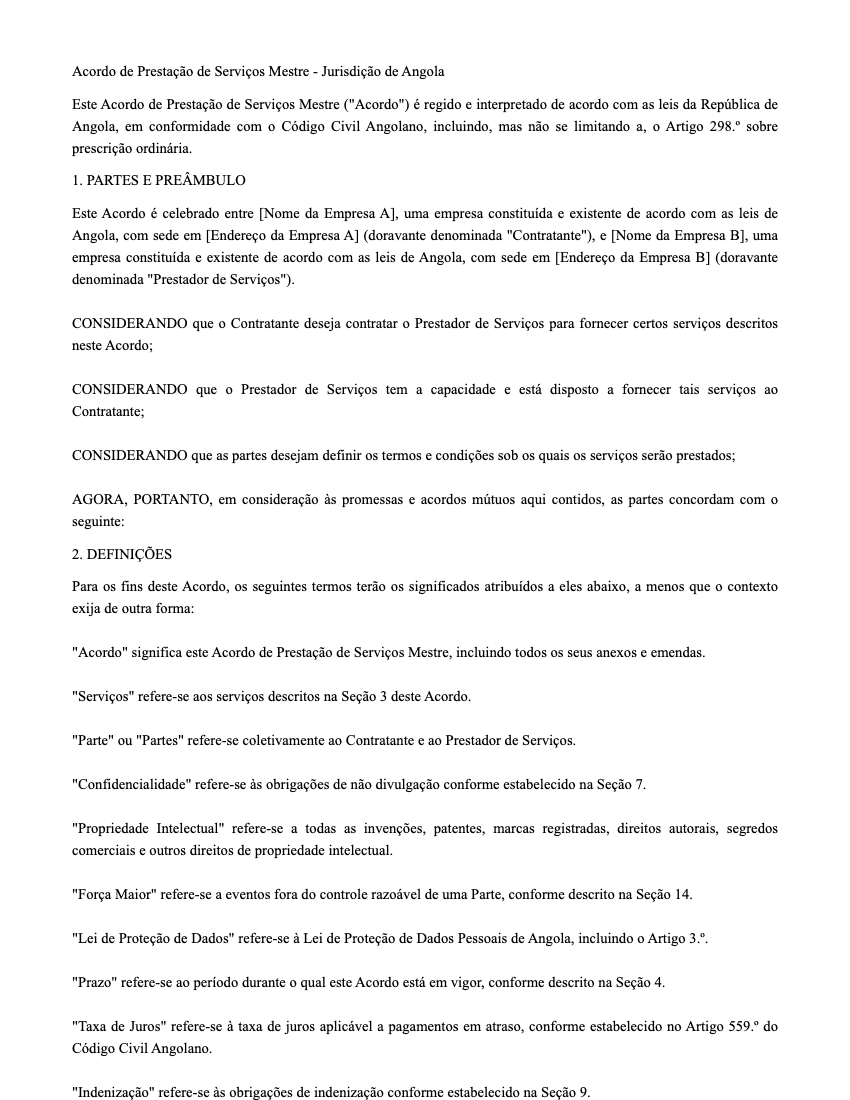
Why You Cannot Use a Generic MSA in Angola
Generic templates (for example, made for the US/UK/EU) tend to fail on three practical points in Angola: (i) they confuse a services arrangement with an employment relationship and end up creating reclassification risks; (ii) they import non-compete clauses incompatible with typical reasonableness limits in local labor law; and (iii) they treat intellectual property as “work for hire,” a concept that does not work the same way in civil law jurisdictions and may not transfer rights as the parties expect.
In addition, foreign templates often include late-payment interest “at discretion” or very high rates, whereas in Angola it is important to anchor the contract in legally defensible bases. A practical example is to provide for late-payment interest by reference to the applicable legal rule, such as the 12% rate indicated in the Angolan Civil Code, Artigo 559.º, to avoid disputes about abuse or uncertainty. Another critical point is aligning the timeframe for claims and disputes with the ordinary limitation period of the Angolan Civil Code, Artigo 298.º, especially for recurring services, where older charges may become time-barred if not pursued.
For a comprehensive guide to structuring MSAs and SOWs that protect your business, see our Freelancer Contracts Guide.
Finally, any modern MSA that involves personal data (customer lists, contacts, logs, images, HR data) needs to speak the language of the Personal Data Protection Law, starting by acknowledging the concept and scope of “personal data” and processing, as in Artigo 3.º. “Global” templates usually paste a GDPR annex and ignore local baseline requirements—which, in practice, leaves the provider and the client without a clear contractual roadmap on purposes, confidentiality, security, and subcontractors.
3a. Worker Classification Rules
Angola does not use an “ABC test” like some North American jurisdictions. The relevant distinction is between a civil services agreement (B2B/independent) and a subordinate employment contract, regulated by the Lei Geral do Trabalho (LGT). In practice, the determining criterion is legal subordination: if the “provider” works under the direction, orders, schedule, integration into the organization, and discipline of the “client,” the risk of reclassification into an employment relationship increases.
A generic MSA often includes clauses that, unintentionally, describe an employment regime (e.g., time control, broad exclusivity, provided tools, daily approval, reporting as an employee). To reduce risk, the template should: (i) reinforce the provider’s technical and organizational autonomy; (ii) allow performance by a team/subcontractors (when applicable); (iii) limit the client’s direction powers to outcome requirements and acceptance criteria.
Reclassification consequences may include liability for wages/benefits, contributions, and other obligations typical of an employment relationship under the LGT and the applicable contributory regime, in addition to potential administrative fines in an inspection context. For this reason, in Angola, the MSA drafting must be consistent with a commercial relationship between entities, and each SOW should focus on deliverables, not “presence” or “shifts.”
3b. Non-Compete Enforceability
Non-compete clauses are a sensitive topic in Angola because, when applied to natural persons in a quasi-employment context, they may conflict with principles of freedom to work and with typical labor-law limits. In Angolan contracting practice, non-compete may be viable, but it must be proportionate: limited in time, territory, and subject matter, and justified by a legitimate interest (for example, protection of trade secrets, customer base, specific know-how).
A generic MSA often imposes a long (2–5 years), global, and vague non-compete (“any similar activity”), which increases the risk of unenforceability and conflict. In Angola, a safer route is to replace broad non-competes with more defensible mechanisms: (i) robust confidentiality; (ii) non-solicitation of clients/employees for a reasonable period; (iii) intellectual property and information return/deletion clauses; and (iv) proportionate contractual remedies.
When a competitive restriction is truly necessary, the template should require it to be defined by SOW (case by case) and calibrated: short duration (e.g., 6–12 months), scope only to the contracted services, and territory where the client actually operates. Damages for breach should be reasonable and related to likely harm, to reduce allegations of an excessive penalty clause. (Note: the specific legal basis may vary depending on whether the framework is labor or civil; therefore, best practice is to treat it as an ancillary obligation tied to confidentiality and unfair competition, not as a “general prohibition on working.”)
3c. IP/Work-for-Hire Considerations
In Angola, as a civil law jurisdiction, the transfer of intellectual property typically requires an express written assignment/transfer and, in many cases, a clear definition of what is being assigned, so that the client has exploitation rights. Foreign models with “work made for hire” may not produce the intended effect. Thus, the template should provide for: (i) initial ownership by the provider; (ii) assignment to the client upon payment; (iii) licenses for the provider’s pre-existing components; and (iv) rights over client materials. For software and content, this avoids disputes over who may reuse libraries, templates, and know-how.
What's Included in This Template
Flexible SOW Structure
The MSA works as an “umbrella” and each SOW defines scope, deadlines, prices, acceptance criteria, and milestones. This reduces negotiation time and helps control “scope creep”: any task outside the SOW becomes a formal change, with agreed cost and timeline impact.
Angola-Specific Indemnification
The indemnification clause is designed to be practical in Angola: it allocates risk by type of damage (e.g., IP infringement, breach of confidentiality, willful misconduct) and avoids impossible promises (“indemnify for everything”). It also references civil liability for unlawful acts and damages, aligning the language with the Angolan Civil Code, including Artigo 483.º, for consistency with the general liability regime.
Dispute Resolution and Venue
The template provides for binding arbitration in Luanda, Angola, a common option for B2B contracts when the parties want confidentiality and predictability. Alternatively, it may provide for court venue in Luanda, but the template default favors arbitration with defined rules and language, avoiding litigation in a foreign jurisdiction.
Other provisions (with legal basis):
- Late-payment interest for delayed payment: Angolan Civil Code, Artigo 559.º (12%)
- Limitation period/time limits for claims: Angolan Civil Code, Artigo 298.º
- Definitions and processing of personal data: Personal Data Protection Law, Artigo 3.º
Who Needs This Document?
| User Type | Relationship | Key Benefit |
|---|---|---|
| Marketing agencies | Recurring projects with companies | Fast SOWs and control of scope changes |
| Management/finance consultants | Monthly retainers | Clear rules on payment, confidentiality, and acceptance |
| Devs/software houses | Milestone-based deliveries | Well-defined IP and assignment triggers after payment |
| IT providers (MSP) | Ongoing support | SLAs, liability limits, and incident process |
How to Use This MSA Template
Step 1: Correctly identify the parties
Use the full corporate name, NIF (if applicable), and address/representation. In B2B, this reduces disputes about who is responsible for paying and signing SOWs.
Step 2: Define term and termination
Choose a fixed term (e.g., 12 months) or automatic renewal. Include termination for convenience with prior notice and immediate termination for material breach.
Step 3: Attach the first SOW
In the SOW include: deliverables, schedule, acceptance criteria, fees, expenses, and invoicing calendar. Avoid “open-ended tasks” with no cap—this is the most common source of conflicts.
Step 4: Sign and operationalize
Sign the MSA once and keep a controlled version (PDF). Then, each new project is only a signed SOW—without reopening the base clauses.
Related MSA Templates
Get the Template
Sign up for our newsletter to receive the template.
Frequently Asked Questions

About Designer Content
Designer Content creates practical legal document resources for landlords, contractors, and small business owners. We simplify complex legal concepts into actionable guidance. Connect with us on LinkedIn.