
A Angola Non-Disclosure Agreement (NDA) is a written contract that secures confidential business information under Angolan private law. Because Angola follows a civil‑law tradition (Código Civil angolano) and has sectoral data protection rules, an enforceable NDA must reflect local formalities (language, written form), privacy notice requirements under the Lei de Protecção de Dados Pessoais, and applicable post‑employment limits in labour law.
What is an Angola NDA?
Definition: In Angola, an NDA (Acordo de Confidencialidade) is a bilateral or unilateral contract whose legal basis is the Código Civil angolano and related labour and consumer protections. The contract creates obligations of secrecy and limited use of information disclosed for a specified purpose.
Unlike common‑law jurisdictions that rely on case law doctrines, Angola’s enforceability analysis looks first to statutory rules (Código Civil and Código do Trabalho) and to whether the parties respected formal requirements (written contract, clear purpose, and, where applicable, agreed compensation for restraints). NDAs in Angola must also comply with Lei de Protecção de Dados Pessoais when personal data are processed.
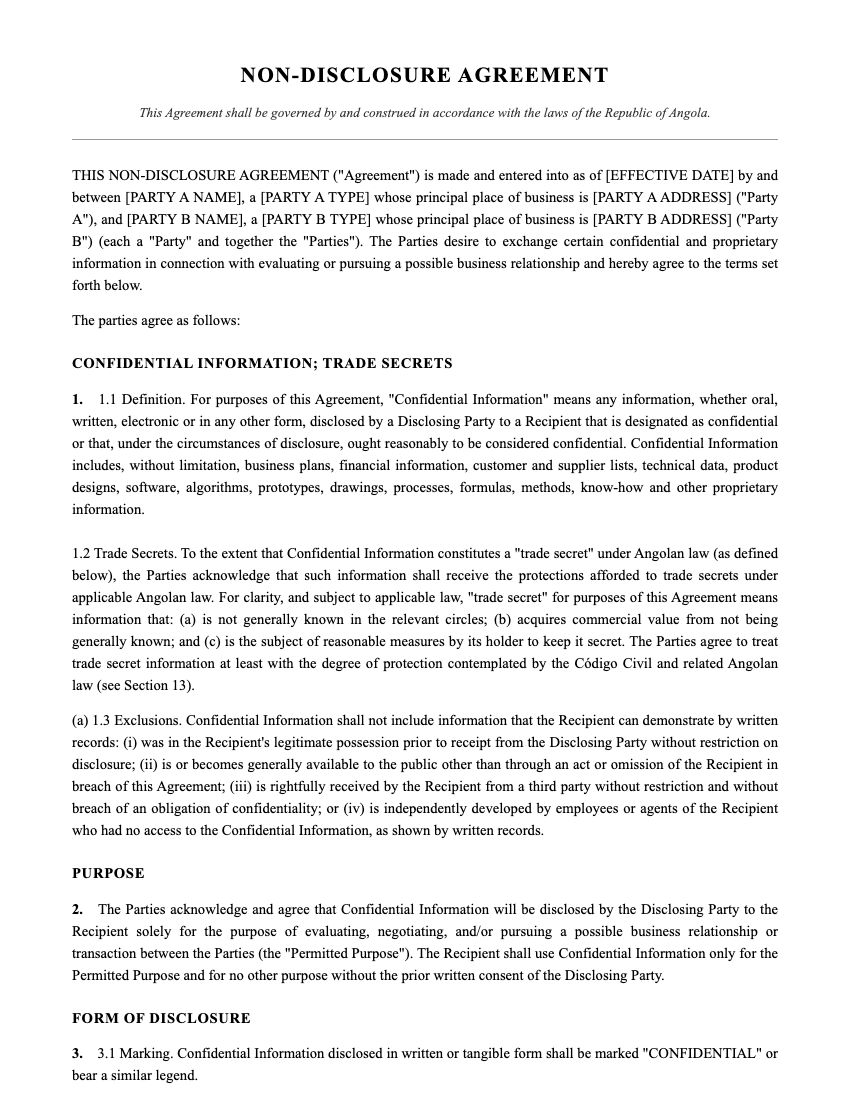
For a complete guide to NDA terms, duration, and standard exclusions, see our NDA Agreement Guide.
Why generic Anglo‑American NDAs are dangerous in Angola
Using a generic online NDA drafted for the US or UK creates at least three Angolan‑specific risks.
- Formality and language problems. Angola’s courts and administrative bodies expect contracts to be clear, in Portuguese for courtroom evidence, and properly signed. Oral confidentiality claims are harder to enforce without contemporaneous written proof (contract, emails with clear Portuguese language, or notarial acknowledgement).
- Labour and public policy limits on restraints. Post‑employment restraints (non‑compete or overly broad “no‑work” language) are treated under the Código do Trabalho and the Código Civil as potential limitations on an employee’s right to work. In practice, Angolan employers must draft narrowly, tie any post‑contractual restraint to a legitimate business interest, and — critically — often provide express contractual compensation for the restraint. A generic NDA that appears to restrict future employment can be declared unenforceable as contrary to public policy.
- Data protection and administrative exposure. Angola’s Lei de Protecção de Dados Pessoais governs how personal data are collected, processed and shared. If an NDA allows unfettered transfer of personal data (employee or customer lists) without the required legal basis or processing notice, organisations risk administrative sanctions and reputational damage.
Paradigm‑shifting insight for Angola: the “compensation + form” trap
Angolan practice centers on two decisive elements that many templates ignore: (1) post‑employment restraints that are enforceable only if they are proportionate and accompanied by express compensation; and (2) correct procedural form. In short, a lawful post‑contract restraint in Angola is rarely a simple sentence in an NDA — it must be a narrowly tailored clause, in Portuguese, in a written contract, and typically specify compensation or other balancing measures. Many foreign templates therefore either contain unenforceable restraint language or inadvertently create a stronger administrative record (exposing private data) without the required data‑processing safeguards.
Real development: data‑protection emphasis
Angola’s approval and implementation of its personal data protection law (Lei de Protecção de Dados Pessoais) and subsequent guidance from regulators have increased scrutiny of confidentiality arrangements that handle customer and employee data. Businesses operating in Angola now face both contract law scrutiny and administrative oversight for mishandled personal data—so NDAs must combine civil‑law enforceability with privacy compliance.
Key clauses adapted for Angola
- Definition of Confidential Information: carve out personal data and require compliant processing under the Lei de Protecção de Dados Pessoais.
- Purpose and Use Limitation: precise Portuguese‑language description of the evaluative purpose (e.g., “avaliação de parceria tecnológica relativa ao Sistema X”).
- Duration: two‑tier protection — ordinary confidential information (2–5 years) and bona fide trade secrets protected for as long as secrecy is maintained (in line with Código Civil principles on property and obligations).
- Post‑Employment Restraints: optional special clause requiring narrow scope, limited duration, express compensation where applicable and reference to the Código do Trabalho limitations.
- Security and Data Processing: obligations to process personal data lawfully, to notify supervisory authority where required, and to adopt technical and organizational measures.
- Exclusions: information already public, independently developed, previously known, or lawfully disclosed.
- Remedies: injunctive relief and indemnification, while recognizing Angolan procedural rules for enforcement.
Mutual vs Unilateral
- One‑Way (Unilateral): Use when only you disclose secret know‑how (investor pitches, contractor engagements).
- Mutual: Use when both sides exchange confidential information (M&A due diligence, joint development).
Choosing the wrong form increases enforcement risk under the Código Civil and may create unnecessary data processing obligations.
Who needs this document?
| User Persona | Usage Scenario | Local Benefit |
|---|---|---|
| Tech startups in Luanda | Pitching to investors | Protects business model while complying with data rules and Portuguese language formalities |
| Manufacturers | Sharing drawings with factories | Narrow post‑employment and IP carve‑outs; written proof of transfer and confidentiality |
| Recruiters & HR | Sharing CVs with clients | Ensures personal data are processed lawfully under the Lei de Protecção de Dados Pessoais |
| Professional services | Due diligence in M&A | Mutual NDA that balances trade secrecy and required disclosures |
How to execute a valid Angola NDA (practical steps)
- Draft in Portuguese and include a precise Purpose clause. A Portuguese version is the evidentiary baseline in Angolan courts.
- Identify and segregate personal data. Add data‑processing clauses that comply with the Lei de Protecção de Dados Pessoais and specify lawful grounds for transfer.
- If including post‑employment restraints, specify compensation and narrowly draft the scope and duration to match Código do Trabalho principles.
- Sign before disclosure and keep original signed copies. Electronic evidence (scanned signed PDF) is helpful, but ensure the signature method is acceptable in Angola and maintain originals where possible.
Already receiving NDAs from counterparties?
Review incoming NDAs for foreign choice‑of‑law and forum clauses that attempt to oust Angolan mandatory provisions (particularly labour law and data protection). Even if parties choose a foreign law, Angolan mandatory provisions may still apply to local employees and data subjects.
an AI contract review tool helps by flagging clauses that clash with Angolan civil‑law formality, data protection obligations, and overbroad post‑employment restraints—saving negotiation time.
Related NDA Templates
Get the Template
Sign up for our newsletter to receive the template.
Frequently Asked Questions

About Designer Content
Designer Content creates practical legal document resources for landlords, contractors, and small business owners. We simplify complex legal concepts into actionable guidance. Connect with us on LinkedIn.