
A Master Services Agreement (MSA) in Argentina is a framework contract that sets the legal and commercial rules for a service-delivery relationship between companies or professionals, so that each project is subsequently defined in a Statement of Work (SOW) without renegotiating everything. In practice, it serves to avoid “scope creep,” to organize payments, intellectual property, confidentiality, and dispute resolution. For SMEs, agencies, and consultants, a well-adapted MSA for Argentina reduces friction and accelerates signing new work.
Definition: An Argentine MSA (Master Services Agreement) is a framework contract governed by the Código Civil y Comercial de la Nación (CCCN) that defines permanent conditions between Client and Provider: general scope, prices or billing criteria, payment terms, late-payment interest, confidentiality, data protection, limitation of liability, insurances and indemnities. The operational details of each engagement (deliverables, milestones, schedule, acceptance and specific fees) are documented in one or more SOW/Órdenes de Trabajo annexes. Thus, the MSA provides legal stability and the SOWs provide commercial flexibility for successive projects.
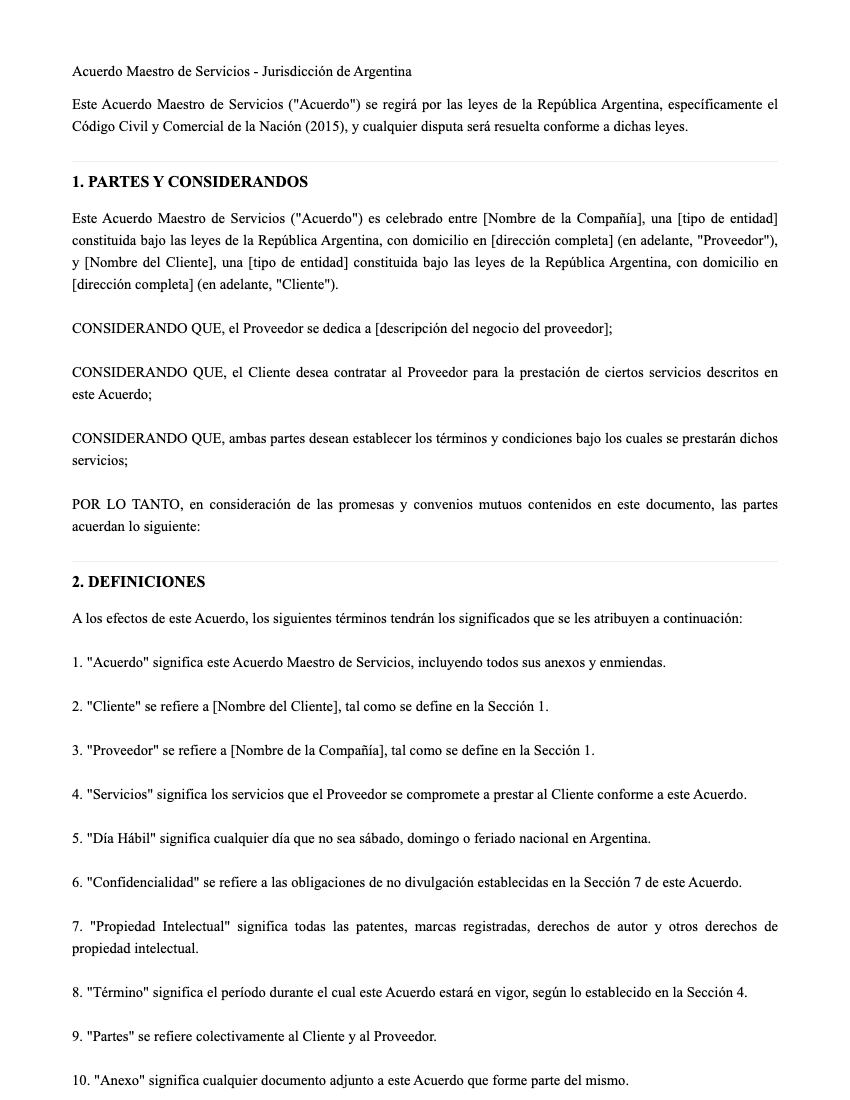
Why You Cannot Use a Generic MSA in Argentina
Using a generic MSA (for example, one designed for the U.S. or for another jurisdiction) typically fails in three critical areas in Argentina: (i) how the relationship between employment and independent contractor is analyzed, (ii) how enforceable a non-compete clause is, and (iii) how author rights and assignment of intellectual property are managed in a civil-law system. Additionally, Argentina has local rules on default interest, data privacy, and prescription periods that change the contract’s actual economic risk.
3a. Worker Classification Rules
Argentina does not use an “ABC test” like some U.S. states; the focus is on the reality of the relationship and dependence. The Law on Labor Contract No. 20,744 (LCT) defines the employment contract by the personal provision of services in a relationship of subordination (art. 21) and presumes the existence of an employment contract when someone provides services to another (art. 23), unless proven otherwise. In a B2B MSA, this matters because if, in fact, there is technical/economic subordination (imposed hours, exclusivity, disciplinary control, integration into the client’s structure), the “service” contract can be reclassified as employment.
For a comprehensive guide to structuring MSAs and SOWs that protect your business, see our Freelancer Contracts Guide.
The costs of reclassification can be high: omitted contributions and social security, wage differences, vacations/holiday pay, and penalties. Law 24.013 provides penalties related to unregistered or poorly registered employment (e.g., arts. 8 to 15), and Law 25.323 increases indemnities in certain non-payment scenarios. An Argentine MSA should include clear independence language (no exclusivity, no daily direction), allow subcontracting where appropriate, and align the SOW with a results-based execution, not “presence.”
3b. Non-Compete Enforceability
In Argentina, non-compete clauses are not absolutely prohibited in civil/commercial contracts, but their validity is evaluated using criteria of reasonableness, lawful object, and no disproportionate impact on the freedom to work and trade. A common problem with foreign templates is copying broad prohibitions (global, for several years, on any activity), which in a CCCN-based system may be considered abusive or contrary to general principles.
For relationships with individuals who could be deemed workers, there is also strong protection: the LCT (protective principles) and case law tend to permit restrictions only if they are bounded and, in post-contractual scenarios, typically require reasonable consideration to compensate for the restriction (especially if it limits the provider’s livelihood). As a civil-law framework, the CCCN requires good faith in performance (art. 9) and prohibits the abusive exercise of rights (art. 10), which directly impacts overly broad non-competition.
Rather than broad non-compete, an Argentine MSA is better protected with more executable alternatives: (i) robust confidentiality (technical information, pricing, client lists), (ii) limited non-solicitation of clients or personnel for a short period and in a defined territory, and (iii) clauses on ownership of materials and return/deletion. When a non-compete is used, it is prudent to limit it (for example, 6–12 months, specific activities, defined territory) and justify a legitimate interest. This reduces the risk of nullity for excess and improves the negotiating position.
3c. IP/Work-for-Hire Considerations
Argentina is particularly sensitive to “work made for hire” templates typical of common law. In general, copyrights are governed by Law 11.723, where the author is the person who creates the work; therefore, if the client seeks ownership, the MSA/SOW should provide a clear assignment/license (what is ceded, scope, territory, term) and ideally condition it on payment. In software and creative deliverables, it’s key to distinguish between provider’s pre-existing tools (background IP) and SOW-specific developments (foreground IP), and to document usage authorizations to avoid later disputes.
What's Included in This Template
Flexible SOW Structure
The MSA acts as an umbrella: it defines stable terms (payments, taxes, liability, confidentiality) and each SOW adds deliverables, milestones, acceptance criteria and fees. This allows signing new projects with a short annex, avoiding renegotiating legal terms each time.
Argentina-Specific Indemnification
Indemnification is drafted to allocate risks reasonably under the CCCN (good faith and responsibility). It includes caps and exclusions (for example, indirect damages), carve-outs for fraud or gross negligence, and practical obligations (defense, notice, mitigation). It also aligns with the requirement to maintain ongoing insurance.
Dispute Resolution and Venue
The template provides for dispute resolution via ICC arbitration in Buenos Aires, which is useful in B2B for confidentiality and technical specialization. Alternatively, ordinary jurisdiction can be set in CABA or an agreed province, avoiding extraterritorial clauses that are difficult to enforce.
Other included clauses (with citations):
- Late payment interest and applicable rate per CCCN art. 768.
- Data protection: security measures and confidentiality duty pursuant to Ley 25.326 art. 9 and art. 10.
- Contractual limitation period as a reference for claims: CCCN art. 2560.
- B2B (non-consumer) approach and warning of non-application if there is a final consumer, considering Ley 24.240.
Who Needs This Document?
| User Type | Relationship | Key Benefit |
|---|---|---|
| Marketing/design agencies | Retainers and recurring campaigns | Avoid renegotiating IP ownership and acceptance for each campaign |
| Consultants (IT, strategy, finance) | Ongoing monthly SOW support | Control scope and milestone-based billing |
| Software studios / freelancers | Module-based development | Defines assignment/licensing and payments tied to deliverables |
| Managed services providers (MSP) | Support and maintenance | Establishes SLAs and liability limits |
How to Use This MSA Template
Step 1: Correctly Identify the Parties
Use the full legal name, CUIT, address and legal form (S.A., S.R.L., monotributista, etc.). In Argentina, misidentification complicates invoicing, service of process and enforcement.
Step 2: Define the “framework” scope and what goes into the SOW
Leave the MSA for general rules and move deliverables, dates and rates to the SOW. This reduces discussions about “what was included” and helps budget changes.
Step 3: Adjust payments, default interest and taxes
Specify currency, terms, invoicing and the late-payment interest per CCCN art. 768. Clarify applicable withholdings/taxes and whether prices include VAT.
Step 4: Sign and version SOWs
Sign the MSA once and number each SOW (SOW-01, SOW-02). Maintain versions and written approvals to avoid scope and acceptance disputes.
Related MSA Templates
Get the Template
Sign up for our newsletter to receive the template.
Frequently Asked Questions

About Designer Content
Designer Content creates practical legal document resources for landlords, contractors, and small business owners. We simplify complex legal concepts into actionable guidance. Connect with us on LinkedIn.