
A Argentina Non-Disclosure Agreement (NDA) is a written contract that protects confidential and proprietary information when parties share it during negotiations, employment, contracting, or commercial relationships. In Argentina, NDAs must be drafted with two distinct legal frameworks in mind: civil-contract rules under the Código Civil y Comercial de la Nación (2015) and data-protection obligations under Ley de Protección de Datos Personales 25.326. Additionally, post-contractual restraints and employee-related clauses are interpreted under labor doctrine and public-order limits.
What is an Argentina NDA?
Definition: An Argentina NDA is a contract by which one or both parties undertake to keep certain information secret and to use it only for a permitted purpose. The Código Civil y Comercial recognizes freedom of contract but binds parties to good faith and limits that affect employment relationships and consumer protection. NDAs must therefore be reasonable, lawful, and consistent with statutory duties such as data privacy (Ley 25.326).
Unlike jurisdictions that rely on a single "trade secrets" statute, Argentina protects confidential business information through civil contract law, unfair competition rules, labor law principles, and—where personal data are involved—Ley 25.326. The practical effect: an NDA must be precise about what is protected, how personal data will be handled, and whether any post‑employment restraint is intended (and if so, how it will be compensated and limited).
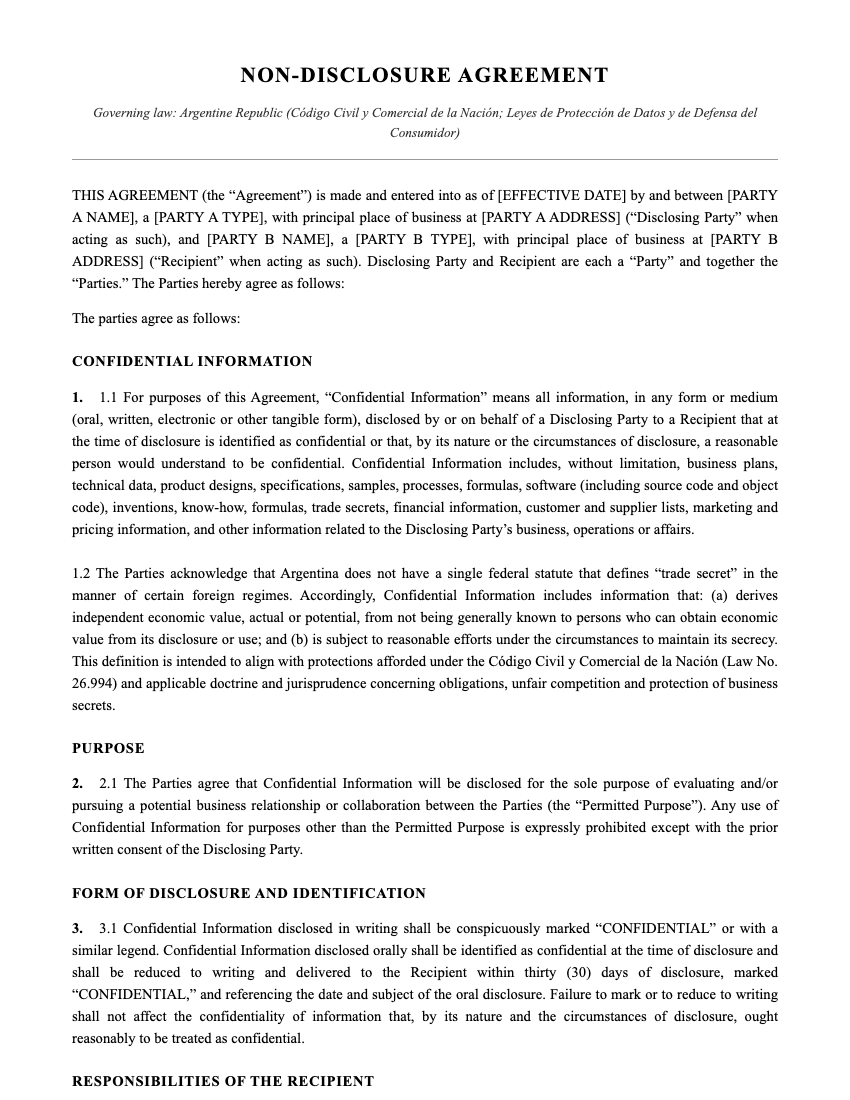
For a complete guide to NDA terms, duration, and standard exclusions, see our NDA Agreement Guide.
Why generic NDAs are dangerous in Argentina
Using a boilerplate NDA drafted for another legal system creates four local risks:
- Data-protection exposure. If your NDA covers personal data (clients, employees), it must reflect obligations under Ley 25.326: lawfulness of processing, purpose limitation, security measures, and, in cross-border contexts, compliance with transfer rules. Generic templates often ignore these duties.
- Unenforceable post-contract restraints. Argentine labor doctrine and civil courts scrutinize non-compete or post-employment restraints. Where a restraint affects an employment relationship, courts require the restriction to be reasonable in time, geography, and scope and often expect some form of compensation or consideration. Overbroad post-contract clauses can be declared null as contrary to public policy.
- Ambiguous "trade secret" claims. Because protection is fact-driven (secret, economic value, reasonable secrecy efforts), calling all confidential files "trade secrets" invites a court to deny protection entirely. You need a two-tiered definition: (a) personal data subject to Ley 25.326, (b) general confidential information (time-limited), and (c) high-value trade secrets (protected while secret).
- Missing electronic-signature and execution formalities. Argentina recognizes electronic signatures under Law 25.506; however, the parties should expressly allow electronic execution and specify signature method to avoid evidentiary disputes.
Paradigm-shifting insight: In Argentina, confidentiality obligations often collide with data-protection duties. NDAs that treat client lists or employee records merely as "confidential" may inadvertently create breaches of Ley 25.326 if they do not describe processing bases, security measures, and cross-border transfer protocols. In short: an NDA can be both a confidentiality agreement and a data-processing arrangement—ignore the overlap at your peril.
Real case study / development
Argentina has seen increased enforcement and litigation around data-handling and misuse of confidential information. Recent commentary by major Argentine law firms highlights courts' readiness to annul post-employment restraints that are not compensated or justified by legitimate business need. For cross-border tech and services contracts, local counsel now insist NDAs include data-protection clauses compliant with Ley 25.326 and explicit electronic-signature acceptance per Law 25.506.
What’s included in this Argentina NDA template? (Key clauses)
- Precise definition of Confidential Information: split into (A) Personal Data (Ley 25.326), (B) Business Confidential Information (time-limited), and (C) Trade Secrets (protected while secret).
- Purpose limitation: restricts use to a narrowly defined business objective.
- Duration: recommended two-tier durations—e.g., 2–5 years for business confidential information; indefinite protection for true trade secrets while secrecy is maintained.
- Post-contractual restraints: optional, narrowly drawn clause with suggested compensation language and time/geography limits (to maximize enforceability under Argentine practice).
- Data-protection addendum: security measures, authorized processors, notification obligations, and rules for international transfers consistent with Ley 25.326.
- Electronic execution: express recognition of Law 25.506 e-signatures and accepted platforms.
- Exclusions: publicly known info, previously known by recipient, independently developed, or compelled disclosure by authority (with notice obligation where permitted).
- Remedies and limitation of liability: injunctive relief, accounting, and damages; note on prescription (contractual claims in Argentina frequently prescribe after five years under applicable provisions of the Código Civil y Comercial).
Who needs this document?
| User Persona | Typical Use Case in Argentina | Why this template helps |
|---|---|---|
| Local startups | Pitching to investors, sharing client pilots | Protects confidential tech and customer data while complying with Ley 25.326 |
| Employers & HR | Hiring senior staff, contractors | Includes narrowly tailored post-employment restraint option and electronic-signature language |
| Professional services firms | Outsourcing, vendor onboarding | Data-processing addendum protects both parties from Ley 25.326 exposure |
| Manufacturers & designers | Sharing prototypes with suppliers | Trade-secret tier protects technical know‑how while allowing necessary manufacturing info |
How to execute a valid Argentina NDA
Step 1: Choose the right type. Decide One-Way (discloser-only) vs Mutual (both share). If personal data will be shared, include the data-processing addendum.
Step 2: Define the Purpose and scope narrowly. Argentine courts emphasize proportionality; the clearer the purpose, the easier enforcement.
Step 3: Identify and label. Mark documents "CONFIDENTIAL" and log disclosure dates. For personal data, note legal basis and security measures required under Ley 25.326.
Step 4: Sign correctly. Include an express clause consenting to electronic signatures under Law 25.506 and record the method (e.g., certified digital signature, DocuSign). For sensitive employee restraints, consider separate written acceptance and—where appropriate—compensation language.
Receiving NDAs from counterparties?
When asked to sign someone else's NDA in Argentina, check for: hidden non-compete terms, inadequate data‑protection obligations, overly broad definitions, absence of signature method, or waiver of labor rights. Negotiate to insert lawful limits, compensation for restraints, and clear data-processing terms.
an AI contract review tool can instantly flag risky clauses, compare terms against Argentine legal norms (data-protection, civil good-faith, and employment limits), and suggest jurisdiction-specific redlines—saving time and reducing litigation risk.
Related NDA Templates
Get the Template
Sign up for our newsletter to receive the template.
Frequently Asked Questions

About Designer Content
Designer Content creates practical legal document resources for landlords, contractors, and small business owners. We simplify complex legal concepts into actionable guidance. Connect with us on LinkedIn.