
An Arizona Non‑Disclosure Agreement (NDA) is a written contract that protects confidential business information and trade secrets, while reflecting Arizona's contract‑friendly courts and the Uniform Trade Secrets Act codified in state law. Unlike some states that narrowly limit post‑employment restraints, Arizona enforces reasonable non‑competes—so NDAs must be drafted with care to avoid unintentionally limiting lawful competition or exposing you to claims under the Arizona Consumer Fraud Act.
What is an Arizona NDA?
Definition: An Arizona Non‑Disclosure Agreement is a contract in which one or both parties agree to keep certain information confidential and to use it only for a permitted purpose. Arizona’s statutory trade secret law (A.R.S. § 44‑401 et seq.) defines trade secrets and supplies the remedies available for misappropriation. For written contracts, the six‑year statute of limitations (A.R.S. § 12‑548) governs most breach claims.
Because Arizona is a common‑law jurisdiction that generally enforces parties' agreements, NDAs here are treated as ordinary contracts subject to well‑established reasonableness tests. That makes precise drafting—and an awareness of local traps—critical.
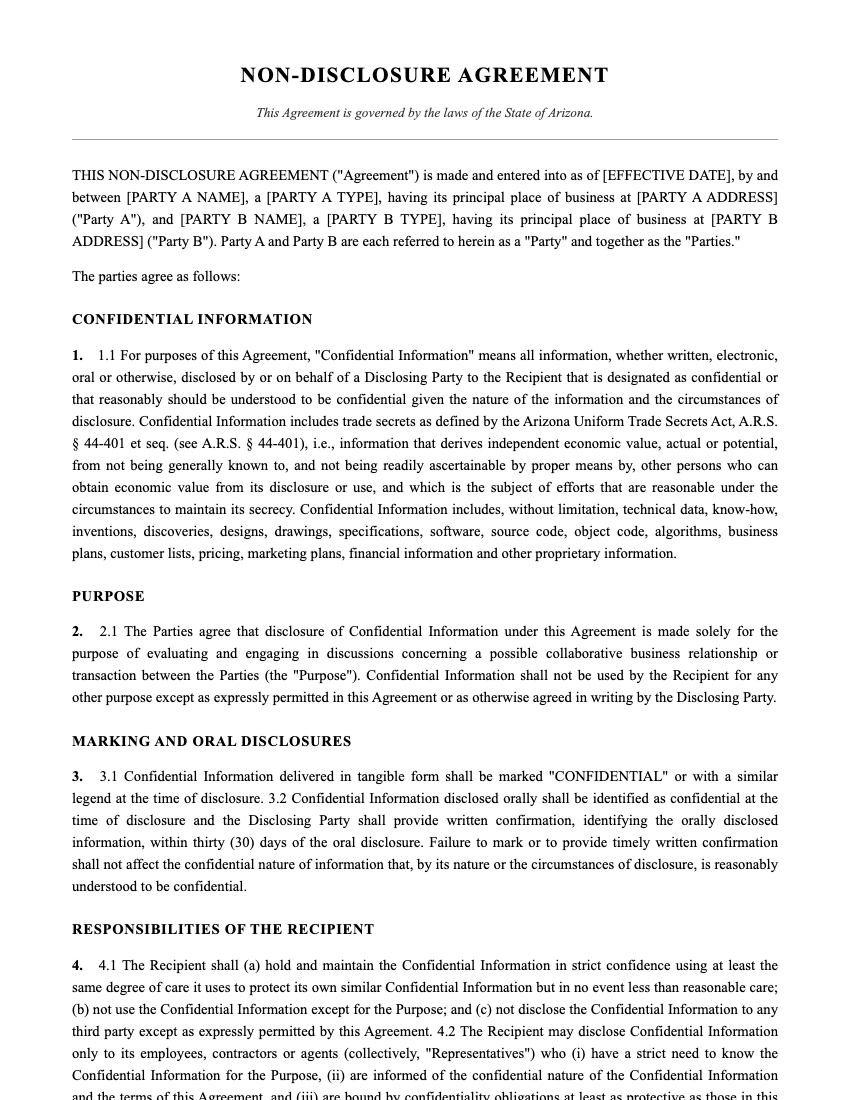
For a complete guide to NDA terms, duration, and standard exclusions, see our NDA Agreement Guide.
Why "Generic" NDAs Are Dangerous in Arizona
Many free NDA forms are written for states with different case law or statutory limits. Using a generic template in Arizona creates three practical risks.
- Overbroad restraints disguised as confidentiality
Arizona courts will enforce non‑competition and restrictive covenants when they are reasonable in scope, duration, and geography. A generic NDA that includes expansive use restrictions (for example, a catchall preventing any contact with a customer for an indefinite period) can be enforced in part—but may also invite litigation. Worse, if the draft mixes confidentiality with broad restrictive covenant language, you may unintentionally create an enforceable post‑employment restraint without sufficient consideration or narrowly tailored limits.
Paradigm‑shifting insight for Arizona: Arizona's legal trap is not a blanket ban on restraints (as in California), it's the "false security" of thinking a boilerplate NDA gives unlimited protection. Because Arizona enforces reasonable restraints, vague or unlimited language can either be reformed by a court or enforced in harmful ways. Draft NDAs to separate pure confidentiality obligations from any permissible restrictive covenants, and be explicit about duration, scope, and consideration.
- Consumer fraud claims and B2B relationships
The Arizona Consumer Fraud Act (A.R.S. § 44‑1521 et seq.) is typically used in consumer contexts, but courts and regulators have allowed B2B claims in limited circumstances—particularly where deceptive or unconscionable clauses are used to hide unlawful acts. NDAs that attempt to conceal illegal conduct or mislead a counterparty may attract regulatory or statutory scrutiny under state consumer protection laws.
- Missing DTSA whistleblower notice
If you ever pursue trade secret remedies under the federal Defend Trade Secrets Act (DTSA), federal law (18 U.S.C. § 1833(b)) requires NDAs to include a notice that a party may disclose trade secrets to government officials for reporting suspected wrongdoing without liability for civil damages. Without that notice, you forfeit the ability to recover exemplary damages and attorney’s fees under federal law.
Real case study (practical takeaway)
While Arizona lacks a single landmark NDA case on the scale of some other states, Arizona courts routinely apply the Uniform Trade Secrets Act and the reasonableness test for restraints. Business litigators in Arizona frequently point to the consistent pattern: where an agreement clearly separates confidentiality duties from restrictive covenants, courts are more likely to enforce the confidentiality provisions while scrutinizing non‑compete language under a narrow standard. The practical lesson: clarity beats ambiguity when you want enforceability without overreach.
Key clauses adapted for Arizona practice
- Definition of Confidential Information: Distinguish between general confidential information (subject to a fixed term) and trade secrets as defined in A.R.S. § 44‑401. Only label information "trade secret" when it meets the statutory test.
- Purpose and Permitted Use: Narrow the permitted purpose to a specific business evaluation or project. Arizona courts favor purpose‑limited clauses where there is a legitimate business justification.
- Term and Survival: For non‑trade confidential information use a defined term (commonly 2–5 years). For trade secrets, state that protection lasts so long as the information remains a trade secret under A.R.S. § 44‑401.
- Injunctive Relief & Remedies: Include a clear injunctive relief clause and express remedies for breach. Note DTSA notice language (18 U.S.C. § 1833(b)) so you preserve federal enhanced remedies.
- Non‑Competition and Non‑Solicit Carveouts: If you need post‑employment restraints, include separate, narrowly tailored non‑compete or non‑solicit provisions with explicit consideration and geographic/scope limits. Do not bury restraints inside a confidentiality definition.
- Choice of Law & Venue: If you expect disputes in Arizona, state Arizona law and specify the county or federal district. Be mindful that courts may refuse to enforce a forum selection clause that undermines statutory rights.
Who needs this document?
- Tech startups: Protect prototypes and early‑stage product roadmaps during investor conversations.
- Manufacturers: Shield process know‑how and supplier lists when contracting with overseas vendors.
- Employers & HR: Limit misuse of personnel files, onboarding materials, and internal processes while respecting enforceable non‑compete tests.
- M&A parties: Govern due‑diligence disclosures with purpose and survival rules.
- Consultants & freelancers: Clarify what is shared and how it can be used to avoid later disputes.
How to execute a valid Arizona NDA (practical steps)
- Choose the right form: Decide between unilateral (one‑way) and mutual NDAs based on who will disclose.
- Define the purpose precisely: Limit the recipient’s use to the agreed evaluation or project.
- Mark and document secrecy efforts: Label documents and record access controls—this supports trade secret status under A.R.S. § 44‑401.
- Sign and preserve written proof: Because A.R.S. § 12‑548 provides a six‑year statute of limitations for written contracts, keep executed originals and consider an express acknowledgment of consideration if restrictive covenants are included.
Cross‑sell: If you receive an NDA to sign, use an AI contract review tool to flag Arizona‑specific risks—overbroad restraints, missing DTSA notice, or questionable choice‑of‑law clauses—so you can negotiate with confidence.
Related NDA Templates
Get the Template
Sign up for our newsletter to receive the template.
Frequently Asked Questions

About Designer Content
Designer Content creates practical legal document resources for landlords, contractors, and small business owners. We simplify complex legal concepts into actionable guidance. Connect with us on LinkedIn.