
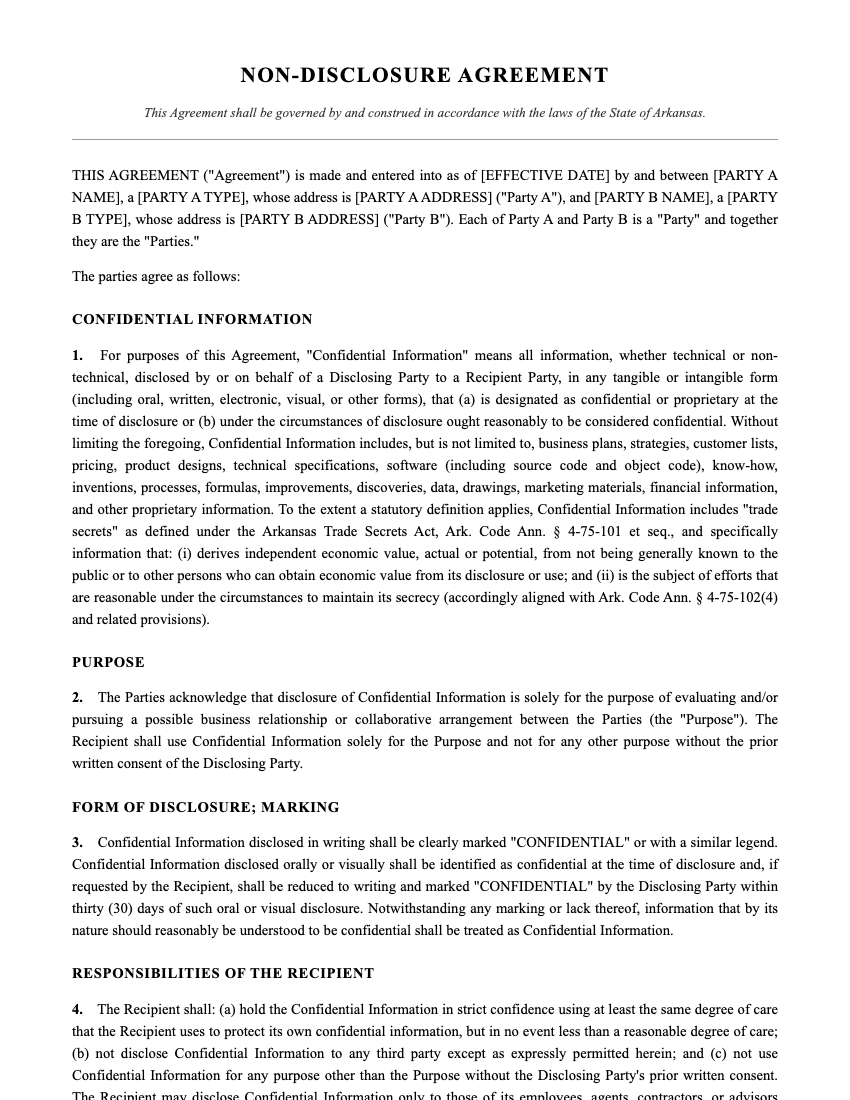
A well-drafted Arkansas Non-Disclosure Agreement (NDA) protects your confidential business information and trade secrets while fitting Arkansas law. This template balances enforceability (Arkansas courts generally enforce reasonable restraints) with practical protections—avoiding disguised non-competes, accounting for Arkansas’s contract-limitations rules, and preserving federal remedies where possible.
What is an Arkansas NDA?
Definition: An Arkansas NDA is a contract in which one or both parties promise to keep specified information confidential. Trade-secret claims in Arkansas are governed by the Arkansas Uniform Trade Secrets Act (Ark. Code Ann. § 4-75-601 et seq.), and contract claims are subject to the state’s limitation periods—most written contract claims must be brought within five years under A.C.A. § 16-56-111.
An NDA can protect everything from source code and customer lists to manufacturing processes and strategic plans. But what makes an NDA enforceable in Arkansas is (1) a clear, reasonable definition of confidential information, (2) limited and proportionate duration and scope, and (3) reasonable security and notice steps by the disclosing party.
For a complete guide to NDA terms, duration, and standard exclusions, see our NDA Agreement Guide.
Why "Generic" NDAs Are Dangerous in Arkansas
Online templates are often written for other states and contain hidden traps if used in Arkansas.
- Backdoor restraints: Arkansas courts will enforce legitimate confidentiality clauses, but if your NDA effectively restrains competition (for example, by prohibiting any work in a particular field), a court may recharacterize or strike the provision. Arkansas applies a reasonableness test to restraints, so overbroad language can doom enforcement.
- Statute-of-limitations trap (paradigm-shifting insight): Arkansas’s five-year limitation for written contracts (A.C.A. § 16-56-111) is easy to overlook. Many NDAs include long-term or indefinite confidentiality obligations but do not consider that a written-contract claim for breach of the NDA is subject to the five-year clock. If your NDA breach claim accrues and you wait beyond five years to sue, you may be barred even though the underlying information remains secret. To mitigate this, consider preservation, tolling, and accrual language, and tie injunctive-relief provisions to prompt actions—don’t assume indefinite enforceability simply because the information is a trade secret.
- Deceptive Trade Practices exposure: Arkansas has statutes and case law that permit consumer and business plaintiffs to challenge unfair or deceptive practices. Overbroad or deceptive confidentiality representations—especially those used to conceal unlawful conduct—can invite additional claims under Arkansas’s Deceptive Trade Practices framework.
- Missing federal notice for DTSA remedies: The federal Defend Trade Secrets Act (DTSA) provides access to federal courts and enhanced remedies, but to seek exemplary damages and attorney’s fees under the DTSA you must include certain whistleblower notice provisions in NDAs (18 U.S.C. § 1833(b)). Without that notice, your remedies in a federal trade-secret action can be limited.
Real statutory framework (and recent developments)
- Arkansas Uniform Trade Secrets Act, Ark. Code Ann. § 4-75-601 et seq. (provides elements and remedies for misappropriation claims).
- Written-contract limitations: A.C.A. § 16-56-111 (five-year statute of limitations for written contracts).
- Federal DTSA whistleblower notice: 18 U.S.C. § 1833(b) (to recover enhanced DTSA remedies, include the statutory notice language in any agreement that may affect reporting to government officials).
These statutes together shape how Arkansas courts will evaluate confidentiality agreements and trade-secret litigation.
Key Clauses in the Template (what we include and why)
- Precise definitions: Distinguish between “Confidential Information” (time-limited, contractual protection) and “Trade Secrets” (protected under Ark. Code Ann. § 4-75-601 et seq.). Avoid calling everything a trade secret; courts expect specificity and evidence of secrecy efforts.
- Permitted disclosures and exclusions: Standard carve-outs for publicly known information, prior possession, independent development, and compelled disclosure by law. Include a compelled-disclosure procedure to preserve privilege and avoid surprise.
- Purpose limitation: Narrowly limit how the receiving party may use the information—"for evaluating a potential partnership regarding Project X"—to make injunctive relief more likely.
- Duration: Two-tier protection—shorter, definite period (e.g., 2–5 years) for general confidential info; indefinite protection for properly pleaded trade secrets while they remain secret.
- Non-solicit vs. non-compete clarity: The template avoids blanket non-compete language. If you need a non-compete, draft a separate, reasonable covenant supported by consideration and tailored to Arkansas’s reasonableness standard.
- DTSA whistleblower notice: Statutory language to preserve eligibility for exemplary damages and fee awards in federal trade secret claims (18 U.S.C. § 1833(b)).
- Remedies and injunctive relief: Make clear that the parties agree injunctive relief is an appropriate remedy for breaches involving trade secrets, and state preservation procedures for evidence and notice to authorities.
Who needs this document?
| User Persona | Usage Scenario | Why this template fits Arkansas |
|---|---|---|
| Arkansas startups | Pitching to investors or strategic partners | Protects pitch decks and tech while keeping restrictions reasonable for court enforcement |
| Manufacturers | Sharing prototypes with vendors | Carves out compelled disclosures and assigns responsibility for security measures |
| Employers | Hiring employees and contractors | Separates confidential-information protections from standalone non-compete covenants |
| Sellers in M&A | Due diligence with buyers | Mutual NDA variant preserves buyer access while protecting seller trade secrets |
How to execute a valid Arkansas NDA
- Choose the right form: One-way for single discloser; mutual when both sides will share.
- Be specific about purpose: Narrow purposes reduce ambiguity in enforcement.
- Mark and protect: Label documents, restrict access, use passwords and access logs—Arkansas courts expect reasonable secrecy efforts for trade-secret protection.
- Sign before sharing: Execute the NDA (including electronic signatures where applicable) before any sensitive disclosure.
Note on timing: Because A.C.A. § 16-56-111 imposes a five-year limit on written-contract claims, consider monitoring accrual dates for any potential breach and include notice and dispute-resolution provisions to reduce delay.
Already receiving NDAs from clients?
Before signing: look for broad-use language that could be read as a non-compete, indefinite confidentiality without trade-secret support, missing DTSA notice (if federal remedies are important), or clauses that purport to limit whistleblowing or government reporting. Use an AI contract review tool to flag risky clauses and compare them to Arkansas law automatically.
Related NDA Templates
Get the Template
Sign up for our newsletter to receive the template.
Frequently Asked Questions

About Designer Content
Designer Content creates practical legal document resources for landlords, contractors, and small business owners. We simplify complex legal concepts into actionable guidance. Connect with us on LinkedIn.