
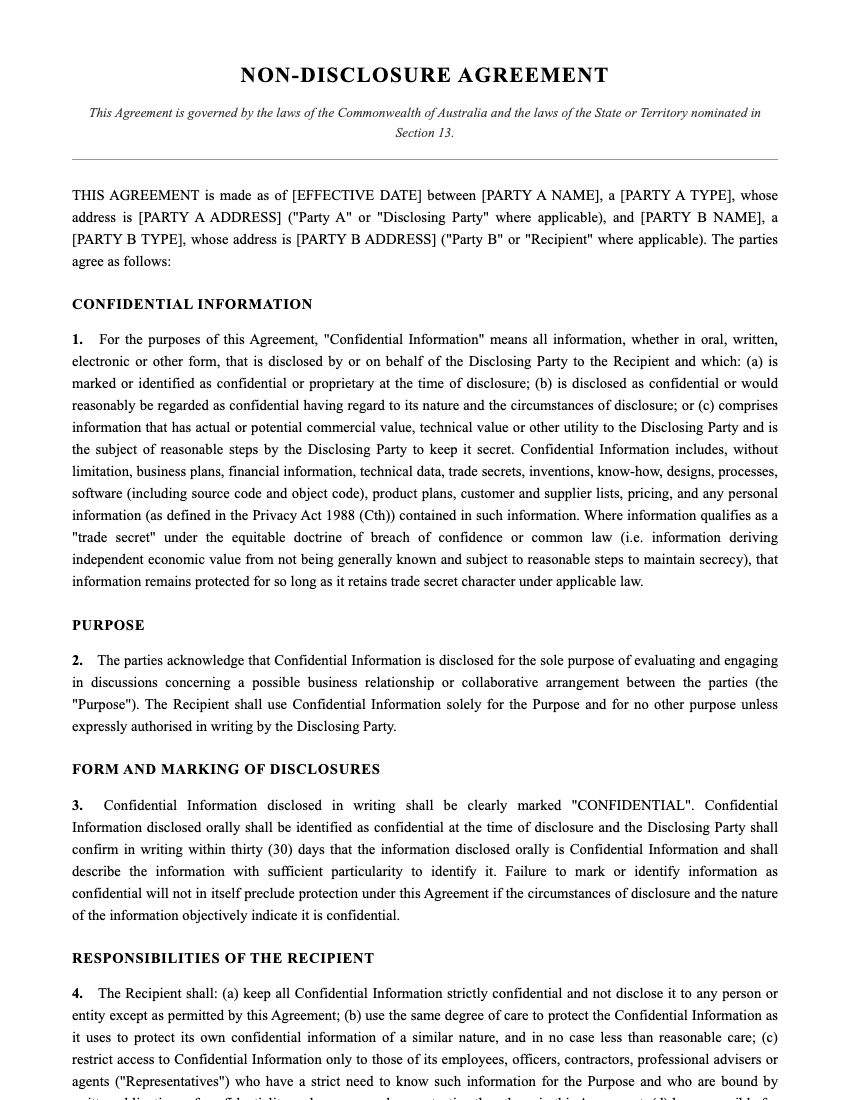
An Australia Non-Disclosure Agreement (NDA) is a contract that protects confidential information, trade secrets and other proprietary material while fitting within Australia’s restraint-of-trade doctrine, the Competition and Consumer Act 2010 (Cth), and privacy rules under the Privacy Act 1988 (Cth).
What is an Australia NDA?
Definition: An Australian NDA is a bilateral or unilateral contractual promise by the receiving party to keep specified information confidential and to use it only for an expressly agreed purpose. Unlike in some jurisdictions with a statutory “trade secrets” regime, Australia relies principally on contract, equitable obligations and common law for trade-secret protection. Restraints on post‑termination conduct are governed by the common‑law restraint-of-trade doctrine and assessed on reasonableness (see Maggbury Pty Ltd v Hafele Australia Pty Ltd [2001] HCA 63).
Because Australian courts test restraints for reasonableness in duration, geography and scope, an overbroad NDA can become unenforceable or be read down. That’s why this template uses narrowly tailored definitions, phased time limits, and optional cascading (stepped) restraints to improve enforceability.
For a complete guide to NDA terms, duration, and standard exclusions, see our NDA Agreement Guide.
Why "Generic" NDAs Are Dangerous in Australia
Many free NDA forms are drafted for U.S. or UK practice and miss three Australia‑specific traps:
- Restraint-of-trade scrutiny: Australian courts treat restrictions on future work or trade skeptically. If confidentiality language effectively prevents someone from working in their industry (even indirectly), a court may strike the restraint or refuse to enforce the clause. The High Court’s decision in Maggbury confirms the courts’ willingness to examine commercial reasonableness closely.
- Competition and Consumer Act (Cth): The Competition and Consumer Act 2010 (Cth) prohibits contracts that have the purpose or effect of substantially lessening competition (see s 45) and may affect NDAs that function as anti‑competitive restraints between businesses. Confidentiality must not be a backdoor method to limit competition.
- Privacy and disclosures: The Privacy Act 1988 (Cth) restricts handling of personal information. NDAs that require secrecy over personal data must still permit handling in compliance with the Privacy Act, and must not prevent permitted disclosures (for example to regulators or under whistleblower protections).
Paradigm‑shifting insight (Australia): cascading or “stepped” restraint clauses materially increase enforceability. Rather than a single sweeping restriction, a sequence of progressively narrower restraints gives courts room to enforce a lesser restriction rather than void the whole covenant. Australian practitioners commonly use this technique to pass the reasonableness test applied by the High Court.
Real case study: Maggbury Pty Ltd v Hafele Australia Pty Ltd [2001] HCA 63 (High Court of Australia) remains the leading authority shaping how Australian courts approach restraint clauses in business sale and employment contexts. The decision emphasises commercial context and proportionality in testing reasonableness.
Key Clauses (what this template includes)
- Purpose and limited use: The template limits use of Confidential Information strictly to a defined Purpose (e.g., "evaluating a proposed supply arrangement for Project X"). Narrow purposes reduce the risk a court will view the clause as an impermissible restraint on trade.
- Precise definition of Confidential Information: Distinguishes between routine business data (time‑limited protection) and genuinely secret information (protected while secret). Because Australia lacks a federal trade‑secrets statute, a clear contractual definition and evidence of reasonable steps to keep secrecy are critical.
- Duration and cascading restraints: Offers a primary confidentiality period (commonly 2–5 years for non‑secret commercial information) plus an indefinite protection carve‑out for bona fide trade secrets, and an optional stepped restraint clause for post‑termination conduct to improve chances of enforcement.
- Exclusions and compelled disclosure carve‑outs: Carve outs for publicly available information, independently developed information, previously known information, and disclosures required by law or to regulators (including prescribed whistleblower channels under Corporations Act protections).
- Data protection and personal information: Clauses requiring compliance with the Privacy Act 1988 (Cth) and specifying permitted processing, retention and secure destruction standards.
- Remedies and injunctive relief: Express remedies (injunctions, damages, account of profits) and Australian jurisdiction and governing law clauses.
Who Needs This Document?
| User Persona | Usage Scenario | Key Australian Benefit |
|---|---|---|
| Startups & scaleups | Pitching to investors, sharing IP with partners | Narrow Purpose clauses preserve investor appetite while protecting core know‑how |
| Employers | Onboarding senior staff or contractors | Reasonable post‑termination restraints and cascading options help protect client lists without risking unenforceability |
| Businesses selling assets | Pre‑sale due diligence | Ensures sensitive financials are disclosed under narrowly framed terms to avoid voiding sale covenants |
| Manufacturers & designers | Sharing prototypes with suppliers | Clear trade‑secret definitions and security requirements create evidence of “reasonable steps” to protect secrets |
How to Execute an Enforceable Australian NDA
Step 1: Choose One‑Way or Mutual — Use One‑Way when only one party discloses; use Mutual when both sides share confidential material.
Step 2: Limit the Purpose — Be specific. Replace "business discussions" with a targeted Purpose (e.g., "evaluation of a potential distribution agreement for Product Y in NSW").
Step 3: Prove reasonable secrecy — Label documents, use access controls, and keep disclosure lists. Courts expect demonstrable steps to maintain secrecy when protecting trade secrets.
Step 4: Sign before sharing — Australia recognises electronic signatures under the Electronic Transactions Act 1999 (Cth). Still, execute before disclosure and keep audit trails (timestamps, signed PDFs).
Cross‑sell: If you receive NDAs from others, use an AI contract review tool to flag over‑broad restraints, competition risks, or Privacy Act conflicts in seconds.
Related NDA Templates
Get the Template
Sign up for our newsletter to receive the template.
Frequently Asked Questions

About Designer Content
Designer Content creates practical legal document resources for landlords, contractors, and small business owners. We simplify complex legal concepts into actionable guidance. Connect with us on LinkedIn.