
Opening
An Austrian Master Services Agreement (MSA) is a framework contract under Austrian law that sets the baseline rules for recurring services between businesses, while individual projects are specified through Statements of Work (SOWs). For SMEs, agencies and consultants in Austria, an MSA reduces negotiation effort, provides for predictable payment and liability terms, and creates clear guardrails for data protection, IP rights, and dispute resolution. Crucially, it should align with the ABGB, DSG/DSGVO, and Austrian enforcement practice.
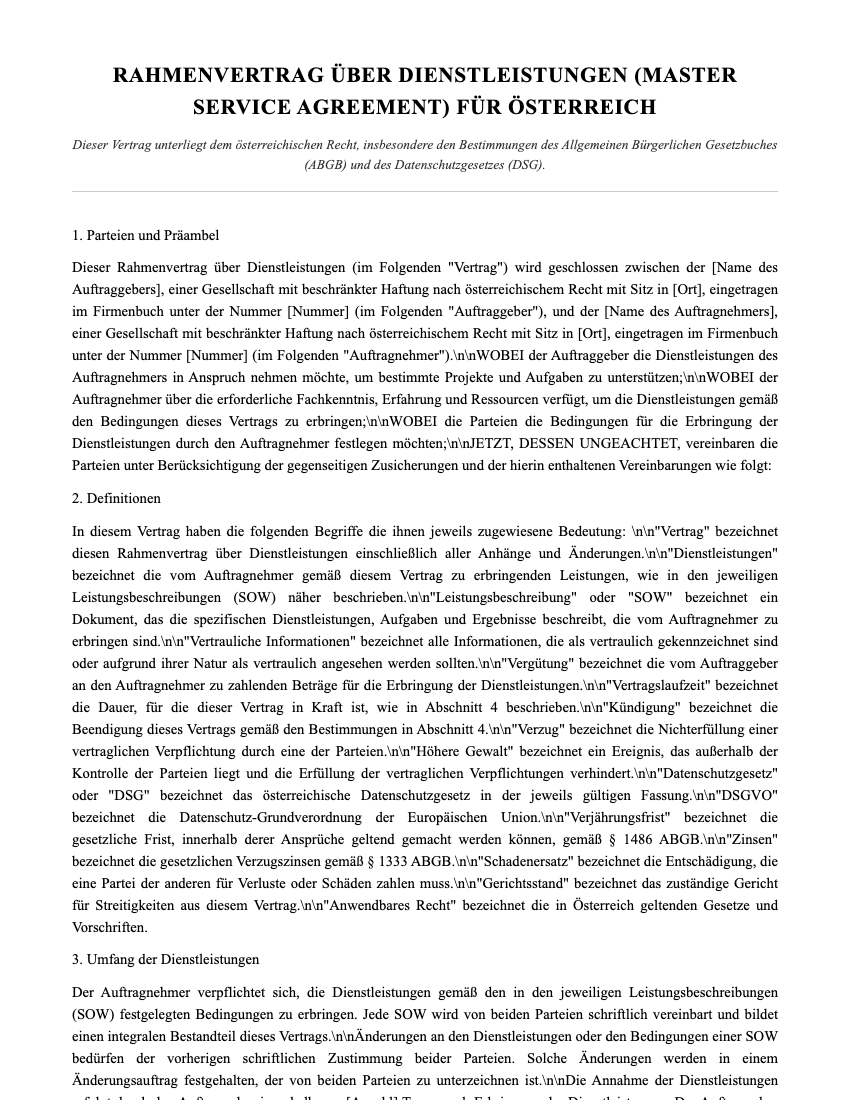
For a comprehensive guide to structuring MSAs and SOWs that protect your business, see our Freelancer Contracts Guide.
Definition Box
Definition: An Austrian Master Services Agreement (MSA) is a reusable framework agreement between client and contractor that sets out the general terms and conditions (e.g., performance standard, remuneration, default, liability, statute of limitations, data protection, confidentiality, IP, governing law/venue). Concrete service content, milestones, prices and schedules are governed in separate Statements of Work (SOWs) or service descriptions that fall under the MSA. In Austria, an MSA should in particular contain provisions on statute of limitations (§ 1486 ABGB), default interest (§ 1333 ABGB), and on data processing under GDPR Art. 28.
Why You Cannot Use a Generic MSA in Austria
Many “international” MSA templates are tailored to US common law or UK law. In Austria (civil law) standard clauses often work differently: terms like “work made for hire,” blanket liability waivers or far-reaching non-competes are here either not appropriate, only partially enforceable, or trigger unexpected ancillary obligations. Added to this are mandatory provisions from ABGB, employment law and the GDPR.
Worker Classification Rules
Austria does not use a US “ABC Test.” What matters is the actual form of the collaboration: if personal dependence, subordination, integration into the organization and lack of entrepreneurial risk predominate, it is more likely an employment relationship (Dienstverhältnis) rather than a work/independent contractor contract. For the delineation, labor-law criteria are decisive (typically: right to issue instructions, working hours/location requirements, control and reporting duties, use of the client’s operating resources).
A generic MSA that merely states “Independent Contractor” does not protect you if the practice looks like employment. Misclassification can lead to back payments and penalties, for example under the Arbeitsvertragsrechts-Anpassungsgesetz (AVRAG) for violations of minimum content/transparency obligations (e.g., information duties) and in practice typically substantial social security and payroll-related cost risks (contributions assessments and surcharges). Therefore, an Austrian MSA template should include clear provisions on scope of service autonomy, on authorization/representative capacity, on use of own equipment and on no integration into the client’s organization—and at the same time stay realistic to avoid conflicting implementation.
Non-Compete Enforceability
In a B2B context, non-compete restrictions in Austria are not automatically prohibited, but their enforceability depends heavily on the concrete setting. Common mistakes in generic templates: too long a duration, too broad a substantive scope, or lack of justification for the protection interest. Labor law is particularly relevant: for employees, non-compete clauses are legally restricted. Under § 36 Angestelltengesetz (AngG), post-employment non-competition clauses are only permissible under certain conditions (including limits based on compensation and reasonableness; moreover, the employee’s ability to earn a living must not be unreasonably hindered). A “one-size-fits-all” clause from a US template can therefore be useless or risky in the wrong contractual setting.
For real business-to-business contracts, instead of hard non-competes, opt for more enforceable alternatives: (1) strict confidentiality with a contractual penalty, (2) client protection/non-solicitation in a tight scope, (3) protection of trade secrets under the Geschäftsgeheimnisgesetz (GeschGehG). An Austrian MSA template should therefore be flexible: non-compete only where appropriate, otherwise focus on confidentiality, data and know-how protection.
IP/Work-for-Hire Considerations
“Work made for hire” is a US concept and does not map 1:1. In Austria, copyright arises generally in the creator; transfers typically occur via licenses or assignments, depending on the type of work. For software and content, the MSA should specify precisely: which usage rights, which territory, which duration, whether exclusive, and whether derivative works are included. In case of payment delays, withholding of rights to use can be economically decisive. Also, personal data in the project must be properly covered under a GDPR Article 28 data processing agreement.
What's Included in This Template
Flexible SOW Structure
The template separates the “legal framework” and the “project content”: the MSA covers standard terms, while the SOW covers scope, deliverables, schedule, acceptance, day rates/fixed prices and the change-request process. This allows you to sign a short SOW for each new project without renegotiating the entire contract.
Austria-Specific Indemnification
The liability and indemnification logic is tailored to Austrian practice: clear delineation between direct damages and consequential damages, defined liability caps, exceptions for intent/gross negligence, and balanced indemnification (e.g., for third-party claims arising from IP infringement or data-protection violations).
Dispute Resolution and Venue
Dispute resolution is oriented to Austria, including the Vienna venue (where permissible) and applicable Austrian law. This prevents you from suddenly being sued in a foreign jurisdiction or inheriting ill-fitting arbitration clauses from generic templates.
Additional provisions (with citations):
- Statute of limitations/Claims handling: Acknowledgment of the short limitation periods for certain claims under § 1486 ABGB.
- Default interest & costs: Provision for default interest under § 1333 ABGB (including costs of appropriately pursuing legal action).
- Data protection & DPA: Processing of orders including minimum content per GDPR Art. 28 and note on fundamental rights protection under DSG § 1.
Who Needs This Document?
| User Type | Relationship | Key Benefit |
|---|---|---|
| Digital agency | Ongoing campaigns & retainers | Quick new SOWs without renegotiating terms/liability |
| IT consultant | Project-based advisory | Clear change requests, acceptance and payment schedule |
| Software development studio | Milestone projects | IP/use rights only after payment, clear license chains |
| Engineering/Freelancer | Recurring work-for-hire | Clean delineation of performance/acceptance & delay/interest |
How to Use This MSA Template
Step 1: Parties & Company Details
Enter the correct company names, company registry data (if available) and delivery addresses. Decide who is the contractor (Provider) and who is the client (Client).
Step 2: Choose Term, Termination, Statute of Limitations and Payment Logic
Define the start date, termination notice periods and whether the MSA auto-renews. Set payment terms, consequences of late payment, and handling of disputed invoices.
Step 3: Attach the First SOW
Describe in the SOW the deliverables, acceptance criteria, schedule, price and change-request process. Avoid mixing details into the MSA itself.
Step 4: Finalize Data Protection & IP Options
If personal data is processed, finalize GDPR Article 28 provisions. Choose license/transfer terms so they fit your business model (standard product vs. custom).
Already Receiving Contracts from Clients?
Many SMEs underestimate the risk if they do not send their own MSA, but instead accept the client's MSA/terms. Pay particular attention to venue/law, liability caps, broadly drafted IP transfer, and GDPR processing (Art. 28). Especially with international clients, unfavorable “flow-down” obligations hide in attachments. If you want to review incoming contracts faster, use: an AI contract review tool
Download Options
Free PDF Version: A print-ready PDF version for quick review, internal sharing and as a negotiation base.
Editable Word/Google Docs Version: An editable template (Word/Docs) with placeholders and wording options so you can cleanly tailor SOWs, liability caps, data protection modules and the governing venue to your business.
Disclaimer
This post does not constitute legal advice. For your specific case (industry, data processing, employment law), please seek counsel in Austria.
Related MSA Templates
Get the Template
Sign up for our newsletter to receive the template.
Frequently Asked Questions

About Designer Content
Designer Content creates practical legal document resources for landlords, contractors, and small business owners. We simplify complex legal concepts into actionable guidance. Connect with us on LinkedIn.