
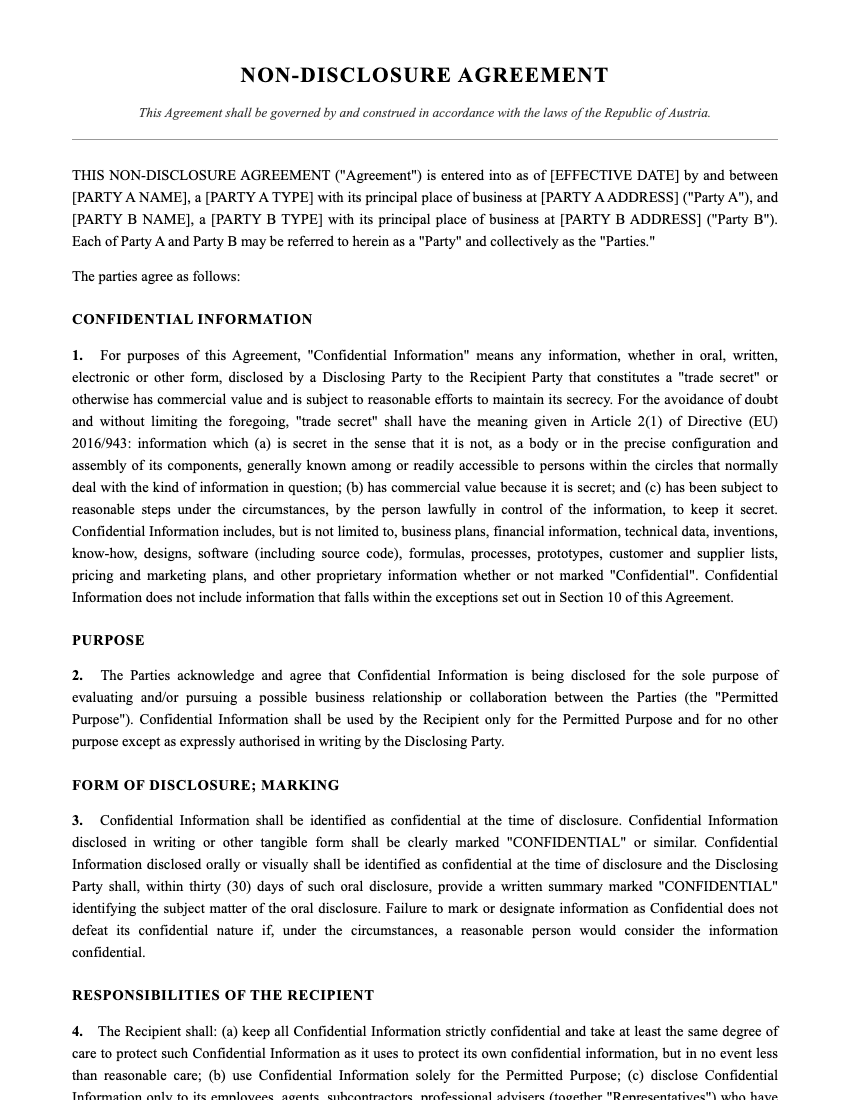
An Austria Non-Disclosure Agreement (NDA) is a contract used to protect business secrets, confidential know‑how and sensitive documents shared between parties. Unlike some common-law templates, an Austria NDA must be drafted with Austria’s civil‑law framework in mind: the Allgemeines bürgerliches Gesetzbuch (ABGB) for contract formation and limitation rules, the Geschäftsgeheimnisgesetz (GeschGehG) implementing the EU Trade Secrets Directive, and data‑protection rules under the DSG/DSGVO.
What is an Austria NDA?
Definition: An Austria NDA is a bilateral or unilateral contract that (1) defines what information is “confidential” or a “trade secret” under the GeschGehG, (2) sets permitted uses and access controls, and (3) creates remedies for breach consistent with Austrian law (contract damages, injunctive relief, and statutory remedies under GeschGehG). Contract formation follows ABGB formalities and Austrian courts look for clear mutual consent and an identifiable purpose.
Two features matter especially in Austria. First, protection for trade secrets under the GeschGehG turns on whether the owner took "reasonable steps to keep the information secret" — not on label alone. Second, NDAs cannot lawfully silence reporting protected by whistleblower rules (Hinweisgeberschutzgesetz) or GDPR rights to report data breaches.
For a complete guide to NDA terms, duration, and standard exclusions, see our NDA Agreement Guide.
Why “generic” NDAs are dangerous in Austria
Many online NDA templates were drafted for other systems and miss three Austria‑specific traps:
- Trade secret protection requires demonstrable secrecy measures. Under the GeschGehG, courts and authorities expect technical and organisational measures (access controls, classification, confidentiality notices, and record‑keeping). Simply stamping "CONFIDENTIAL" on a PDF without demonstrable safeguards often fails the reasonable‑effort test and leaves information unprotected.
- Data protection and whistleblowing carve‑outs. The DSG/DSGVO give data subjects rights that cannot be waived by contract. Equally, the Austrian Hinweisgeberschutzgesetz (Whistleblower Protection Act) and EU rules make clauses that purport to bar reports to public authorities or internal reporting channels unlawful or unenforceable. An NDA that broadly forbids "any disclosure" risks being partially void and may bring reputational or regulatory sanctions.
- Employment restraints and compensation. Austria allows post‑contractual restrictive covenants for employees in specific circumstances, but they are tightly regulated by labour law and case law. Using NDA language to masquerade as a sweeping non‑compete or to impose career‑ending restrictions will be scrutinised and can be recharacterised by courts as an unlawful restraint if it lacks statutory or contractual compensation or clear limits.
Paradigm‑shifting insight: In Austria the real risk isn’t only an overbroad non‑compete; it’s that your NDA can lose trade‑secret protection entirely if you cannot prove reasonable secrecy measures. Austrian courts treat secrecy as an objective, evidentiary issue. That means your operational practices (access logs, internal policies, classification, and audit trails) matter as much as the contract wording.
Real development: Austria implemented a national Trade Secrets Act (GeschGehG) to transpose the EU Trade Secrets Directive in 2019–2020 and later adopted a national Whistleblower Protection Act. Since then Austrian courts and practitioners have emphasised documentation of secrecy measures as decisive in injunction and damages cases.
Key clauses adapted for Austrian practice
- Clear definitions: Separate "Confidential Information" from "Trade Secrets" (GeschGehG). Define retention, marking, and classification procedures.
- Purpose and limited use: Narrow purpose clause (e.g., "evaluating a proposed collaboration for Project X in Austria") to satisfy ABGB consent principles.
- Secrecy measures schedule: Require specific technical and organisational protections (passwords, access lists, encryption, physical storage), because courts look for these when applying GeschGehG.
- Whistleblower/Data‑protection carve‑outs: Explicitly allow disclosures to authorities and internal reporting in line with Hinweisgeberschutzgesetz and DSG/DSGVO, and provide a procedure for compelled disclosures.
- Employee carve‑ins/outs: Avoid backdoor post‑employment restrictions in a general NDA. If a post‑contractual restraint is intended, use a separate, employment‑law compliant covenant with compensation and duration limits.
- Remedies: Include injunctive relief, preservation of evidence, and contractual damages; note statutory claims under GeschGehG.
- Governing law and jurisdiction: Austrian law is appropriate for Austria, but for cross‑border contracts consider forum and enforcement practicalities.
Who needs this document?
| User Persona | Usage Scenario (Austria) | Key Benefit |
|---|---|---|
| Tech Startups (Vienna/Salzburg) | Pitching to investors or sharing source code with contractors | Protects code and roadmaps while documenting secrecy measures required by GeschGehG |
| Consultants & Freelancers | Sharing client lists or pricing with subcontractors | Limits use and establishes audit rights without creating unlawful employment restraints |
| Manufacturers | Sending prototypes to Austrian suppliers | Ensures suppliers use contractual and technical safeguards and permits injunctive relief |
| Research Institutes | Collaborative research with universities | Carves out academic exceptions and defines ownership of newly created IP |
How to execute an Austria NDA (practical steps)
- Choose the correct type (Unilateral vs Mutual) and specify the narrow Purpose in plain language.
- Attach or reference your secrecy measures: include a schedule listing access controls, encryption, and handling procedures—evidence helps courts under GeschGehG.
- Handle personal data carefully: map data flows, state lawful bases under DSG/DSGVO, and include processor/subprocessor obligations where relevant.
- Sign with an eIDAS‑compliant electronic signature or handwritten signatures. Austria recognises qualified electronic signatures under eIDAS for high‑value contracts; for enforceability, keep a signed PDF and audit trail.
Practical tip: Never use NDA language to try to prevent a person from making a protected whistleblower report. Add a compliant carve‑out and an internal reporting channel if you want confidentiality for business details.
Already receiving NDAs from partners?
When someone sends you an NDA in Austria, watch for: overly broad duration, undefined "confidential information," clauses that compel silence about illegal acts, or attempted assignment of IP without compensation. Use an AI contract review tool to flag risky clauses, compare terms against Austrian law, and produce negotiation points in minutes.
Related NDA Templates
Get the Template
Sign up for our newsletter to receive the template.
Frequently Asked Questions

About Designer Content
Designer Content creates practical legal document resources for landlords, contractors, and small business owners. We simplify complex legal concepts into actionable guidance. Connect with us on LinkedIn.