
Opening
The Belarusian Master Services Agreement (MSA) is a framework service agreement between a client and a contractor in Belarus that sets the baseline terms of cooperation for a series of projects, with the details captured in separate Technical Specifications/Statements of Work (SOW). This format helps businesses accelerate project kick-offs, lock in payment terms, rights to the results, and the acceptance process. For Belarus, it is important to immediately take into account the Civil Code requirements, personal data rules, and the practice of economic courts.
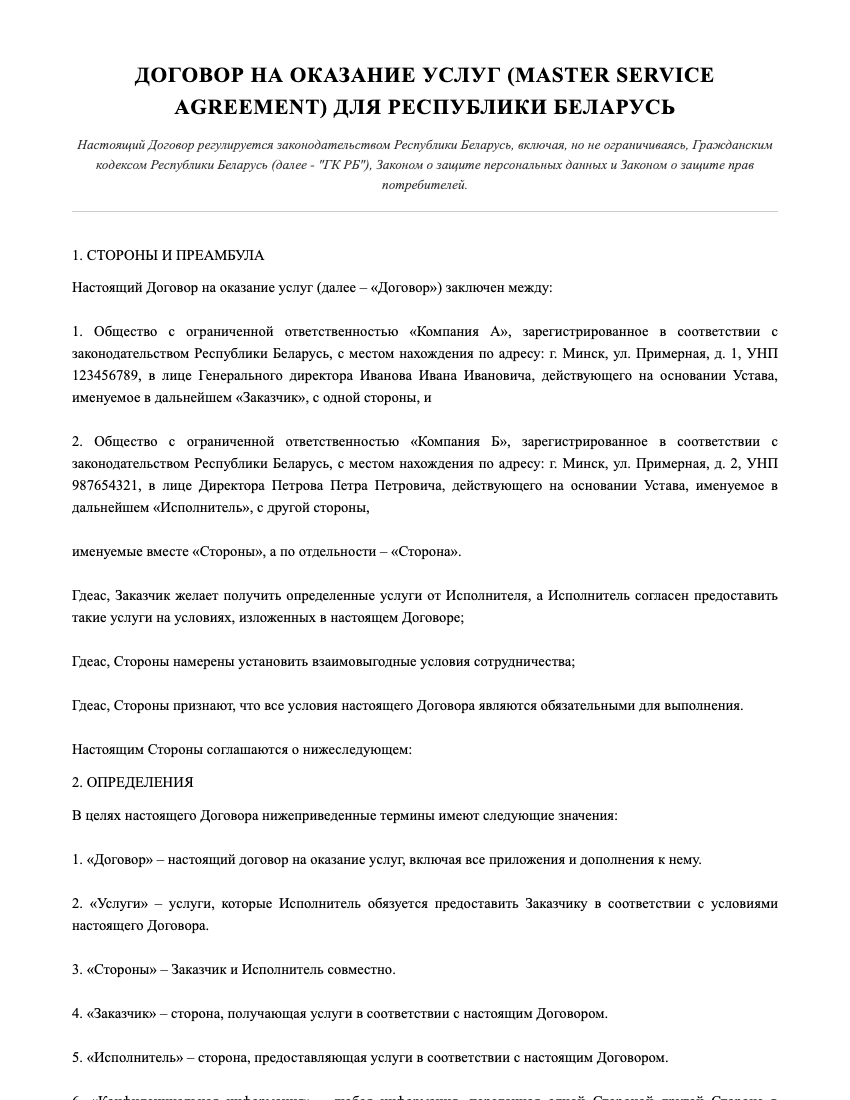
For a comprehensive guide to structuring MSAs and SOWs that protect your business, see our Freelancer Contracts Guide.
Definition Box
Definition:Master Services Agreement (MSA) in Belarus is a framework agreement that regulates recurring relationships for provision of services or work performed between two parties (usually B2B). The MSA establishes the “permanent” terms: the process for issuing acts/invoices, payment terms and conditions, liability and late payment interest, confidentiality, personal data processing, intellectual property rights, the process for changes and termination of the collaboration, and the competent court. Specific tasks, scope, timelines, KPIs, and price are fixed in separate SOWs/technical specifications, which become attachments to the MSA.
Why You Cannot Use a Generic MSA in Belarus
Universal MSA templates written “for any country” often falter in Belarusian realities: here the document flow (acts, primary documents), specific norms of the Civil Code of Belarus on interest and prescription, and separate personal data regulations matter. Below are the three most common legal “pitfalls.”
Worker Classification Rules
Belarus does not have an American ABC test. The distinction is based on differences between employment relations (Labor Code) and civil-law contracts (Civil Code of the Republic of Belarus: contract for work and services). In practice, the key criterion is subordination to internal labor rules and managerial control: if the contractor works on a schedule, under supervision, is integrated into in-house processes, receives “salary-like” payments and obligations like an employee, the relationship may be reclassified as employment.
The Labor Code of the Republic of Belarus requires entering into an employment contract when performing work in a position/profession with subordination to the employer (see general provisions on employment contracts: Art. 1 and Art. 19 of the Belarusian Labor Code). If inspectors or courts recognize de facto employment relationships, the client faces additional payroll contributions and taxes, administrative liability for violations of labor legislation, and the need to retroactively formalize the worker. Therefore, the Belarusian MSA should expressly describe an independent contractor status, lack of subordination, autonomous organization of the process, and absence of employment guarantees.
Non-Compete Enforceability
For B2B templates, a strict non-compete for 1–3 years is often inserted. In Belarus, such a clause is not automatically standard and requires caution. In employment relationships, non-compete restrictions after termination are regulated through special constructs and should not worsen the worker’s position relative to the law (worker-protection principle). In civil-law contracts between companies, restrictions may be permissible, but they must conform to general civil-law principles: freedom of contract operates within the law, and conditions must not contravene imperative norms or public order.
Practically this means: if you include a non-compete, the restriction should be reasonable in duration, territory, and subject matter, and proportionate to the legitimate interest (protection of trade secrets, client base, investments). If the terms are excessive, the counterparty may challenge them as an imbalance of interests. More reliable alternatives include: (1) detailed confidentiality/trade secrets protection, (2) non-solicitation of employees/clients in a narrow sense, (3) contractual liquidated damages for disclosure. For monetary delay, it’s useful to rely on interest rates under Art. 366 of the Civil Code of the Republic of Belarus (10% per annum), rather than an ever-escalating “penalty.”
IP/Work-for-Hire Considerations
A typical English-language “work made for hire” concept does not always translate well to Belarus. In civil-law relationships, it is better to specify: (1) who owns the exclusive rights to the result, (2) the moment of transfer of rights (for example, after payment and signing of the act), (3) the scope of rights transferred and the territory/term. For creative objects (text, design, code) it is important to expressly document the assignment/transfer of exclusive rights or a license; otherwise, rights may remain with the author/creator by default. In the Belarusian MSA, this block should be “prototype-like”: different SOWs may have different rules for rights transfer.
What's Included in This Template
Flexible SOW Structure.The MSA is an “umbrella” for cooperation, and each assignment is documented in an SOW/Technical Specification with a concrete scope, timelines, milestones, price, and acceptance criteria. This reduces the risk of scope creep and helps the accounting team close acts.
Belarus-Specific Indemnification. The template provides realistic liability: caps, exclusions (intentional wrongdoing/gross negligence), the process for claims, and compensation for direct losses. For monetary delay, one can set interest under Art. 366 of the Civil Code of the Republic of Belarus (10% per annum), and specify the accrual and documentation of debt.
Dispute Resolution and Venue. By default, disputes are brought to the Economic Court of Minsk (or another agreed economic court) — convenient for B2B. Belarus does not have a “jury trial” for such disputes, so the template appropriately anchors proceedings in economic court proceedings.
Additionally, the template includes provisions: (1) the three-year statute of limitations — Art. 197 of the Civil Code of the Republic of Belarus; (2) interest on the use of another’s funds — Art. 366 of the Civil Code of the Republic of Belarus; (3) processing of personal data on a lawful basis and transparency — Art. 5 and Art. 9 of the Law of the Republic of Belarus “On Personal Data Protection”.
Who Needs This Document?
| User Type | Relationship | Key Benefit |
|---|---|---|
| IT studios and developers | Phase-based projects with acts | Documents SOW, acceptance, code rights, and payment |
| Marketing agencies | Recurring/retainer engagements | Controls scope creep and additional charges |
| Consultants (B2B) | Long-term advisory | Clear reporting, confidentiality, liability limits |
| Outsource‑accounting/HR | Regular services | Stable terms + quick SOWs for new tasks |
How to Use This MSA Template
Step 1: Identify the parties
Specify the exact names, UIN/registration details, and the status of the parties (legal entity vs. individual entrepreneur). This reduces the risk of disputes about who is a contracting party and who signed the documents.
Step 2: Set the term and document flow
Define the term (for example, 12 months) and the process for exchanging acts/invoices (mail, electronic data interchange, scans). In Belarus, this is critical for confirming the services rendered.
Step 3: Attach the first SOW
Describe in the SOW the scope, timelines, milestones, acceptance criteria, and price. Do not overload the MSA with project-level details—otherwise every new project will require amendments to the framework.
Step 4: Sign and run change control
Sign the MSA once, and thereafter sign only the SOWs and amendments for changes. Establish a change request procedure: what counts as a change and how costs are recalculated.
Already Receiving Contracts from Clients?
If you do not send your MSA but you receive a customer contract for signature, do not automatically agree to “universal” terms. In Belarusian realities it is important to verify: governing law and jurisdiction (to avoid ending up in a foreign jurisdiction), acceptance procedures (no “silent rejection”), transfer of IP, and personal data processing. The tool an AI contract review tool helps quickly highlight risky phrasing and negotiation points.
Download Options
Free PDF Version: download the PDF for review and alignment with the counterparty.
Editable Word/Google Docs Version: obtain an editable MSA template + SOW template to tailor terms to your service type, currency of payments, acceptance process, and transfer of exclusive rights.
Disclaimer
The material is for informational purposes and does not constitute legal advice. For your situation in Belarus, consult a lawyer.
Related MSA Templates
Get the Template
Sign up for our newsletter to receive the template.
Frequently Asked Questions

About Designer Content
Designer Content creates practical legal document resources for landlords, contractors, and small business owners. We simplify complex legal concepts into actionable guidance. Connect with us on LinkedIn.