
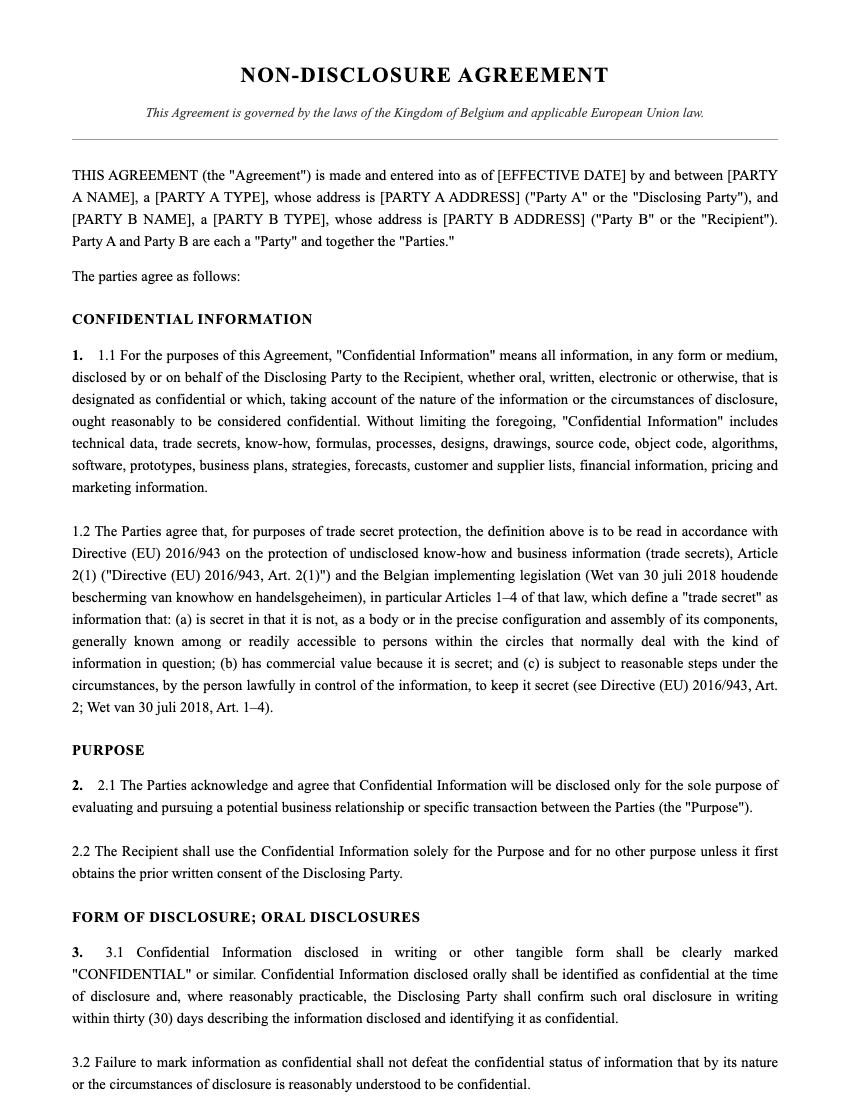
A Belgium (Dutch) Non-Disclosure Agreement (NDA) is a contract used to protect confidential business information and trade secrets while respecting Belgian civil and labour law, the Code of Economic Law (Wetboek van economisch recht), and EU rules such as the GDPR (Algemene verordening gegevensbescherming) and eIDAS for electronic signatures.
What is a Belgium (Dutch) NDA?
Definition: In Belgium, an NDA is a written agreement under which a Receiving Party agrees to keep certain information confidential and to use it only for a stated Purpose. Trade-secret protection is governed by the Belgian implementation of the EU Trade Secrets Directive (Law of 30 July 2018, implementing Directive (EU) 2016/943) and supplemented by the Wetboek van economisch recht. Civil claims (including contractual claims) are subject to the general prescription periods in the Nieuw Burgerlijk Wetboek (new Book 5), which provides a general 10-year limitation for personal obligations.
An NDA in Belgium must be drafted with Belgian public policy in mind: clauses that unlawfully restrict labour rights, impede whistleblowing, or violate data-protection rules risk being void or unenforceable.
For a complete guide to NDA terms, duration, and standard exclusions, see our NDA Agreement Guide.
Why “generic” NDAs are dangerous in Belgium
Templates imported from other jurisdictions commonly miss local traps. The three most important Belgian-specific risks are:
- Whistleblower and public-interest exceptions: Belgium’s whistleblower rules (law of 3 September 2018 transposing the EU Whistleblower Directive) and the GDPR limit the ability to use NDAs to silence reports of illegal conduct or data breaches. Any clause that purports to punish lawful reporting to authorities or the Data Protection Authority is contrary to public policy.
- Employment restraints and undue post-contractual limitations: Unlike California’s absolute ban on non-competes, Belgian law allows post‑employment restraints for employees in certain circumstances—but only when strictly necessary, in writing, proportionate in time and territory, and often accompanied by compensation depending on contract type and sector. A one-size-fits-all NDA that attempts to broadly restrict future work can be characterised as an unlawful restraint of trade under the Wetboek van economisch recht and struck down.
- Data protection and processing obligations: Confidential business information frequently contains personal data. An NDA that says “you may process personal data” without allocating controller/processor responsibilities, legal basis, security measures and cross-border transfer rules will not comply with the AVG (GDPR). That can expose both parties to regulatory fines.
Paradigm-shifting insight: Belgian NDAs often fail because they mix trade-secret protection with labour restraints and data-processing obligations without separating legal regimes. The smarter approach is to (a) identify what is a trade secret under the Trade Secrets Act (Law of 30 July 2018), (b) protect data-processing aspects under a GDPR-compliant Data Processing Agreement, and (c) keep any post-contractual work restrictions in a separate, narrowly tailored clause that satisfies labour-law formalities.
Real development to note: Belgium implemented the EU Trade Secrets Directive by Law of 30 July 2018, which harmonised civil remedies for misappropriation and clarified that reasonable secrecy measures are required to obtain protection. Also, the Law of 3 September 2018 strengthened whistleblower protection — both laws have led Belgian courts to invalidate NDAs that sought to suppress protected reporting or to overreach on employee mobility.
Key clauses in the Belgian (Dutch) NDA template
- Clear definition of Confidential Information vs. Trade Secrets: aligns with Directive (EU) 2016/943 and the Law of 30 July 2018 (trade secrets defined as information that (i) is secret, (ii) has commercial value because it is secret, and (iii) is subject to reasonable secrecy measures).
- Purpose limitation: narrow, specific use language in Dutch/English to meet Belgian contractual interpretation standards.
- Term and survival: two-tier protection—time-limited confidentiality for business info (e.g., 2–5 years) and indefinite protection for bona fide trade secrets (as long as secrecy is maintained), consistent with Belgian practice and the 10‑year prescription for personal obligations in the Nieuw Burgerlijk Wetboek (Book 5).
- Exclusions: public domain, prior knowledge, independent development, compelled disclosure (with procedure to seek protective measures).
- Data protection addendum: assigns controller/processor roles, legal basis, security measures and notification duties to comply with the AVG (GDPR).
- Whistleblower carve-out: confirms Parties may make protected reports under Belgian law (Law of 3 September 2018), and specifies procedure for lawful disclosures to authorities or advisers.
- Labour-law warnings: a separate clause explains that nothing in the NDA creates or replaces the statutory requirements for post‑employment restraints and that any such clause must meet Belgian formalities.
- Remedies and jurisdiction: civil remedies under the Wetboek van economisch recht; choice of Belgian courts or Brussels courts where appropriate.
Who needs this document?
| User Persona | Use Case (Belgian focus) | Key Benefit |
|---|---|---|
| Startups (Brussels/Antwerp/Ghent) | Pitching to investors, sharing prototypes | Protects technical know‑how while handling GDPR and investor reporting concerns |
| Employers | Onboarding key hires with access to client lists | Preserves trade secrets but flags when a separate non‑compete is required under labour law |
| Freelancers & Consultants | Working for Belgian clients | Limits liability for processing personal data and clarifies IP and confidentiality boundaries |
| Manufacturers | Sharing BOMs with local suppliers | Preserves manufacturing know‑how and provides enforcement pathways under Belgian trade‑secret law |
How to execute a valid Belgium (Dutch) NDA
Step 1: Choose the right form — Unilateral (one-way) when only you disclose; Mutual when both sides share confidential information.
Step 2: Be precise about Purpose — name the project, parties and scope in Dutch and/or English to avoid ambiguous interpretation under Belgian contract law.
Step 3: Add a GDPR Data Processing Annex — if the exchanged information contains personal data, include roles, legal bases and technical/organisational measures to satisfy the AVG.
Step 4: Sign formally and keep records — use an eIDAS‑compliant electronic signature (Regulation (EU) No 910/2014) or handwritten signature; retain an executed copy in case of future enforcement.
Note: never expect an NDA to lawfully prohibit whistleblowing or required legal disclosures. If you need stronger mobility restrictions, use a separate post‑employment restraint clause drafted in accordance with Belgian labour law.
If you receive an NDA from a client, use an AI contract review tool to identify problematic clauses, flag GDPR omissions, and point out any disguised labour restraints that require re-drafting.
Related NDA Templates
Get the Template
Sign up for our newsletter to receive the template.
Frequently Asked Questions

About Designer Content
Designer Content creates practical legal document resources for landlords, contractors, and small business owners. We simplify complex legal concepts into actionable guidance. Connect with us on LinkedIn.