
A Belgian Master Services Agreement (MSA) is a B2B framework contract that sets, once and for all, the legal rules (pricing, responsibilities, confidentiality, data, intellectual property) applicable to all your future engagements in Belgium. Instead of renegotiating each project, you sign the MSA and then add Statements of Work (SOW) describing the scope, timelines, and deliverables. For an SME, a consultant, or an agency, it is the most effective tool to reduce commercial friction while remaining compliant with Belgian law and the GDPR.
Definition: In Belgium, a Master Services Agreement (service framework agreement) is a civil/commercial contract that organizes the ongoing relationship between a service provider and a client, while each engagement is detailed in an SOW (purchase order/appendix). The MSA contains the “stable” clauses (invoicing, interest, limitation of liability, intellectual property, confidentiality, data protection, dispute resolution) and refers to the SOWs for the “variable” (scope, schedule, price). It relies on the new Civil Code (Book 5 – Obligations, 2022) for the formation, performance, and consequences of non-performance of obligations.
Why You Cannot Use a Generic MSA in Belgium
A generic template (often inspired by U.S. or UK law) creates blind spots in Belgium. The risk is not only the unenforceability of a clause: it is above all leaving essential topics unaddressed (provider classification, IP rights, personal data, late-payment interest), which increases the cost of a dispute and weakens your negotiating position.
3a. Worker Classification Rules
In Belgium, the line between self-employed and employee is not an “ABC test” like in California. The classification depends mainly on the existence of a relationship of subordination and legal criteria. The law provides general criteria for assessing the nature of the employment relationship: the parties’ intent, the freedom to organize working time, the freedom to organize the work, and the possibility of exercising hierarchical control. These criteria are set out in the Law of 27 June 1969 (social security for workers) and especially in the Program Law (I) of 27 December 2006, which governs the classification of the employment relationship and the role of the Administrative Commission for the Regulation of the Employment Relationship (CRT).
For a comprehensive guide to structuring MSAs and SOWs that protect your business, see our Freelancer Contracts Guide.
If your MSA “looks” like an employment contract (imposed hours, strong exclusivity, integration into the team, daily validation, tools provided, sanctions), you increase the risk of reclassification. The consequences are tangible: back payment of social security contributions, ONSS adjustments, possible tax arrears, and exposure to labor-law-related claims (leave, notice). A Belgian MSA must therefore emphasize autonomy, non-exclusivity (unless justified), the provider’s responsibility for its own means, and deliverables defined in an SOW rather than day-to-day “management.”
3b. Non-Compete Enforceability
Unlike some U.S. states, Belgium does not prohibit non-compete clauses as a matter of principle, but their validity depends on the context. For employees, requirements are strictly regulated by the Law of 3 July 1978 on employment contracts (conditions linked to the function, remuneration, duration, geographic scope, and an indemnity in certain cases). However, an MSA generally targets a B2B relationship between companies or self-employed parties: a non-compete clause may exist, but it will be assessed in light of the general law of obligations and freedom of trade, and may be reduced/set aside if it is excessive.
In practice, to maximize enforceability in Belgium, a non-compete clause in an MSA must be proportionate: (1) limited in time (often 6 to 12 months, depending on the sector), (2) limited geographically (e.g., Belgium, or regions where the client actually operates), (3) limited to genuinely competing activities connected to the services provided, and (4) justified by a legitimate interest (access to trade secrets, product strategy, customer data). If you cannot justify these limits, favor alternatives that are generally more defensible: enhanced confidentiality, protection of trade secrets, a non-solicitation clause (clients/employees), and data security clauses. The key is to protect your business without unduly restricting the other party’s economic freedom.
3c. IP/Work-for-Hire Considerations
Anglo-Saxon templates often rely on “work made for hire.” In Belgium, the logic is different: intellectual property rights do not automatically transfer to the client just because it pays the invoice. For copyright, the assignment/license must be organized contractually, with clearly identified transferred rights and, ideally, the intended modes of exploitation. For software, the Law of 30 June 1994 on copyright (and specific provisions for computer programs) makes precise drafting essential. A good Belgian MSA provides for a license as long as the invoice has not been paid, then an assignment or extended license after payment, and indemnification if a third party alleges infringement.
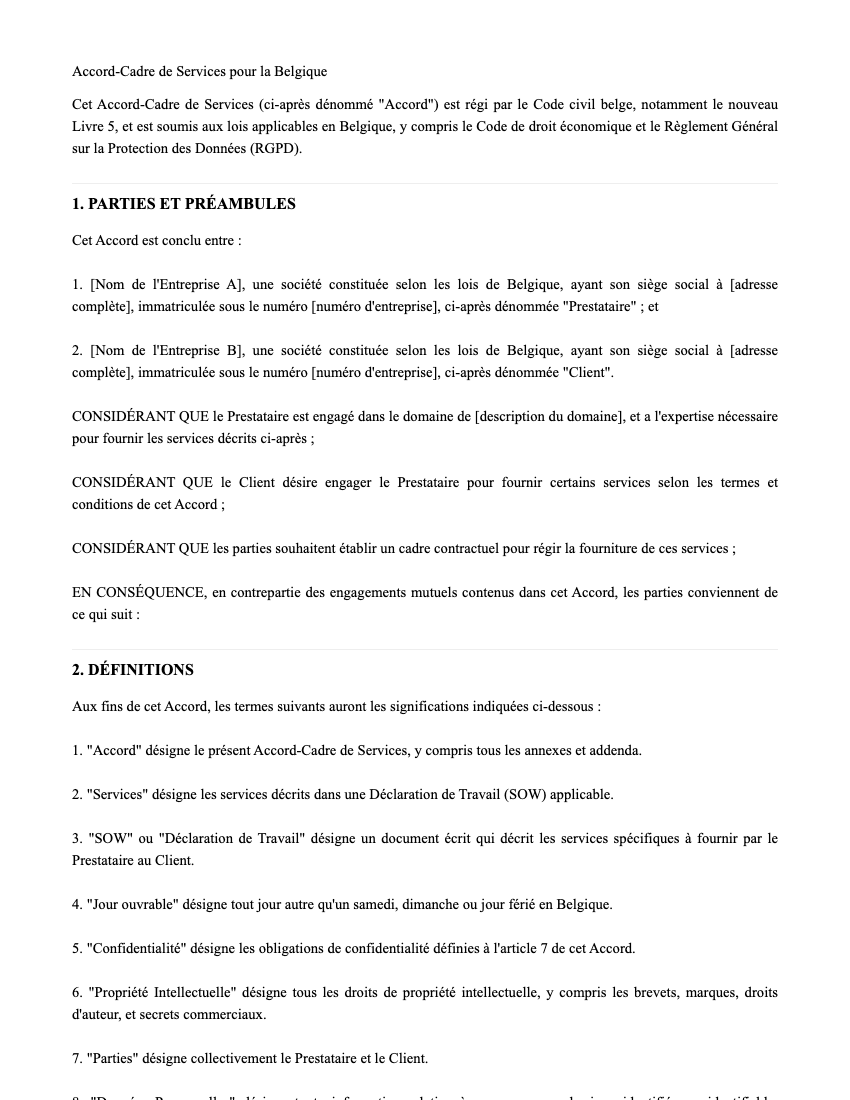
What’s Included in This Template
Flexible SOW Structure. The MSA establishes the legal “framework,” and each SOW describes the scope, milestones, acceptance criteria, and fees. This limits scope creep: any change goes through an amendment/updated SOW and is billable.
Belgium-Specific Indemnification. The template includes realistic B2B indemnification: IP infringement, breach of confidentiality, and GDPR breaches. It also provides for a limitation of liability capped at €1,000,000, with customary exclusions (fraud/gross negligence, breach of confidentiality, IP) depending on the project risks.
Dispute Resolution and Venue. To avoid disputes “abroad,” the template provides for a jurisdiction clause in favor of the courts of Brussels (exclusive jurisdiction) and Belgian governing law, to ensure predictability and enforceability.
Other included clauses (with legal grounding): a late-payment interest clause aligned with the statutory interest rate (Civil Code, art. 5.1), a reminder of the 10-year limitation period for personal actions (Civil Code, art. 2262bis), a GDPR addendum compliant with Article 28 (processor), and a structured confidentiality clause to protect sensitive information and facilitate evidence in case of a leak.
Who Needs This Document?
| User Type | Relationship | Key Benefit |
|---|---|---|
| Agencies (marketing, dev, design) | Recurring projects + retainer | Fast SOWs, capped liability, clear IP |
| Consultants (strategy, IT, finance) | Multi-phase engagements | Frames deliverables and billing for changes |
| Freelancers (developers, creatives) | Fixed-fee services | Payment + IP license conditional on payment |
| SaaS / integrators | Implementation + support | GDPR art. 28, SLA, support and maintenance framed |
How to Use This MSA Template
Step 1: Correctly identify the parties
Indicate the legal name, the form (SRL/SA/self-employed), the CBE/VAT number, and the address. In Belgium, imprecise identification complicates collection and proof.
Step 2: Set the term and termination
Choose a fixed term or automatic renewal, and define termination (notice, material breach, non-payment). Refer to a traceable written notice.
Step 3: Attach a first detailed SOW
The SOW must specify deliverables, acceptance criteria, schedule, price, and assumptions. The clearer your SOW, the fewer disputes you will have about “scope.”
Step 4: Manage IP, data, and confidentiality from the start
Decide whether you assign IP or grant a license, and at what time (often after payment). If personal data is processed, attach the GDPR addendum (art. 28).
Related MSA Templates
Get the Template
Sign up for our newsletter to receive the template.
Frequently Asked Questions

About Designer Content
Designer Content creates practical legal document resources for landlords, contractors, and small business owners. We simplify complex legal concepts into actionable guidance. Connect with us on LinkedIn.