
A Brazil Master Services Agreement (MSA) is a master services contract between companies (or between a company and a PJ professional) that sets fixed rules — payment, liability, intellectual property, confidentiality, and dispute resolution — for all future projects carried out in Brazil. Instead of renegotiating a complete contract for each new job, you sign the MSA once and, for each project, add a Statement of Work (SOW) with scope, deadlines, and amounts. For SMBs, consultants, and agencies, this reduces commercial friction and improves legal predictability.
Definition: A Master Services Agreement (MSA) in Brazil is an “umbrella” agreement that establishes the general legal terms applicable to an ongoing services relationship. It separates what is permanent (for example, confidentiality, limitation of liability, venue/arbitration, billing rules, and data protection) from what changes in each request (deliverables, schedule, price, and acceptance criteria), which goes into attached SOWs. In Brazilian B2B contracts, the MSA is especially useful to reduce “scope creep”, document independent contractor status, and create a compliance track with the LGPD (Lei nº 13.709/2018, arts. 7 and 28) and Civil Code statute of limitations periods.
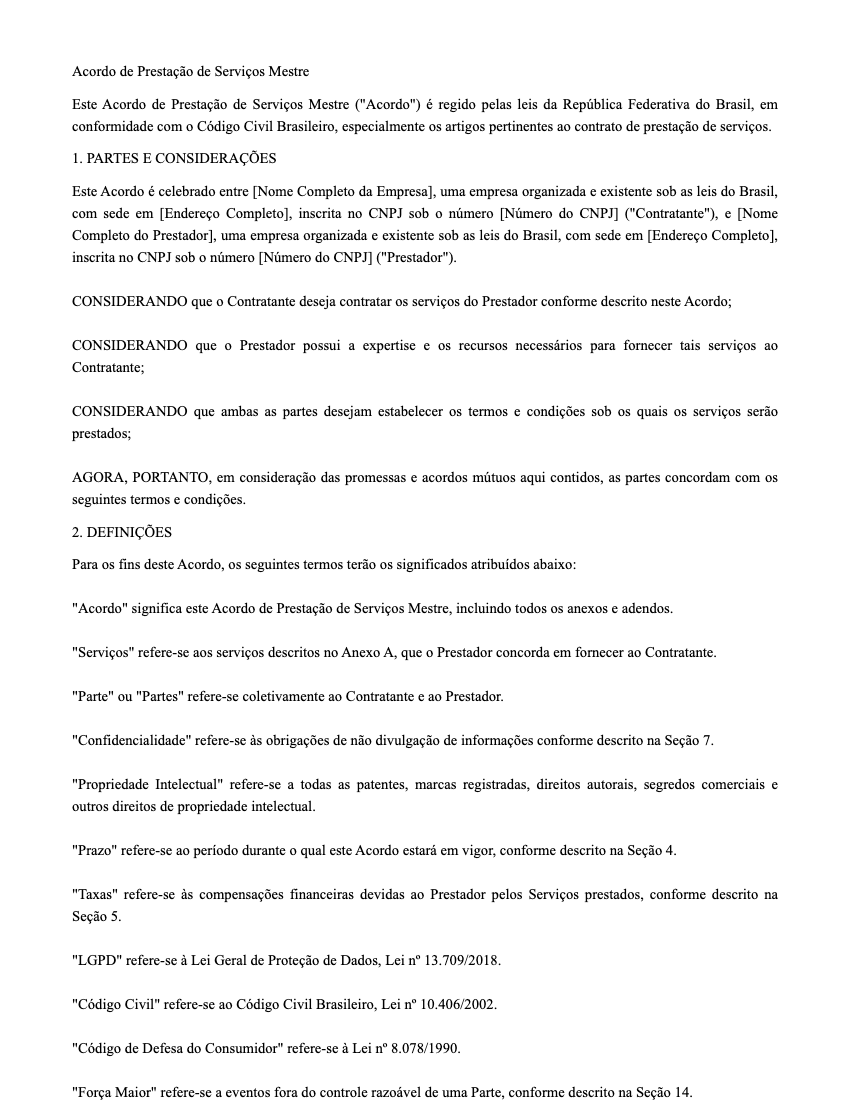
Why You Cannot Use a Generic MSA in Brazil
A generic template (made for the US/EU or “international”) usually fails on sensitive points of Brazilian law. The problem is not only language: it is risk structure. In Brazil, contract enforcement is influenced by principles such as objective good faith (Código Civil, art. 422), rules on interest and default (Código Civil, art. 406), limitation periods (Código Civil, art. 205 and art. 206), and, most importantly, the risk of reclassifying a B2B relationship as an employment relationship (CLT). In addition, the LGPD requires a legal basis and third-party governance, and foreign standard “data processing” clauses do not always fit the controller/operator roles set out in the law.
3a. Worker Classification Rules
Brazil does not use the “ABC test”. The relevant distinction is: autonomous/business services versus an employment relationship governed by the CLT. An employment relationship may be judicially recognized when, in practice, the elements of CLT art. 3º are present: personal service, non-occasionality, remuneration, and subordination. A company that hires as a PJ, but imposes schedules, de facto exclusivity, direct supervision, and integration into the routine as an employee, assumes the risk of “pejotização” and recognition of the employment relationship (CLT, art. 9º, which invalidates acts intended to defraud labor legislation). The consequences may include an award of labor entitlements (13th salary, vacation + 1/3, FGTS and fines), social security charges, and exposure to retroactive liabilities, in addition to attorneys’ fees and costs as applicable. A well-designed Brazilian MSA helps align practices: it describes technical autonomy, absence of subordination, freedom of means, possibility of substitution (when applicable), and defines that team management, taxes, and means of performance are the provider’s responsibility.
For a comprehensive guide to structuring MSAs and SOWs that protect your business, see our Freelancer Contracts Guide.
3b. Non-Compete Enforceability
In Brazil, non-compete clauses can be valid, but they are not “automatic” as in some foreign models. In contracting practice and labor case law, reasonableness is required: limitation of term, territory, and activity, plus financial compensation when the restriction impacts the possibility of work, especially in contexts close to employment. Although the CLT does not have a specific article “standardizing” post-contract non-competes, it protects secrets and typifies conduct related to violation of company secrets (CLT, art. 482, item “g”, in the context of termination for cause of the employee), and the Civil Code imposes parameters of good faith and the social function of the contract (arts. 421 and 422). In B2B contracts, the best design is: (i) a short restriction (e.g., 6–12 months), (ii) clear scope (same market/same target clients), (iii) territory limited to the actual market, and (iv) economic consideration when the restriction is meaningful. If you do not want to carry this risk, safer alternatives include: strong confidentiality and trade secret protection clauses, non-solicitation of employees, and prohibition on using the client’s materials/accounts/data outside the project, plus remedies for breach and limited audit. A Brazilian template should avoid a “global and perpetual non-compete”, as it may be considered abusive and increase the chance of invalidation.
3c. IP/Work-for-Hire Considerations
“Work made for hire” is a US copyright concept and should not be copied literally into Brazilian contracts. In Brazil, the practical rule is to work with assignment/licensing of economic rights and with clear ownership. For software, Lei nº 9.609/1998 (Lei do Software) tends to attribute the economic rights to the employer/contracting party when development occurs in the context provided by the law, but in services engagements it is essential to define: what is the provider’s “background IP”, what is the project’s “foreground IP”, and whether the transfer depends on full payment. A good MSA also governs reuse of libraries, open source, and portfolio use.
What's Included in This Template
Flexible SOW Structure. The MSA sets the rules of the relationship and each SOW describes deliverables, deadlines, acceptance criteria, amounts, reimbursements, and service levels. This reduces renegotiation and prevents scope from “escaping” through messages and meetings, because changes go through an amendment/SOW.
Brazil-Specific Indemnification. Indemnification is tailored to the Brazilian scenario: it defines liability for infringement of third-party rights, the provider’s taxes, and damages for fault (with carve-outs for intent/gross negligence). It also ties in default interest and indexation when there is delay or an adverse judgment.
Dispute Resolution and Venue. The template allows choosing arbitration in São Paulo (with a clear arbitration clause) or court venue, with notice rules and an attempt at prior negotiation. This avoids “foreign venue” that is difficult to enforce and provides predictability for those operating in Brazil.
Other included provisions (with legal basis):
- Contractual statute of limitations: reference to the general 10-year period (Código Civil, art. 205) and specific periods when applicable (Código Civil, art. 206).
- Default interest: provision for interest pursuant to Código Civil, art. 406, with calculation details in the SOW.
- LGPD: legal basis for processing (Lei nº 13.709/2018, art. 7) and operator/processor obligations (art. 28), including sub-operators and security measures.
- Anti-corruption compliance: representations and termination right for violation (Lei nº 12.846/2013).
Who Needs This Document?
| User Type | Relationship | Key Benefit |
|---|---|---|
| Marketing and design agencies | Retainers and recurring campaigns | Standardizes approvals and avoids “scope creep” via SOW |
| Consultants (IT, finance, HR) | Phased projects and monthly hours | Clear billing, reimbursement, and acceptance rules |
| Software houses and PJ devs | Deliveries by sprint/milestones | Protects background IP and defines assignment after payment |
| Corporate service providers | Specialized B2B outsourcing | Reduces risk of labor reclassification with aligned clauses and practices |
How to Use This MSA Template
Step 1: Identify the parties correctly
Use corporate name, CNPJ, address, and legal representative. Confirm whether the provider is a PJ or autonomous and document the business nature to reduce classification noise.
Step 2: Define term and termination
Choose a fixed or indefinite term with prior notice. Include termination for breach and for LGPD/compliance violations, as well as post-termination effects (payments, return of data).
Step 3: Attach the first SOW
In the SOW, include the closed scope, schedule, price, assumptions, and objective acceptance criteria. Provide how changes and out-of-scope services will be handled (hourly table or new SOW).
Step 4: Sign and operationalize
After signing, use the MSA as the standard and issue SOWs for each new project. Ensure operations follow the contract (autonomy, communication, access to systems, and data protection), because this matters in disputes.
Related MSA Templates
Get the Template
Sign up for our newsletter to receive the template.
Frequently Asked Questions

About Designer Content
Designer Content creates practical legal document resources for landlords, contractors, and small business owners. We simplify complex legal concepts into actionable guidance. Connect with us on LinkedIn.