
What is a Brazil NDA?
A Brazil Non‑Disclosure Agreement (NDA) is a contractual instrument governed primarily by the Brazilian Civil Code (Law No. 10.406/2002) and complementary industry‑specific statutes. In Brazil, NDAs are used to protect trade secrets, confidential business methods, proprietary technical information and, in many cases, personal data shared during commercial relationships. NDAs must be compatible with:
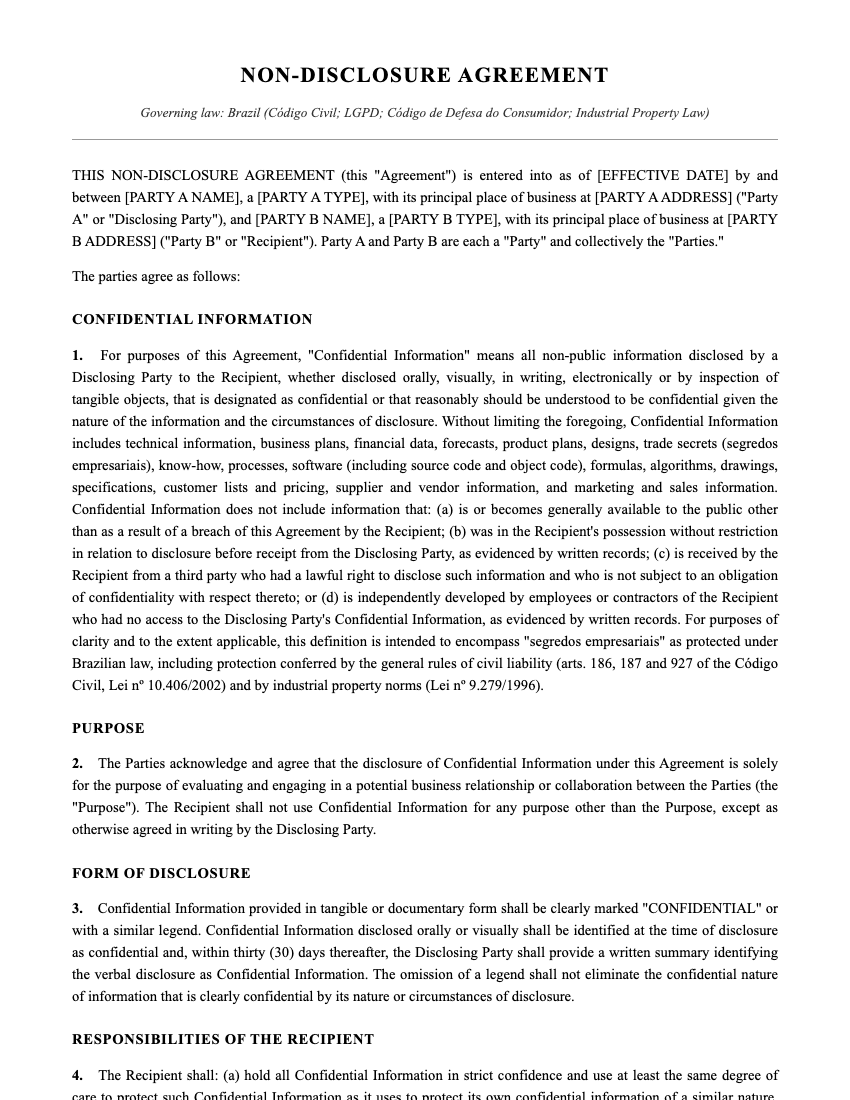
- Código Civil (Law No. 10.406/2002) principles on contracts (good faith and social function of contracts, arts. 421–422);
- Industrial Property Law (Lei da Propriedade Industrial, Law No. 9.279/1996) provisions on unfair competition and trade secrets (see statutory protection against misuse and unfair conduct);
- LGPD (Lei Geral de Proteção de Dados, Law No. 13.709/2018) when the disclosed information contains personal data; and
- Electronic signature rules under Medida Provisória No. 2.200‑2/2001 (ICP‑Brasil) for remote execution.
A Brazil NDA protects what is legally protectable in Brazil: bona fide trade secrets and confidential business information. It cannot be used to strip data subjects of rights under the LGPD or to create abusive restraints on labor that courts will set aside unless properly compensated and limited.
Why "generic" NDAs are dangerous in Brazil
Using a template drafted for common‑law jurisdictions or for US states can create several traps under Brazilian law.
- Confusing trade secrets with personal data (LGPD trap)
For a complete guide to NDA terms, duration, and standard exclusions, see our NDA Agreement Guide.
If your NDA treats any personal data as merely "confidential" without addressing lawful processing, legal basis and data subject rights, you risk non‑compliance with the LGPD (Law No. 13.709/2018). NDAs cannot contractually override data subject rights such as access, correction and deletion (Art. 18 LGPD). An NDA that instructs recipients to "keep all personal data secret" or to "destroy all traces" may inadvertently impede lawful exercise of those rights and trigger ANPD scrutiny.
- Improper non‑compete language (the Brazilian paradigm‑shifting insight)
Brazilian courts do enforce post‑employment non‑compete clauses (cláusula de não concorrência) in civil and commercial contracts, but they require three essentials to be enforceable: (a) clear temporal limitation; (b) reasonable territorial and activity scope; and (c) indemnity (financial compensation) proportional to the restriction. Practitioners often treat NDAs as a place to hide "backdoor" non‑competes (broad prohibitions on using knowledge to work in a field). In Brazil that strategy backfires: labor and civil courts frequently invalidate overbroad restraints and may convert them into damage claims. In short: if you want a post‑contractual restraint in Brazil, expressly draft it, limit it, and provide compensation.
- Overbroad confidentiality definitions
Labeling everything "trade secret" is counterproductive. Brazilian courts look for demonstrable secrecy measures and economic value tied to secrecy (Industrial Property Law and Civil Code concepts). Courts may refuse protection where the disclosing party failed to adopt basic precautions (access limitation, marking, password controls).
- Electronic signatures and execution
Brazil recognizes digital signatures under MP 2.200‑2/2001 (ICP‑Brasil) and courts accept electronic execution when parties use reliable methods. But local practice still favors clearly dated signatures and evidence of consent. For cross‑border deals, add a clause specifying Brazilian governing law and forum if you want Brazilian courts to apply local rules.
Real case / legal development
The deployment of the LGPD in 2020–2021 and the creation of the National Data Protection Authority (ANPD) have reshaped confidentiality practice in Brazil. ANPD guidance emphasizes that confidentiality clauses must not deny data subject rights; many law firms reported contract revisions in 2021–2023 to align NDAs with LGPD. Separately, Brazilian judicial practice—reported in legal press outlets such as ConJur and Migalhas—has consistently required compensation for enforceable post‑contractual non‑compete clauses, confirming the tripartite test above.
Key clauses adapted for Brazilian practice
- Definition of Confidential Information: two‑tier approach distinguishing (A) personal data (subject to LGPD rights) and (B) trade secrets/other confidential business information (protected under civil/industrial property doctrines).
- Purpose and limited use: narrow-purpose clause (e.g., "evaluation of potential distribution agreement for Product X") to satisfy necessity and proportionality standards.
- Term: tiered duration—general confidential information 2–5 years; trade secrets protected as long as secrecy is maintained (subject to statute of limitations for damages claims under Código Civil Arts. 205–206).
- Non‑compete / non‑solicit: optional, separate clause requiring explicit financial compensation and reasonableness limits—do not hide these inside a generic confidentiality definition.
- Security measures: express obligations to adopt technical and organizational measures compatible with LGPD (access control, encryption, breach notification timelines).
- Data subject and ANPD cooperation: clause requiring recipient to comply with data subject requests and to notify disclosing party of any data protection incident.
- Electronic signatures: specify accepted signature methods (ICP‑Brasil certificates or mutually agreed e‑signature platform) and reference MP 2.200‑2/2001.
- Remedies and limitation periods: specify injunctive relief, contractual penalties, and reference applicable prescription periods (Código Civil Arts. 205 and 206).
Who needs this document?
- Startups and investors: protect pitch materials while respecting LGPD when personal data appears (investor contacts).
- Software and R&D vendors: protect source code, algorithms and industrial secrets with clear secrecy measures.
- Employers and contractors: use one‑way NDAs for hiring contractors; include separate non‑compete compensation language if desired.
- Suppliers and manufacturers: protect production methods and supplier lists.
How to execute a valid Brazil NDA (practical steps)
- Choose the type: unilateral for one‑sided disclosure; mutual when both parties exchange information.
- Define the purpose precisely: narrow the permitted use to avoid proportionality problems under LGPD and civil principles.
- Mark and secure materials: label documents, implement access controls, and include technical measures to show "reasonable secrecy efforts."
- Sign before sharing: use ICP‑Brasil digital certificates (MP 2.200‑2/2001) or mutually agreed e‑signature platforms; retain execution evidence and distribution logs.
Already receiving NDAs from clients?
Carefully review incoming NDAs for: (a) LGPD conflicts (clauses limiting data subject rights), (b) hidden non‑compete language without compensation, and (c) ambiguous duration or sweeping indemnities. an AI contract review tool flags these Brazil‑specific issues instantly—saving negotiation time and reducing litigation risk.
Related NDA Templates
Get the Template
Sign up for our newsletter to receive the template.
Frequently Asked Questions

About Designer Content
Designer Content creates practical legal document resources for landlords, contractors, and small business owners. We simplify complex legal concepts into actionable guidance. Connect with us on LinkedIn.