
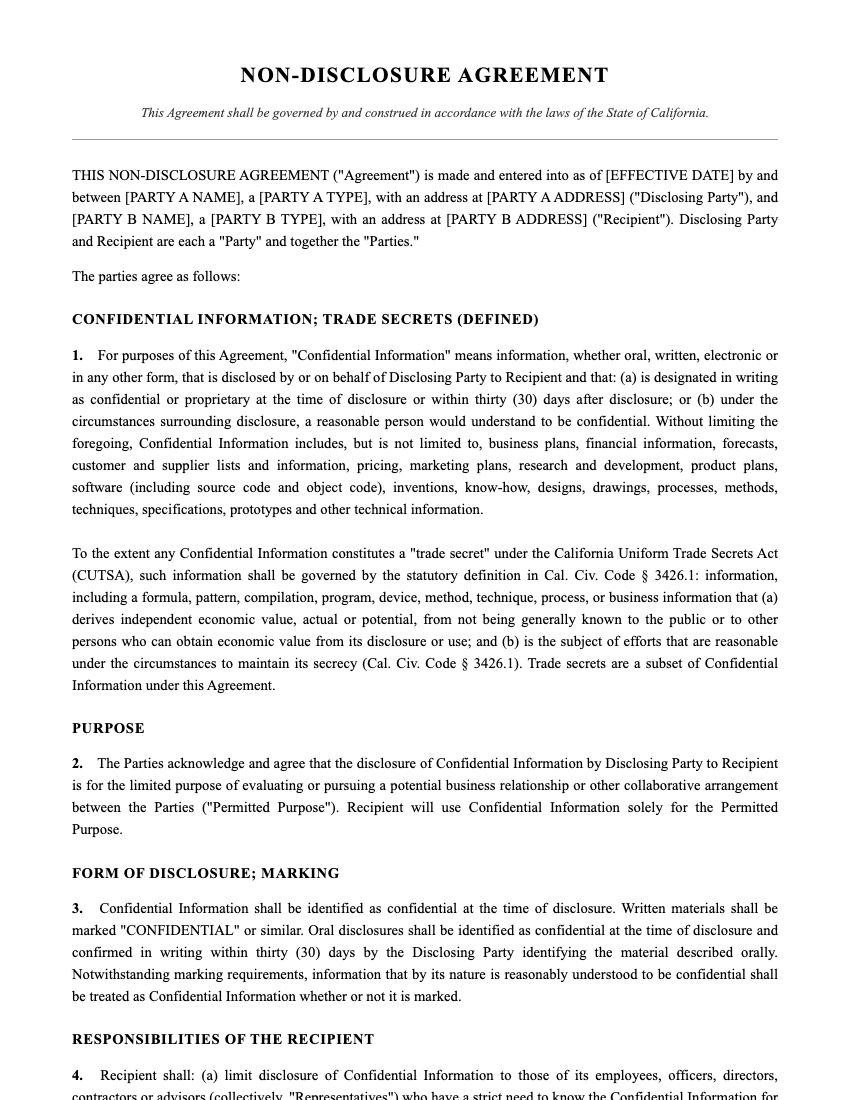
A California Non-Disclosure Agreement (NDA) is a confidentiality contract that protects trade secrets and proprietary information while fully complying with California's strict ban on non-compete clauses—meaning it safeguards what you share without illegally restricting where the other party can work.
What Is a California NDA?
Definition: A California Non-Disclosure Agreement is a legal contract that binds parties to secrecy regarding proprietary information (such as code, client lists, or inventions). Crucially, a valid California NDA protects trade secrets without restricting a worker's right to future employment, adhering to California Business and Professions Code Section 16600.
This distinction matters because California has the strongest non-compete ban in the nation. If your NDA contains any language that could prevent someone from working in their field—even indirectly—it may be void entirely.
For a complete guide to NDA terms, duration, and standard exclusions, see our NDA Agreement Guide.
Why "Generic" NDAs Are Dangerous in California
Most free NDA templates available online were written for states where non-compete agreements are legal and enforceable. Using them in California creates three serious risks.
The SB 699 & Non-Compete Ban
As of January 1, 2024, California SB 699 makes it a civil violation to include OR attempt to enforce any clause that restrains someone from engaging in their profession. This applies regardless of where the contract was signed.
The penalty: up to $2,500 per violation, plus the other party's attorney's fees.
Generic NDAs often include language like "Receiving Party shall not use Confidential Information to compete with Disclosing Party." In Texas, that's a standard protective clause. In California, it's a backdoor non-compete that could void your entire agreement.
In 2022, a California judge ruled that Google's confidentiality agreements were so broad they violated Section 16600 because employees couldn't discuss their work with potential employers. If Google's legal team got it wrong, template generators certainly can.
The "Whistleblower" Immunity Clause
Here's a trap almost nobody knows about: under the federal Defend Trade Secrets Act (18 U.S.C. § 1833(b)), if your NDA doesn't include notice that employees can disclose trade secrets to government officials when reporting suspected violations, you lose the ability to recover enhanced damages in any trade secret lawsuit.
You can still win your case. But without this clause, you cannot recover exemplary damages or attorney's fees. Most free templates don't include it.
Defining "Trade Secrets" vs. "Confidential Info"
Under California's Uniform Trade Secrets Act (Civil Code § 3426.1), a trade secret must:
- Derive economic value from not being generally known
- Be subject to reasonable efforts to maintain secrecy
General business information doesn't automatically qualify. This template distinguishes between general confidential information (time-limited protection, typically 2-5 years) and true trade secrets (protected indefinitely, as long as they remain secret).
Why does this matter? If you call everything a "trade secret" when it isn't, courts may refuse to protect any of it.
What's Included in This Template? (Key Clauses)
Mutual vs. Unilateral Options
The download includes both versions:
- One-Way (Unilateral): Use when you're the only one sharing information—pitching to investors, hiring contractors, licensing discussions.
- Mutual (Two-Way): Use when both parties will share confidential information—partnerships, M&A due diligence, joint ventures.
Using mutual when you're only disclosing creates unnecessary liability. Using unilateral when both sides share creates gaps.
The "Residuals" Clause Negotiation
A residuals clause allows the receiving party to use "ideas, concepts, know-how, and techniques retained in unaided memory" after the relationship ends. This is standard in tech and pharma deals but rarely appears in free templates.
Without it, you're technically claiming that a developer who saw your code can never work in software again. Courts won't enforce that. The template includes optional residuals language you can include or exclude based on your negotiation.
Exclusions from Confidentiality
Standard carve-outs ensure you aren't liable for information that was:
- Already publicly available
- Known to the receiving party before disclosure
- Independently developed without reference to your information
- Required to be disclosed by law
These exclusions are legally expected. An NDA without them may be seen as overreaching.
Who Needs This Document?
| User Persona | Usage Scenario | Key Benefit of This Template |
|---|---|---|
| Tech Startups | Pitching to VCs or Angels | Protects the "Pitch Deck" without scaring off investors with heavy legalese |
| Software Studios | Hiring Freelance Devs | Specifically covers "Source Code" and "Algorithms" as protected assets |
| Small Businesses | Selling the Company (M&A) | Allows you to open your books to a potential buyer safely during Due Diligence |
| Inventors | Manufacturing Prototypes | Ensures the factory cannot steal the design to produce knock-offs |
How to Execute a Valid California NDA
Step 1: Choose the Type
Decide if you need a One-Way or Mutual agreement based on who's sharing information.
Step 2: Define the Purpose
Be specific. Instead of "Business Discussions," write "Evaluating a potential partnership regarding Project X inventory management system."
Step 3: Mark Your Documents
The NDA works best when you actually label your files "CONFIDENTIAL" before sending them. This establishes the "reasonable secrecy efforts" required for trade secret protection under CUTSA.
Step 4: Sign Before Sharing
Never share sensitive information before the agreement is signed. The NDA only protects information disclosed after execution.
Already Receiving NDAs from Clients?
This template helps when you're the one sending the agreement. But what about when someone sends you an NDA to sign?
Before signing any confidentiality agreement, review it for California-specific red flags: void non-compete language, overly broad definitions that could restrict your career, or missing whistleblower immunity provisions.
an AI contract review tool uses AI to instantly identify risky clauses, compare terms against California law, and flag provisions that need negotiation—saving hours of manual review.
Related NDA Templates
Get the Template
Sign up for our newsletter to receive the template.
Frequently Asked Questions

About Designer Content
Designer Content creates practical legal document resources for landlords, contractors, and small business owners. We simplify complex legal concepts into actionable guidance. Connect with us on LinkedIn.