
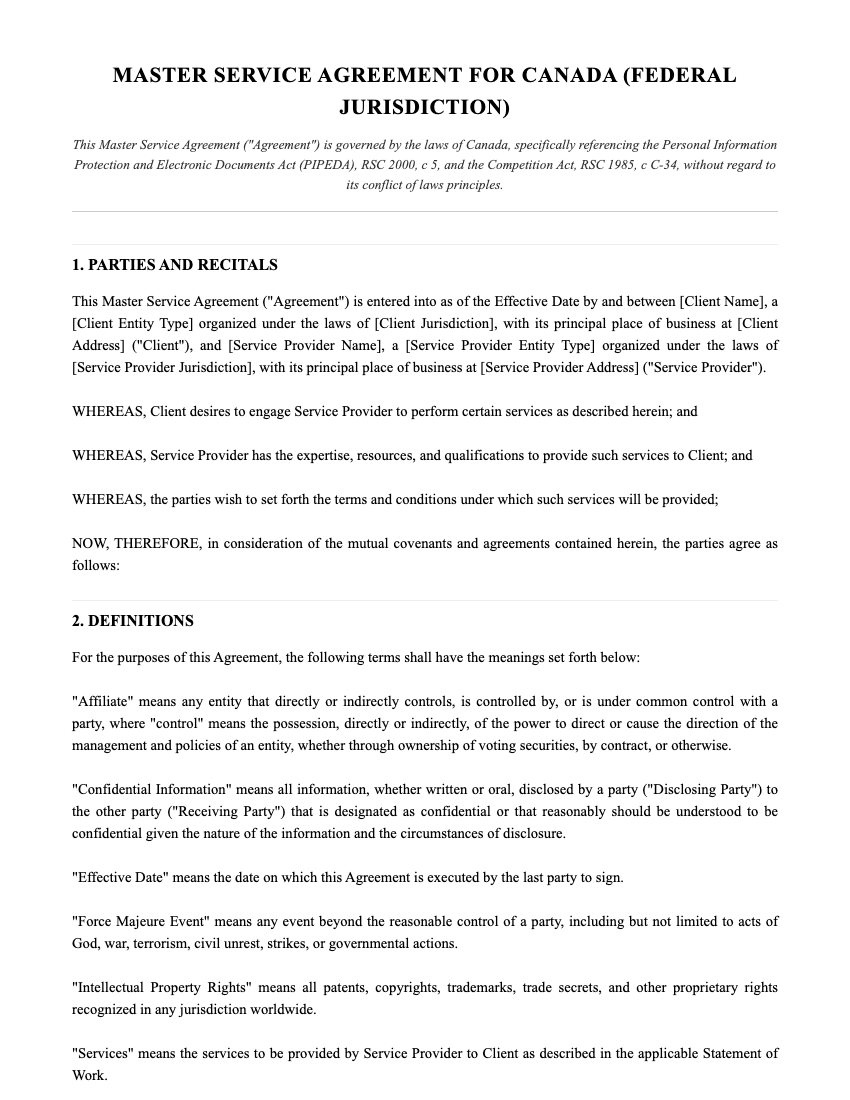
A Canada (Federal) Master Services Agreement (MSA) is a reusable contract that sets the core legal terms for ongoing services between a provider and a client, with project details handled through Statements of Work (SOWs). For Canadian SMBs, agencies, and consultants, an MSA helps you avoid renegotiating the same legal basics on every engagement while keeping payments, confidentiality, and liability predictable. In federally regulated or cross-border data contexts, it also helps you build in PIPEDA-ready privacy language from day one.
Definition: A Canada (Federal) Master Services Agreement is an umbrella B2B contract that governs a series of service engagements between a service provider and a client in Canada, with individual projects documented in SOWs. The MSA typically covers payment terms, intellectual property, confidentiality, liability limits, warranties, and dispute resolution—so each new project can be launched by signing a short SOW rather than rewriting the entire agreement. In federal contexts, the template should anticipate compliance with privacy rules under PIPEDA (RSC 2000, c 5), competition-law constraints under the Competition Act (RSC 1985, c C-34), and enforceable interest, arbitration, and anti-corruption provisions.
Why You Cannot Use a Generic MSA in Canada (Federal)
A generic “North America MSA” often fails in Canada because Canadian enforceability turns on different legal tests, different statutory limits, and different drafting conventions than many U.S.-centric templates. In practice, three issues drive the most expensive disputes for service businesses: (1) worker classification exposure (tax and payroll), (2) restrictive covenant enforceability (non-competes), and (3) who owns the deliverables (copyright and other IP). A Canada (Federal)-tailored MSA also needs to address privacy and security obligations that are triggered simply by handling personal information in the course of commercial activity.
3a. Worker Classification Rules
Canada does not use a simple “ABC test” at the federal level. Instead, worker status is assessed primarily under the common-law control/organization tests and the “business relationship” analysis used by the Canada Revenue Agency (CRA), focusing on control, ownership of tools, chance of profit/risk of loss, and integration. These factors matter because misclassification can trigger payroll tax and source-deduction consequences under the Income Tax Act (with related CRA assessments for unremitted withholdings and penalties) and can create employment-rights exposure where labour standards apply. For federal labour contexts, the Canada Labour Code (RSC 1985, c L-2) governs many federally regulated workplaces; even where your relationship is intended to be independent, unclear drafting can be used as evidence of control and dependency.
For a comprehensive guide to structuring MSAs and SOWs that protect your business, see our Freelancer Contracts Guide.
A Canada (Federal)-ready MSA and SOW structure should: (i) clearly describe the contractor as independent, (ii) avoid day-to-day managerial control language, (iii) confirm the contractor supplies tools/resources where appropriate, and (iv) allocate responsibility for remittances and insurance. Misclassification disputes are costly because they can lead to retroactive deductions, interest, and potential statutory claims—often emerging after the relationship ends, when the parties are already in conflict.
3b. Non-Compete Enforceability
Non-competes are not automatically void in Canada, but they are heavily scrutinized and often unenforceable unless narrowly drafted. There is no single “Federal Non-Compete Act” for general B2B contracting; enforceability is largely common-law, and courts typically require a legitimate proprietary interest and reasonable limits on duration, geography, and scope of restricted activities. Overbroad clauses are at high risk of being struck.
The federal angle matters for two reasons. First, some businesses operate across provinces (or remotely), so a “one-size-fits-all” non-compete can become ambiguous on what geography even means—inviting a court to invalidate it. Second, if your template includes strong exclusivity or market-allocation language, you can also create competition-law risk. Under the Competition Act (RSC 1985, c C-34), certain arrangements between competitors (including market allocation or output restriction) can be criminally prohibited; even where the Act’s specific provisions depend on context, an MSA should avoid language that looks like competitor coordination. Practically: a generic non-compete copied from another jurisdiction may not only fail; it can also create negotiation friction and delay procurement approval.
A better Canada (Federal) approach is to treat non-competes as the exception, not the default. Use enforceable alternatives: (1) robust confidentiality and trade secret protections, (2) non-solicitation of customers and employees where appropriate, and (3) clear return/destruction of information obligations. If a non-compete is truly required, keep it narrow and tied to a legitimate interest (for example, protecting a specific client relationship or confidential method), with a short duration and precise activity restrictions.
3c. IP/Work-for-Hire Considerations
Generic templates often rely on “work made for hire” language, which does not map cleanly onto Canadian copyright rules. Under Canada’s Copyright Act (RSC 1985, c C-42), the default is that the author is the first owner of copyright, subject to specific exceptions (such as certain employment situations). For independent contractors, you typically need an express written assignment of copyright to move ownership to the client—plus a waiver of moral rights if the client needs broad modification rights. A Canada (Federal)-tailored MSA should separate (i) provider background IP, (ii) client materials, and (iii) project deliverables, and should clarify licensing versus assignment depending on the business deal.
What's Included in This Template
Flexible SOW Structure: The MSA sets the standing legal terms, while each SOW states scope, milestones, fees, acceptance criteria, and dependencies. This reduces scope-creep disputes by forcing both sides to write down what “done” means and what triggers change orders.
Canada (Federal)-Specific Indemnification: The template includes mutual indemnities aligned to typical Canadian commercial practice, with clear limits and carve-outs for gross negligence or wilful misconduct. It also helps allocate risk for third-party IP claims and privacy/security incidents based on who caused the issue.
Dispute Resolution and Venue: The template offers a structured escalation process and an arbitration option suitable for federal contexts, referencing the federal Arbitration Act (RSC 1985, c A-2) as a framework where applicable, while still allowing parties to choose courts when arbitration is not desired.
Additional Canada (Federal) provisions included (with legal hooks): (i) privacy/data handling obligations referencing PIPEDA (RSC 2000, c 5); (ii) anti-corruption compliance commitments referencing the Corruption of Foreign Public Officials Act (SC 1998, c 34) for cross-border dealings; (iii) late payment interest drafting aligned to the Interest Act (RSC 1985, c I-15) (including clear rate disclosure); and (iv) competition-law “no coordination” language mindful of the Competition Act (RSC 1985, c C-34).
Who Needs This Document?
| User Type | Relationship | Key Benefit |
|---|---|---|
| Marketing/Creative Agencies | Retainers and multi-campaign work | Faster project starts via SOWs and cleaner approval cycles |
| IT Consultants & MSPs | Ongoing support + project work | Clear service levels, change control, and data-handling terms |
| Software Developers | Milestone-based builds | Strong IP allocation and acceptance/payment protection |
| Operations/Finance Freelancers | Fractional roles | Clear independent contractor structure and deliverable-based scope |
How to Use This MSA Template
Step 1: Identify the Parties Correctly
Use exact legal names (including “Inc.”/“Ltd.”) and include addresses for notice. If either party is a sole proprietor, name the individual and the business name if different.
Step 2: Sign the MSA Once, Then Use SOWs
Keep the MSA stable and put project specifics in SOWs. This avoids constant redlining and makes renewals easier.
Step 3: Define Data, Security, and Confidentiality Needs
If personal information will be handled, tailor the PIPEDA-related language to your workflow. Set minimum safeguards, breach notification expectations, and subcontractor controls.
Step 4: Set Payment, Interest, and Change Control
State fees, invoicing cadence, and a clearly expressed interest rate for late payments. Add a simple change-order process so extra work becomes billable without conflict.
Related MSA Templates
Get the Template
Sign up for our newsletter to receive the template.
Frequently Asked Questions

About Designer Content
Designer Content creates practical legal document resources for landlords, contractors, and small business owners. We simplify complex legal concepts into actionable guidance. Connect with us on LinkedIn.