
A Canada (Federal) Non-Disclosure Agreement (NDA) is a contract parties use to protect confidential business information across provincial borders and in federally regulated transactions. Because Canada lacks a single federal “trade secrets statute,” NDAs must be drafted with attention to common‑law misappropriation principles, federal privacy obligations under PIPEDA, and competition law risks under the Competition Act.
What is a Canada (Federal) NDA?
Definition: A Canada (Federal) NDA is a written agreement that defines Confidential Information, limits permitted uses and disclosures, sets retention and return obligations, and provides remedies for misuse. In federal/interprovincial matters the NDA complements common‑law duties and sectoral rules (for example, federally regulated employers and interprovincial M&A).
Unlike some jurisdictions, Canada does not have a federal “Trade Secrets Act.” Trade secrets are protected by contract, equitable remedies (injunctions, accounting), and tort causes of action such as breach of confidence and loss of bargain. For privacy of personal information, the Personal Information Protection and Electronic Documents Act (PIPEDA, S.C. 2000, c. 5) governs federally regulated private-sector handling of personal data.
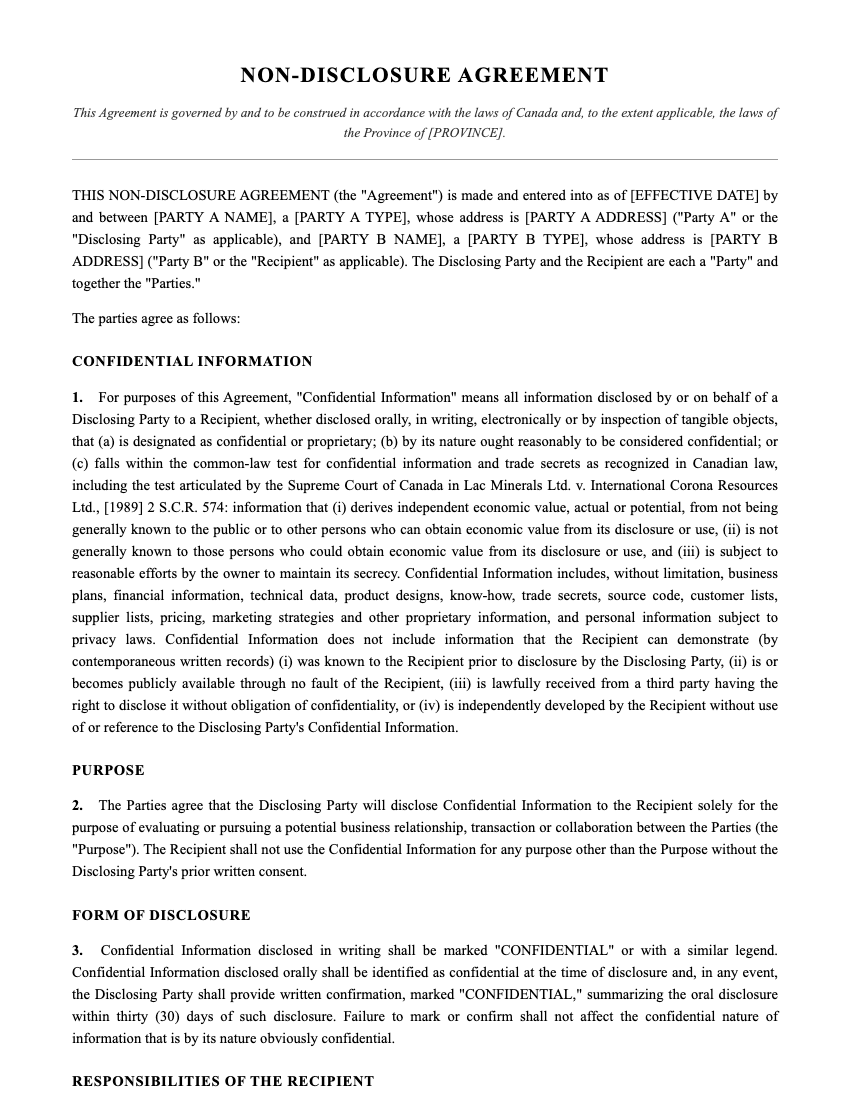
For a complete guide to NDA terms, duration, and standard exclusions, see our NDA Agreement Guide.
Why “Generic” NDAs Are Dangerous in Canada (Federal)
Many online NDA templates assume a U.S. legal environment. Using them in
Canada risks three common pitfalls:
- Disguised restraints on competition. Employers or vendors sometimes try to achieve non‑compete results by drafting NDAs that effectively prevent working in an industry. Canadian courts will scrutinize such disguised restraints under the restraint‑of‑trade doctrine—an overbroad NDA can be struck down, and an attempt to mask a non‑compete inside confidentiality language can destroy your remedy.
- Privacy non‑compliance. If your NDA requires a party to collect, transfer, or disclose personal information, PIPEDA imposes consent, purpose‑limitation and breach‑notification obligations. A confidentiality clause that prevents reporting a privacy breach to the Office of the Privacy Commissioner may be unenforceable.
- Competition Act exposure. Agreements that unduly restrict commercial conduct between competitors risk review under the Competition Act. While ordinary confidentiality for legitimate commercial reasons is fine, clauses that fix prices, allocate markets, or unduly limit competitive activity can trigger enforcement.
Paradigm‑shifting insight for Canada (Federal)
There is no federal trade‑secret statute: protection is contractual and equitable. That means a well‑drafted NDA is your primary tool for preserving trade secrets—but it must also respect Canadian public policy (privacy law, competition law) and common‑law doctrines. Equally important: the Supreme Court of Canada has emphasized a contractual duty of honest performance (Bhasin v. Hrynew, 2014 SCC 71). You cannot use an NDA to conceal bad faith or mislead the other party; NDAs must be applied consistently with that duty.
Real case study: Shafron v. KRG Insurance Brokers Ltd., 2009 SCC 6, is a cautionary example. The Supreme Court struck down an overly narrow geographic clause in a restrictive covenant because the drafting made enforcement unworkable. The lesson for NDAs: ambiguous or overbroad restrictions (including disguised restraints in confidentiality language) will be interpreted narrowly or invalidated.
Another instructive decision, Bhasin v. Hrynew (2014 SCC 71), underscores that parties owe each other an obligation of honesty in contract performance—NDAs cannot be a tool for deception.
Key clauses tailored for Canada (Federal)
- Definition of Confidential Information: tiered approach distinguishing general confidential business information (time‑limited protection) from true trade secrets (protected indefinitely while secret). Require identification and objective steps taken to maintain secrecy.
- Permitted Use / Purpose: narrowly state the commercial purpose (e.g., "evaluating a proposed joint venture regarding Project X"). Purpose‑limitation helps with PIPEDA compliance when personal information is involved.
- Exclusions: standard carve‑outs for publicly known information, independently developed knowledge, or information lawfully obtained from a third party.
- Required Disclosures & Whistleblower/Regulatory Carve‑outs: permit disclosure where required by law or to government regulators, and include an express PIPEDA‑compliant clause for breach reporting so the NDA cannot be used to block regulatory disclosures.
- Remedies: injunctive relief and accounting, plus liquidated damages if enforceable. For interprovincial or international injunctive relief, consider language enabling urgent interim relief (Equustek principles may apply).
- Return/Destruction and retention limits: specify how to handle personal information and trade secrets on termination, consistent with PIPEDA retention principles.
- Electronic signatures and governing law: specify governing law and recognize electronic signatures (see federal/provincial e‑commerce frameworks).
Who needs this document?
| User Persona | Typical Use | Benefit in Canada (Federal) |
|---|---|---|
| Exporting tech startups | Sharing code with US/Cdn partners | Protects IP across provinces and flags privacy/compliance obligations |
| Federally regulated employers | Secondments or interprovincial hires | Ensures confidentiality while avoiding disguised non‑competes |
| Law firms / M&A teams | Cross‑border due diligence | Limits data use, addresses PIPEDA breach reporting and injunctive needs |
| Manufacturers | Sharing specs with overseas vendors | Preserves trade secrets and sets return/destruction rules |
How to execute a valid Canada (Federal) NDA
- Choose the right type: unilateral if only one party discloses; mutual when both sides will share confidential information.
- Define the Purpose: be specific—“evaluate a potential licensing arrangement for Product Y.” Narrow purposes limit unintended use and support PIPEDA consent requirements.
- Protect personal information: if personal data is shared, ensure consent, minimization, security safeguards and breach notification obligations comply with PIPEDA (and applicable provincial laws). Label materials and set retention limits.
- Sign correctly: electronic signatures are widely recognized in Canada (provincial uniform electronic commerce legislation and federal guidance). Specify governing law and a forum for injunctive relief.
Practical tip: avoid trying to use an NDA to lock someone out of a labour market. If you need a non‑compete or other restrictive covenant, draft a separate, province‑specific agreement and test its reasonableness against Canadian precedents (see Shafron). NDAs are for information protection, not market restriction.
Receiving an NDA? Watch for these red flags
- Broad language that forbids "competition" or vague "use" restrictions—could be a disguised non‑compete.
- Clauses that prohibit reporting privacy breaches or regulatory complaints—likely unenforceable under PIPEDA and public policy.
- Unlimited confidentiality for routine, non‑secret information—use a reasonable time limit.
an AI contract review tool can scan incoming NDAs, compare clauses against Canadian law flags (PIPEDA, Competition Act, common‑law traps), and highlight risky provisions for negotiation.
Related NDA Templates
Get the Template
Sign up for our newsletter to receive the template.
Frequently Asked Questions

About Designer Content
Designer Content creates practical legal document resources for landlords, contractors, and small business owners. We simplify complex legal concepts into actionable guidance. Connect with us on LinkedIn.