
Opening
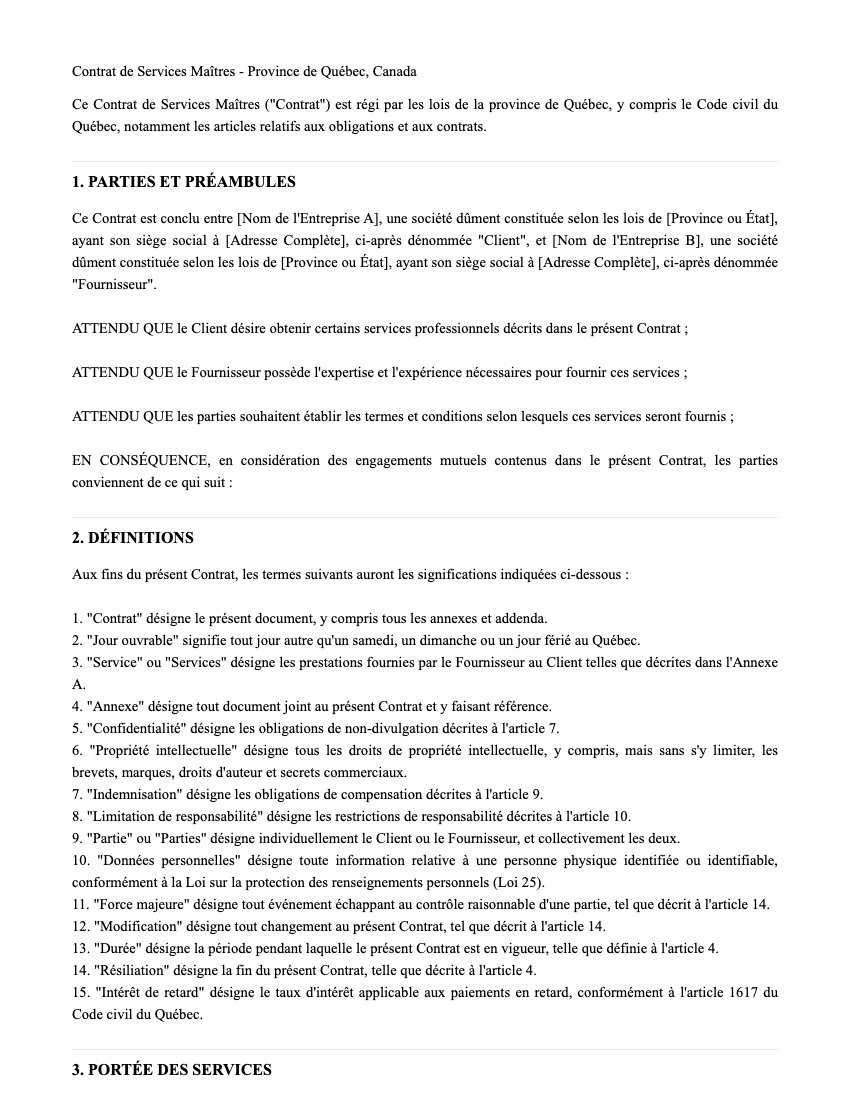
A Master Services Agreement (MSA) in Canada (Quebec) is a master agreement that sets the legal rules (payment, liability, confidentiality, intellectual property) applicable to all your future services, while each concrete mandate is described in a Statement of Work (SOW). For an SME, a consultant, or an agency, this structure speeds up the signing of new projects and reduces repetitive negotiations. In Quebec, a generic template can, however, conflict with the Code civil du Québec and Law 25.
For a comprehensive guide to structuring MSAs and SOWs that protect your business, see our Freelancer Contracts Guide.
Definition Box
Definition: A Quebec MSA (often called services framework agreement) is a B2B contract governed by the Code civil du Québec that establishes, in advance, the constant terms of the relationship between a service provider and a client: invoicing, late payment interest, limitation of liability, indemnification, confidentiality, intellectual property, termination, and dispute resolution. Each project is then detailed in a SOW (or purchase order/service annex) indicating deliverables, timeline, and price. This approach avoids renegotiating the “legal baseline” for each assignment.
Section 3: Why You Cannot Use a Generic MSA in Canada (Quebec)
A North America-type or US-style template often forgets that Quebec is a civil law province: concepts, formulations, and even drafting instincts (e.g., clauses of work made for hire) do not automatically translate. Moreover, some common clauses become risky if they ignore Quebec’s rules on worker status qualification, non-compete restrictions, and contractual liability.
Worker Classification Rules
In Quebec, the qualification “employee vs. independent contractor” depends largely on the facts: subordination, control, integration into operations, provision of tools, chance of profit and risk of loss. In practice, authorities (e.g., CNESST and Revenu Québec) rely on criteria close to the subordination test and the “organization/business” analysis. Statutorily, the Loi sur les normes du travail defines the salarié (see LNT, art. 1) and sets minimum non-renounceable protections.
If your MSA resembles an employment contract in disguise (imposed hours, exclusivity, daily approvals, tight control), you increase the risk of reclassification. Consequences may include vacation claims, notice, overtime, and retroactive payroll/taxes. A good Quebec MSA template thus includes clauses aligned with a B2B relationship (autonomy, absence of subordination, the service provider’s tax responsibility, possibility to subcontract, etc.), but without assuming that a simple phrase “independent contractor” suffices.
Non-Compete Enforceability
Unlike some U.S. states, non-compete clauses can be valid in Quebec, but they must meet strict conditions. The Code civil du Québec, art. 2089, provides that a non-compete obligation must be limited in time, place, and type of activities and must not exceed what is necessary to protect legitimate interests. Even though Article 2089 explicitly targets the employer-employee context, its reasonableness principle strongly influences the analysis of post-contract restrictions.
In a B2B MSA, a too-broad non-compete (e.g., “worldwide prohibition for 5 years”) risks being deemed abusive and therefore unenforceable, especially if it prevents the service provider from earning a living. Best practice is often to replace a general non-compete with more defensible alternatives: (1) robust confidentiality (including trade secrets), (2) targeted non-solicitation of identified clients, and (3) restrictions limited to specific projects or sectors.
IP/Work-for-Hire Considerations
In intellectual property, beware of imported templates. In Canada, the default rule in copyright law is that the author is the initial owner, unless there is an exception (e.g., employment). The Loi sur le droit d’auteur (L.R.C. 1985, ch. C-42), art. 13 provides rules of ownership, notably for works created in the course of employment, but this is not automatic for a consultant. Therefore, a Quebec MSA should provide a clear assignment or a licence of the deliverables, often conditioned on final payment, rather than relying on an American “work made for hire.”
What's Included in This Template
Flexible SOW Structure
The model separates the master agreement (MSA) from the SOWs. The MSA sets the permanent rules; each SOW describes the project: deliverables, milestones, acceptance criteria, pricing, expenses and dependencies. You sign the MSA once, then you add a SOW per mandate, which reduces commercial friction.
Canada (Quebec)-Specific Indemnification
Indemnification is drafted to stay compatible with the Quebec liability regime. It includes exceptions for intentional fault and gross fault (often translated as gross negligence), in accordance with C.c.Q., art. 1474, and is framed with a realistic limitation of liability, keeping in mind C.c.Q., art. 1479 (adjustment of damages, within permitted parameters).
Dispute Resolution and Venue
The template provides for the applicable law of Québec and a Quebec-competent court (or arbitration if chosen), to avoid an ill-suited “Delaware/New York” clause. It also incorporates claims-management elements: written notice, cure period, documentation, and acknowledgment of the generally 3-year prescription period for personal claims.
Other provisions included (with legal references):
- Late interest: C.c.Q., art. 1617 (legal rate of 5%/year, unless stipulated or required by law).
- Confidentiality and protection of personal information: Loi sur la protection des renseignements personnels (Loi 25), art. 3-10 (governance, collection, use, disclosure).
- Indemnification and cap: C.c.Q., art. 1474 and C.c.Q., art. 1479.
- B2B vs consumer caution: Loi sur la protection du consommateur, art. 215 (useful to avoid applying a B2B MSA to consumers).
Who Needs This Document?
| User Type | Relationship | Key Benefit |
|---|---|---|
| Marketing / web agencies | Recurring engagements with SMEs | Quick SOWs, scope creep management, and deliverable approvals |
| Consultants (IT, HR, finance) | Monthly/retainer advisory | Clarifies deliverables, access, confidentiality, and billing |
| Software developers | Milestone-based projects | Clear IP assignment/licensing and protection in case of non-payment |
| Professional services firms | Subcontracting | Indemnification framework, insurance, and limited liability |
How to Use This MSA Template
Step 1: Correctly identify the parties
Enter the full legal name (NEQ if applicable) and address. If a provider operates via a company vs as an individual, specify it: this affects risk, taxes, and liability.
Step 2: Set the duration and termination
Choose a fixed term (e.g., 12 months) or renewable, with notice. Prepare a termination clause for breach with a cure period.
Step 3: Attach an initial SOW
Describe precisely the scope, assumptions, timeline, pricing, and acceptance criteria. This is the primary tool against scope creep.
Step 4: Sign and manage changes
Have the MSA signed once, then a SOW per project. Require a written “change order” for any scope or schedule modification.
Already Receiving Contracts from Clients?
Even if you have an excellent template, many businesses mainly sign contracts that are received from clients (procurement MSA, purchase terms, DPA, etc.). In Quebec, pay particular attention to jurisdiction/venue, asymmetrical liability caps, overly broad IP assignment, and confidentiality/data obligations under Law 25. To accelerate triage before negotiation, use an AI contract review tool to identify risky clauses and issues to correct.
Download Options
Free PDF option: ideal for reading, internal validation, and comparison with the client’s contract.
Word/Google Docs editable option: perfect for customizing clauses (pricing, IP, confidentiality, limitations) and quickly generating coherent SOWs. Keep a “standard” version and a “sensitive projects” version.
Disclaimer
Template for general information purposes only. Not legal advice. For your situation in Quebec, consult a qualified lawyer.
Related MSA Templates
Get the Template
Sign up for our newsletter to receive the template.
Frequently Asked Questions

About Designer Content
Designer Content creates practical legal document resources for landlords, contractors, and small business owners. We simplify complex legal concepts into actionable guidance. Connect with us on LinkedIn.