
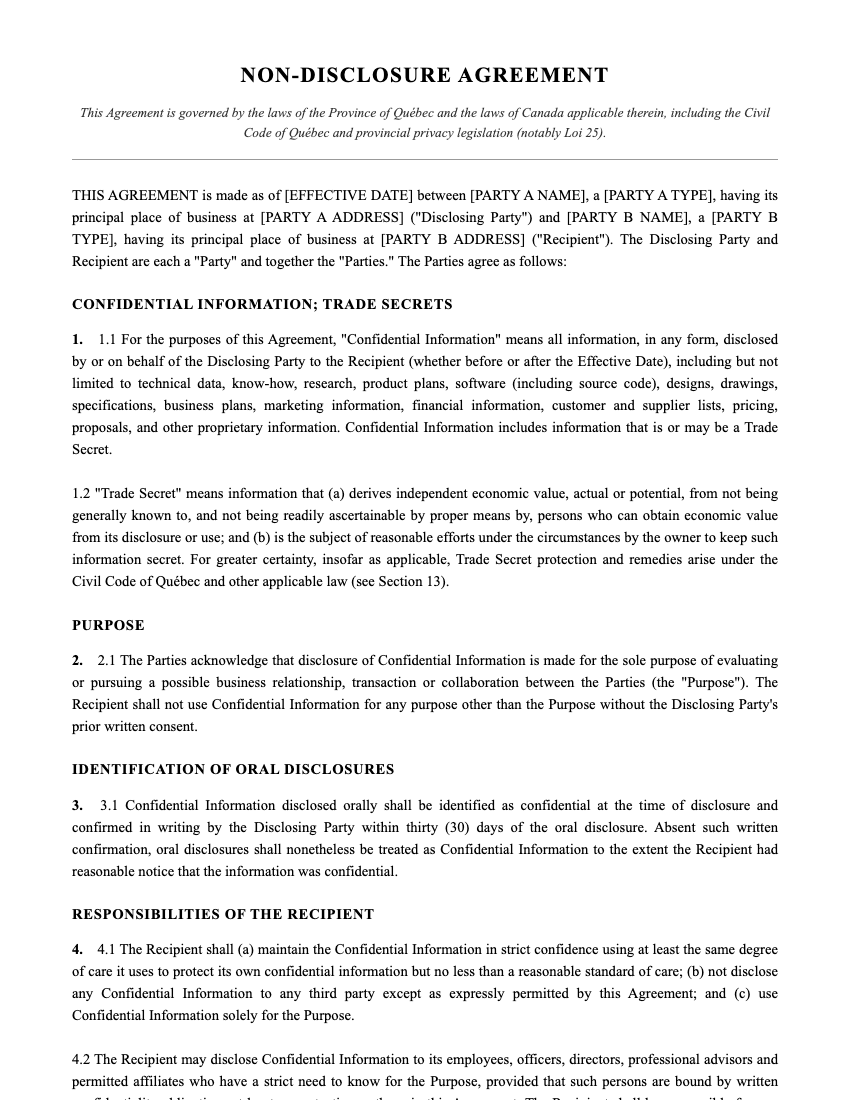
A Canada (Quebec) Non-Disclosure Agreement (NDA) is a civil-law contract that creates binding confidentiality obligations under the Civil Code of Québec (CCQ) and Quebec privacy law. Unlike some U.S. states, Quebec combines civil-law contract principles with strong language and privacy rules—so an effective NDA must do three things at once: (1) create a clear civil-law obligation of confidentiality, (2) respect personal-information obligations under Law 25 (S.Q. 2021, c. 25), and (3) comply with Quebec's language requirements under the Charter of the French Language (C-11) when the counterparty is a consumer or employee.
What Is a Canada (Quebec) NDA?
Definition: A Quebec NDA is a written contract under the Civil Code of Québec that imposes duties of confidentiality and non‑disclosure. Breach remedies flow from CCQ obligations (for example, extra‑contractual liability under CCQ art. 1457 and contractual remedies), and actions for an injured party are generally subject to a three‑year limitation period (CCQ art. 2925).
Because Quebec is bijuridical (civil law for private law matters), NDAs are interpreted according to CCQ principles—contractual freedom tempered by good faith and reasonableness. That means terms like duration, scope, and permitted use must be clear and proportionate.
For a complete guide to NDA terms, duration, and standard exclusions, see our NDA Agreement Guide.
Why Generic NDAs Are Dangerous in Quebec
Most free NDA templates are drafted for common‑law U.S. or international deals and miss at least three Quebec‑specific traps:
- Language law (Bill 101) risk: The Charter of the French Language (C-11) requires that standard contracts offered to consumers be in French. Failing to provide a French version where required can trigger consumer‑protection issues and enforcement risk.
- Privacy (Law 25) obligations: Quebec’s modernized privacy regime (commonly called "Law 25," S.Q. 2021, c. 25) imposes obligations on controllers that affect NDAs—data minimization, breach notification duties, privacy impact assessments, and recordkeeping. An NDA that requires disclosure of personal information must allocate responsibilities for compliance and cross‑border transfers.
- Civil‑law enforceability and prescription: Quebec courts apply CCQ good‑faith interpretation and a three‑year prescription (limitation) period for personal actions (CCQ art. 2925). Overly broad perpetual confidentiality covenants may be re‑characterized or limited by a civil court applying principles of proportionality.
Paradigm‑shifting insight: In Quebec, the intersection of language law and privacy law changes what a typical NDA looks like. You cannot treat an NDA as only a private contract: if it governs employee or consumer information, you must (a) offer a French version (Charter C-11, s. 52 et seq.), and (b) include concrete Law 25 compliance clauses (data controller obligations, breach notification workflow). Missing either can transform a simple confidentiality clause into a regulatory headache.
Real legal development: Bill 64 (now Law 25), enacted as S.Q. 2021, c. 25, substantially modernized Quebec private‑sector privacy rules and introduced new obligations (breach notification, privacy governance) that came into force in stages through 2022–2024. Organizations operating in Quebec must update NDAs and supplier clauses to allocate these statutory duties.
Key Clauses for a Quebec NDA
- Clear definition of "Confidential Information": separate business confidences from personal information. For personal data, reference Law 25 obligations explicitly.
- Purpose and limited use: a narrowly drafted Purpose clause ties permitted use to a specific project and avoids open‑ended restrictions that Quebec courts may pare back.
- Duration: specify time limits for ordinary confidential information (e.g., 2–5 years) and provide for continued protection of trade secrets so long as secrecy is maintained—subject to CCQ principles and prescription rules (art. 2925).
- Language clause: provide that a French version exists and controls for dealings with employees/consumers in Quebec (to respect Charter C-11 where applicable).
- Data processing clause: allocate responsibility for personal information, breach notification procedures, cross‑border transfers, and security measures consistent with Law 25 (S.Q. 2021, c. 25).
- Remedies and choice of law: specify injunctive relief and damages, and choose Quebec law (Civil Code of Québec) and venue. Courts will apply CCQ interpretive principles and public‑policy limits.
- Electronic signature: confirm acceptance of electronic signatures and electronic delivery under Quebec and federal electronic‑document frameworks.
Who Needs This Document?
| User Persona | Usage Scenario | Key Quebec Benefit |
|---|---|---|
| Quebec startup | Sharing code with contractors | Protects IP while allocating Law 25 duties and offering a French version |
| Manufacturing exporter | Sharing designs with a Montreal supplier | Clauses for personal data of workers and cross‑border transfer rules |
| Recruiters / HR | Onboarding employees | Language‑compliant, reasonably timed confidentiality tied to legitimate employer interest |
| Professional services | Due diligence for M&A | Privacy, confidentiality, and data‑room access governed by CCQ good faith |
How to Execute a Valid Quebec NDA
Step 1 — Choose the right type: unilateral if only one party discloses; mutual if both exchange confidential material. In Quebec, clarity of obligation matters more than label.
Step 2 — Draft bilingual where needed: If the counterparty is a Quebec consumer or employee, include or provide a French version up front to avoid Charter (C‑11) issues.
Step 3 — Add Law 25 language: state who is the data controller, security measures, breach notice procedure, and whether cross‑border transfers are permitted.
Step 4 — Sign and preserve: execute before disclosure. Electronic signatures are commonly accepted; retain execution records to support CCQ proof of agreement and to trigger the three‑year prescriptive period for claims (CCQ art. 2925).
Receiving an NDA? Watch for these red flags
- Vague duration or perpetual confidentiality without justification
- No allocation of privacy duties where personal information is involved
- Lack of French version for consumer/employee relationships
- Overbroad restraints that look like disguised non‑compete obligations (Quebec courts will scrutinize reasonableness)
an AI contract review tool still helps: it flags privacy, language, and scope issues, and compares clauses against Quebec law and Law 25 best practices to speed negotiation.
Related NDA Templates
Get the Template
Sign up for our newsletter to receive the template.
Frequently Asked Questions

About Designer Content
Designer Content creates practical legal document resources for landlords, contractors, and small business owners. We simplify complex legal concepts into actionable guidance. Connect with us on LinkedIn.