
A Master Services Agreement (MSA) in Chile is a B2B umbrella contract that sets the baseline rules (payments, liability, IP, confidentiality and dispute resolution) for multiple future projects, executed via Service Orders or Statements of Work (SOW). For SMEs, consultants and agencies, the MSA avoids renegotiating the essentials each time and reduces commercial friction. But in Chile a generic template is not enough: you must consider labor subordination (Código del Trabajo), transfer of copyright, data protection (Ley 19.628) and prescription periods of the Civil Code.
Definition: A Chilean MSA (Acuerdo Marco de Servicios) is a framework contract between a provider and a client that establishes general conditions applicable to all work entrusted during its term. Rather than describing each deliverable within the MSA, the parties attach SOWs with scope, milestones, prices, acceptance and deadlines. The MSA defines how invoices are issued, what happens in case of delays (interest), who bears risks and liability limitations, how personal data is handled in accordance with the Ley 19.628, how intellectual property is assigned under the Ley 17.336, and which court or arbitration applies in Chile.
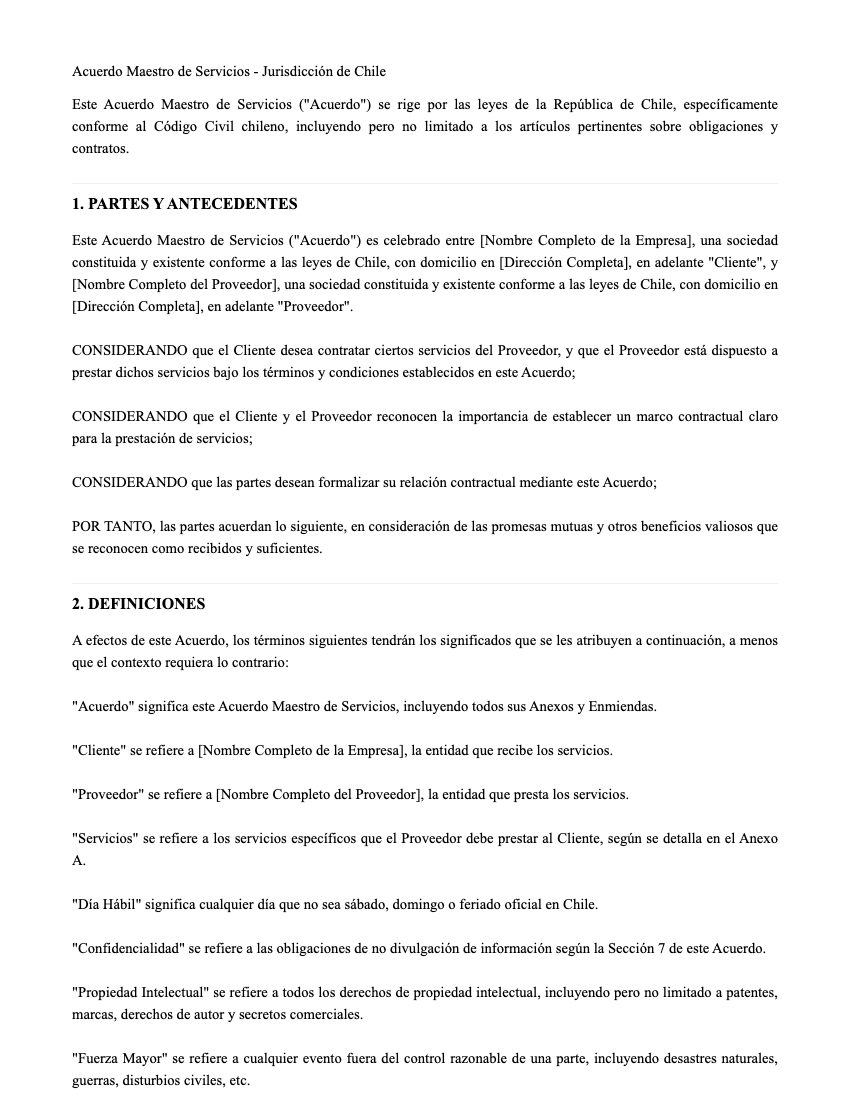
Why You Cannot Use a Generic MSA in Chile
An “imported” MSA (for example, based on common law or U.S. templates) tends to fail in three critical areas for Chile: (1) it may seem to create an employment relationship by the way it controls the work; (2) it may include non-competes drafted as if universally valid, when in Chile enforceability depends on reasonableness criteria and, above all, on not disguising subordination; and (3) it may assume that a mere phrase of “work made for hire” suffices, when copyright and software ownership require a cesión or licenses properly negotiated under Chilean law.
In a civil law system like Chile’s, contracts are interpreted according to their text and their actual execution. That means that even if you say “independent service provision,” if in practice you operate with instructions, time control or functional integration, you can fall into labor contingencies. Moreover, the risks are not theoretical: an inspection or a lawsuit can recharacterize the relationship, generate retroactive charges, and affect your business reputation.
For a comprehensive guide to structuring MSAs and SOWs that protect your business, see our Freelancer Contracts Guide.
3a. Worker Classification Rules
Chile does not use the “ABC test.” The central criterion to differentiate an independent contractor from an employee is Subordination and Dependency: direction, control, oversight, obligation to provide assistance, working hours, de facto exclusivity, integration into the organization, and the employer’s disciplinary power. The regulatory basis is in the Código del Trabajo, artículo 7 (defines employee contract) and artículo 8 (presumption for personal provision of services under subordination and dependency). In practice, what weighs most is how the service is executed: daily instructions, hierarchical supervision and fixed schedules are typical signals of labor status.
Bad classification exposes the client to claims for wages, social security contributions and employment benefits, in addition to administrative penalties. The Dirección del Trabajo can audit and impose fines under its sanctioning regime; and a labor court can recognize the labor relationship even if the contract says otherwise, applying the primacy of reality principle. A well-constructed Chilean MSA reduces risk: it defines autonomy, absence of hours, control by results, and the use of SOWs for deliverables, without bossy instructions.
3b. Non-Compete Enforceability
In Chile there is no single express norm that “authorizes” or “prohibits” non-compete clauses in civil/commercial contracts; their validity is usually evaluated under general rules: freedom of contract and binding force of the contract (Código Civil, artículo 1545) and the requirement that its object is lawful (Código Civil, artículo 1461) and not contrary to public order. In the labor field, post-contractual non-compete agreements are especially sensitive because they may clash with freedom of work; therefore, many companies replace them with confidentiality and non-solicitation, or limit them strictly.
In B2B relationships (agency–company, consultant–client), a non-compete clause can be more defensible if it is reasonable and proportionate: (i) time-limited (for example, 6–12 months), (ii) limited to territory or relevant market, (iii) restricted only to activities that compete directly with the client and (iv) justified by access to strategic information. If the clause prevents “working on anything” or for extended periods, it increases the risk of being considered abusive or contrary to general principles.
If your counterpart is a consumer (rare in MSAs, but possible in digital services), the also may apply the Ley 19.496 (Protección del Consumidor) on abusive clauses. Therefore, a Chilean template often prefers safer alternatives: robust confidentiality, protection of business secrets, and a narrowly tailored non-solicitation of personnel or clients, instead of a broad non-compete.
3c. IP/Work-for-Hire Considerations
The phrase “work made for hire” typical of Anglo-Saxon templates does not replace the Chilean logic. In Chile, the ownership of copyright is governed by the Ley 17.336: to ensure that the client receives sufficient rights over deliverables (designs, texts, software, documentation), you normally need a cesión de derechos patrimoniales or a clear, written license, indicating scope, territory, duration and exploitation modalities. If you do not do this, the provider may retain rights and the client may be limited in modifying, sublicensing or commercially exploiting. A Chilean MSA should separate: (i) IP pre-existing in the provider, (ii) deliverables of the SOW, and (iii) licenses/assignments conditioned on full payment.
What's Included in This Template
Flexible SOW Structure. The MSA sets permanent rules and each SOW defines scope, milestones, acceptance criteria and fees. This helps control “scope creep”: if the client requests extras, an additional SOW or a change order is issued, without rewriting the framework contract.
Chile-Specific Indemnification. Indemnity is drafted with a Chilean civil-law focus: liability for breach, reasonable limitations, and exclusions for fraud or gross negligence. You can also require insurance when the service involves operational risk, and establish a duty to mitigate damages.
Dispute Resolution and Venue. The template allows choosing ordinary courts in Chile or arbitration, and sets the domicile/jurisdiction to avoid litigations in foreign jurisdictions. It also contemplates claim deadlines and written evidence of acceptance of deliverables.
Additional provisions included (with references): (i) late payment interest in accordance with Código Civil art. 2000 (late interest, as applicable in the contract); (ii) data protection and security duties under Ley 19.628; (iii) B2B use warning and caution if a consumer exists under Ley 19.496; (iv) prescription and deadline management in accordance with Código Civil art. 2514; (v) compliance and cooperation clause for prevention models under Ley 20.393.
Who Needs This Document?
| User Type | Relationship | Key Benefit |
|---|---|---|
| Marketing and design agencies | Retainers and campaigns by SOW | Controls scope changes and rights to use pieces |
| B2B consultants and coaches | Monthly or project-based services | Orders milestones, acceptance and payments without renegotiating everything |
| Software developers | Implementations, support and improvements | Defines licenses, delivery of code and limited warranty |
| Companies that subcontract operations | Recurring services (IT, HR, finance) | Reduces subordination risk when hiring by outcomes |
How to Use This MSA Template
Step 1: Correctly identify the parties
Use the legal name, RUT and exact contractual address. If you are signing with a natural person, define whether they act as a company (invoice/services) and avoid clauses that resemble employment.
Step 2: Define term and termination
Choose a fixed term with renewal or an “evergreen” term with prior notice. Add termination for breach and what happens with ongoing SOWs (orderly wind-down and payment for what has been performed).
Step 3: Attach your first SOW
Detail deliverables, timeline, price, invoicing method and acceptance criteria. The MSA should stay high-level; the SOW is where you land the work and avoid ambiguities.
Step 4: Sign and operate with evidence
Sign by representatives with sufficient authority and keep emails/minutes of acceptance. For late payments, apply the agreed interest and the collection procedure of the MSA.
Related MSA Templates
Get the Template
Sign up for our newsletter to receive the template.
Frequently Asked Questions

About Designer Content
Designer Content creates practical legal document resources for landlords, contractors, and small business owners. We simplify complex legal concepts into actionable guidance. Connect with us on LinkedIn.