
A Chile Non-Disclosure Agreement (NDA) is a contract to protect confidential information and trade secrets between parties. Because Chile uses a civil-law approach (Código Civil) and layered sectoral statutes—especially Ley 19.628 (Data Protection) and Ley 19.496 (Consumer Protection)—a Chile-focused NDA must do more than copy a U.S. template. It must respect labor public-order rules, personal data obligations, and the five-year prescripción periods that govern ordinary claims.
What is a Chile NDA?
Definition: In Chile, an NDA (acuerdo de confidencialidad) is a bilateral or unilateral contract in which one or both parties agree to keep specified information secret, limit its use, and return or destroy materials on termination. Contractual duties are enforced under the Código Civil (general contract law), Código del Trabajo (for employment relationships), and sectoral statutes such as Ley 19.628 (protection of personal data).
Unlike jurisdictions with a dedicated Trade Secrets Act, Chilean protection of business secrets is primarily contractual and tort-based: courts apply Código Civil rules on obligations and damages and may rely on unfair competition principles. That makes precise contractual drafting essential.
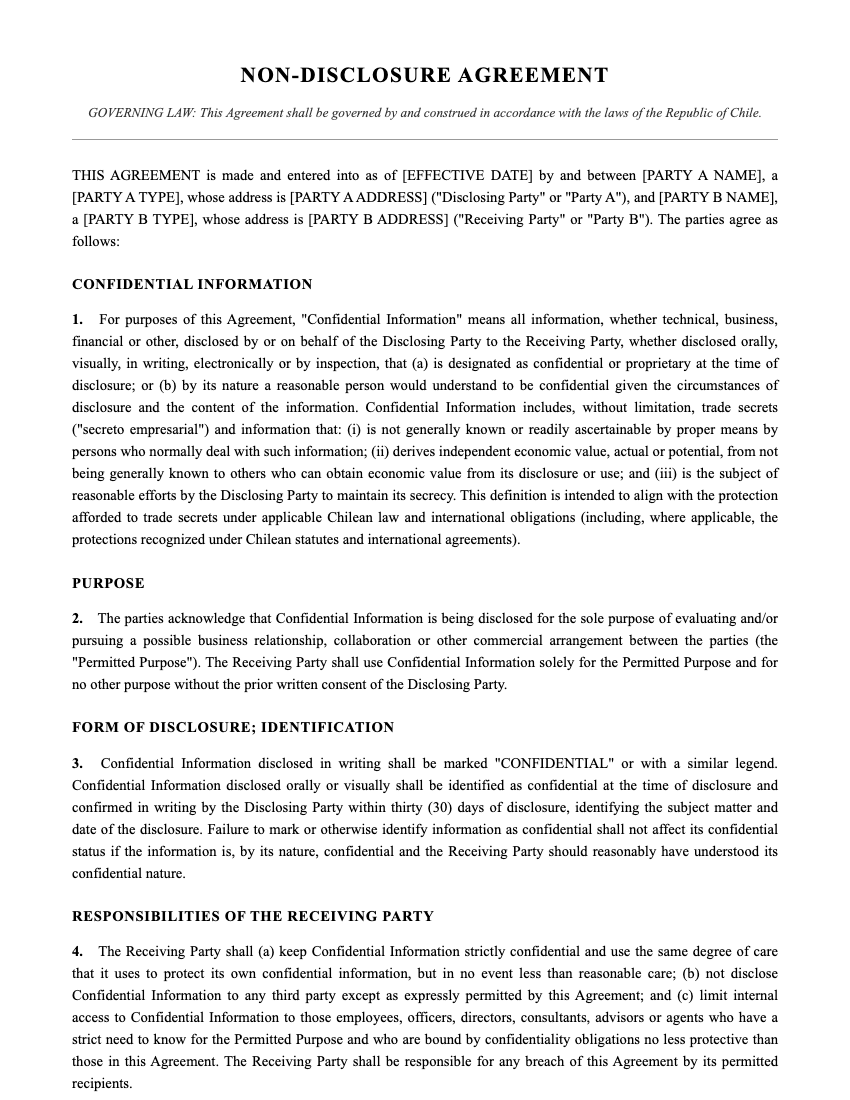
For a complete guide to NDA terms, duration, and standard exclusions, see our NDA Agreement Guide.
Why "Generic" NDAs Are Dangerous in Chile
Using an off-the-shelf NDA drafted for another legal system can create three Chile-specific risks:
- Labor public-order conflict: clauses that restrict an employee’s right to complain to the Dirección del Trabajo, file a lawsuit, or make protected labor disclosures can be declared void as contrary to public policy in employment law. Confidentiality cannot lawfully prevent workers from reporting labor rights violations.
- Personal-data violations: Ley 19.628 places limits on processing and sharing personal data. An NDA that requires transfer or retention of personal data without addressing lawful basis, purpose limitation, or security measures can create administrative liability and evidence problems in court.
- Overbroad post-employment restraints: while Chilean courts can enforce reasonable post-contractual restraints (including non-competes) when supported by consideration and narrow scope, an NDA that functions as a hidden, wide-ranging non-compete may be recharacterized or struck down. Chile’s justice system enforces public-order protections when rights to work are disproportionately affected.
Paradigm-shifting insight: In Chile the real trap is not only “backdoor non-competes” but the intersection of confidentiality with labor public order and data protection. A clause that seems neutral can be unenforceable because it impedes a worker’s statutory right to report to authorities or violates data-subject rights under Ley 19.628 — and that can nullify remedies you planned to rely on.
Recent Legal Development (Practical Note)
Regulatory guidance from the Dirección del Trabajo and administrative practice increasingly emphasize that confidentiality clauses cannot obstruct labor claims or whistleblowing. Employers relying solely on contractual confidentiality without a parallel compliance program and appropriate data-processing safeguards have faced findings in administrative opinions and labor litigation in recent years. That practical trend means NDAs must include express carve-outs for legal reports and align with data-protection obligations.
Key Clauses for a Chile NDA
- Purpose and scope: narrowly define the business purpose (e.g., "evaluating a distribution agreement for Product X in Chile") to avoid vagueness under Código Civil interpretation rules.
- Definitions: distinguish between "Confidential Information" and "Personal Data" (Ley 19.628) and explain handling obligations for each.
- Exclusions: expressly exclude information (a) public through no fault of the recipient, (b) known prior to disclosure, (c) independently developed, and (d) required to be disclosed by law or to authorities (including Dirección del Trabajo, fiscal authorities, or courts).
- Use and limitation: restrict use to the stated purpose; prohibit reverse engineering of technical materials if appropriate and lawful.
- Security measures: require reasonable technical and organizational safeguards compatible with Ley 19.628 principles.
- Duration: set a two-tier duration—fixed term for ordinary confidential business information (commonly 2–5 years) and indefinite protection while a trade secret remains secret; align with Código Civil and the five-year prescripción for ordinary claims.
- Return/destruction: require return or certified destruction of materials on termination.
- Remedies and jurisdiction: specify Chilean law (Código Civil principles) and competent Chilean courts; include liquidated damages carefully—Chilean courts scrutinize penalties (pactos de indemnización) under contract law.
- Whistleblower and legal-report carve-out: explicit permission to make disclosures required by law or to government authorities, including labour authorities and public prosecutors.
Mutual vs. Unilateral Options
The template pack includes:
- One-way (unilateral) NDA — use when only one party discloses (startups, licensors, vendors).
- Mutual (two-way) NDA — use for negotiations, joint ventures, or M&A due diligence where both parties exchange confidential data.
Choose mutual only when both sides truly disclose; otherwise unilateral is cleaner and reduces reciprocal risk.
Who Needs This Document?
- Tech Startups: protect source code and product roadmaps while engaging Chilean investors and vendors.
- Employers & HR: limit misuse of internal procedures while preserving workers’ right to report to Dirección del Trabajo.
- Manufacturers & Importers: control technical drawings and supplier pricing in cross-border supply chains while complying with consumer law (Ley 19.496) when dealing with end-customer data.
- Advisers & Consultants: protect client lists and analyses when engaging with Chilean counterparties.
How to Execute a Valid Chile NDA
- Choose the correct form (One-way or Mutual) and define the precise purpose.
- Confirm personal-data law compliance: identify lawful bases, limit recipients, and document security measures under Ley 19.628.
- Sign and date before exchanging confidential material. Chile recognizes electronic signatures under Ley 19.799 — but retain evidence of the signature and the signing process.
- Mark or label confidential documents and keep an audit trail showing efforts to preserve secrecy; this supports contractual and tort claims if misappropriation occurs.
Receiving an NDA? Know the Red Flags
Don’t sign clauses that broadly bar disclosures to authorities, that allow unlimited monitoring of employees’ private data, or that attempt to convert routine employment termination into forfeiture of claim rights. If a counterparty imposes a clause you cannot accept, negotiate specific carve-outs and limit durations.
an AI contract review tool can instantly flag clauses that conflict with Chilean labor public-order, Ley 19.628 obligations, and standard Código Civil pitfalls—helpful when time is limited.
Related NDA Templates
Get the Template
Sign up for our newsletter to receive the template.
Frequently Asked Questions

About Designer Content
Designer Content creates practical legal document resources for landlords, contractors, and small business owners. We simplify complex legal concepts into actionable guidance. Connect with us on LinkedIn.