
In China, a Master Services Agreement (MSA) is a long-term contract that “sets the framework first, then runs projects,” used to agree once and for all on the basic rules for payment, delivery, liability, confidentiality, intellectual property, and dispute resolution, and then to refine scope and pricing through each project’s Statement of Work (SOW). For SMEs, consultants, and outsourcing teams, the greatest value of an MSA is reducing repeated negotiations, lowering scope creep and collection risk, and writing China-style “hard requirements” such as data compliance, invoicing, and tax coordination into the contract.
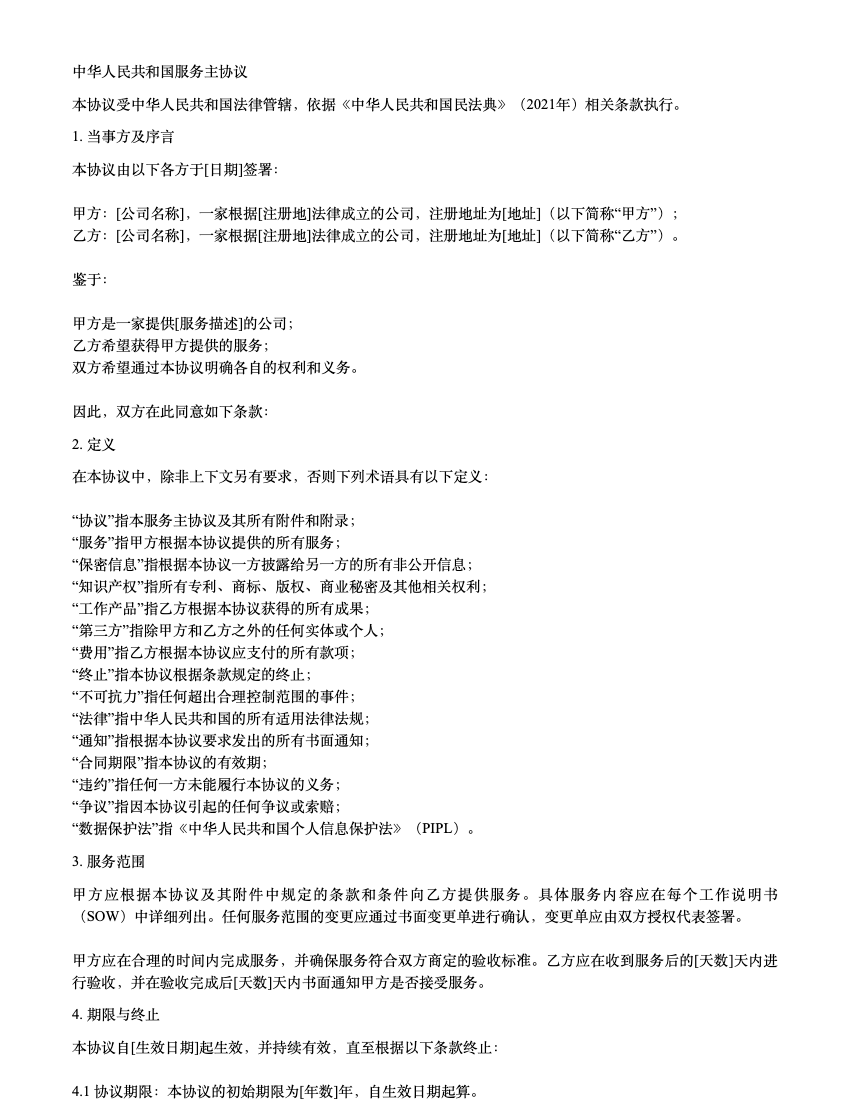
Definition: A China-version MSA refers to a master agreement signed by the service provider and the customer under the legal framework of the People’s Republic of China, used to uniformly stipulate the general terms for multiple future service projects (such as payment and late-payment liability, acceptance and change control, confidentiality and data processing, IP ownership, breach and damages, dispute resolution and governing law). Specific projects are not fixed in the MSA, but are defined through reusable SOWs/orders/appendices that set out deliverables, milestones, fees, and schedules. This both maintains contract stability and enables each project to go live quickly, making audits and reconciliation easier.
Why you can’t directly use a “generic” MSA in China
Many English templates or MSAs from other jurisdictions (e.g., the U.S., the U.K.) default to operating based on “case law + industry practice.” When used in China, three categories of issues often arise: first, unclear labor/employment boundaries, causing outsourcing to be deemed a de facto employment relationship; second, treating non-compete as “self-evident,” ignoring China’s strict prerequisites for non-competes; third, copying “work made for hire” logic in IP and deliverables clauses, which is inconsistent with China’s copyright and service invention/work product rules. More realistically, China projects also often involve practical details such as VAT invoices, cross-border data transfers, personal information processing authorizations, confidentiality classification levels, and acceptance chops/signatures—items that generic templates often lack.
3a. Labor and “de facto employment relationship” risk (Worker Classification Rules)
China does not have an ABC Test like the U.S.; the more common risk point is: you cooperate in the name of a “service contract/outsourcing contract,” but the management method is highly similar to employment, and it may be deemed that a labor relationship exists (commonly called a “de facto employment relationship”). Once deemed an employment relationship, the parties fall under the 《中华人民共和国劳动合同法》 regime, rather than pure B2B contract logic. For example, if the employer fails to sign a written labor contract as required by law, it may trigger liabilities such as paying double wages (《劳动合同法》第82条); termination or ending of the labor relationship may also involve economic compensation (《劳动合同法》第46条、第47条). At the MSA level, the template should clearly specify: the service provider’s personnel management, working time and place arrangements, tools/equipment and cost allocation, personnel replacement mechanisms, deliverable acceptance and payment milestones, etc., to reflect as much as possible a contracting/service relationship “based on deliverables,” rather than an employment relationship “controlled by working hours.” At the same time, it should avoid typical employer management behaviors by the customer toward individuals—such as attendance checks, disciplinary actions, internal position appointments—to reduce labor dispute and social insurance back-payment risks.
For a comprehensive guide to structuring MSAs and SOWs that protect your business, see our Freelancer Contracts Guide.
3b. Whether non-compete clauses are enforceable in China (Non-Compete Enforceability)
China does not comprehensively prohibit non-competes, but the “mandatory applicable scenarios” for non-competes are mainly in the labor law domain: that is, the most typical and most enforceable non-competes come from labor contracts or confidentiality agreements with employees, executives, senior technical personnel, or personnel who have confidentiality obligations. Under Articles 23 and 24 of the Labor Contract Law, an employer may agree on a non-compete with a worker who has confidentiality obligations and must pay monthly economic compensation during the non-compete period; the non-compete term must not exceed two years. If there is no compensation or the subject is not qualified, the enforceability and remedies of the clause will drop significantly.
For a B2B services MSA, many “generic templates” directly include a broad non-compete (e.g., prohibiting the service provider from serving any competitor in China/Asia for two years). In China practice, this often faces two types of problems: first, if the service provider is a company rather than a worker, it is not appropriate to directly apply the 《劳动合同法》 non-compete rules; second, even if written into a civil contract, overly broad restrictions may be considered contrary to fairness principles or beyond what is necessary, making them difficult to obtain support for. A more prudent approach is to use “confidentiality obligations + non-solicitation of customers/employees + purpose-limited data use + deliverables and source code delivery conditions” to replace a pure non-compete, and where restrictions are truly necessary, to narrow the scope (limit business line, limit customer list, limit term and territory, and provide consideration or a fee discount in exchange). At the same time, the contract should clearly set out anti-commercial bribery and compliance clauses to avoid risks under the 《反不正当竞争法》 arising from obtaining business opportunities through improper means.
3c. Intellectual property and “work product ownership” (IP/Work-for-Hire Considerations)
China does not have a universal “work made for hire” button like in common law jurisdictions. Ownership of copyright, patent rights, technical achievements, etc. must be determined in accordance with Chinese law’s categorization rules and by contractual agreement. Generally, the MSA should clarify: whether deliverables (reports, code, designs, documents) are “commissioned works/commissioned development results” or improvements to the service provider’s pre-existing results; whether the customer receives ownership/transfer of economic rights in copyright, an exclusive license, or a non-exclusive license; and the effective time of transfer (typically recommended to be tied to “full payment”). In addition, where personal information or customer data processing is involved, it should be incorporated into the requirements for processors’ obligations under the Personal Information Protection Law (《个人信息保护法》), such as security measures and internal management systems (PIPL第41条、第42条), and the SOW should specify the data types, purpose, term, and deletion/return mechanisms.
What’s Included in This Template
Flexible SOW Structure (Flexible SOW Structure): The MSA handles “uniform rules,” and the SOW handles “project details.” You only need to sign the MSA once; for each subsequent project, use a 1–2 page SOW to define scope, milestones, acceptance criteria, pricing, and invoicing information, reducing the cost of repeatedly amending the contract.
China-Specific Indemnification (China-Specific Indemnification): The template clearly sets out breach liability, damages, liability caps, and exclusions, and avoids “unlimited joint and several” style wording. For late payments, it may refer to 《民法典》第207条 regarding late interest, and clearly specify the calculation method and start date for late interest/liquidated damages.
Dispute Resolution and Venue (Dispute Resolution and Venue): The template provides optional paths for litigation or arbitration, and specifies the application of PRC law and the competent court or seat of the arbitration institution, avoiding problems where “foreign law + offshore arbitration” is disconnected from actual enforceability in China.
Additional clauses (examples) will also be built into the MSA and further detailed in the SOW:
- Waiver of Unknown Rights/Settlement ScopeWith reference to Article 123 of the Civil Code on general rules of rights disposition, to avoid disputes caused by unclear phrasing of "waiving unknown claims" in the Chinese context.
- Personal Information and Data Security: PIPL第41条 (security protection requirements) and 第42条 (processor obligations) are incorporated to specify processing purpose, minimization, access controls, incident notification, and subcontractor management.
- Anti-Bribery and Commercial Conduct Compliance: Combined with the Anti-Unfair Competition Law's regulation of commercial bribery and other unfair competition, stipulating termination for breach, remedies, and cooperation with audits.
Who Needs This Document? (Who Needs This Document?)
| User Type | Relationship | Key Benefit |
|---|---|---|
| Consulting consultants/training instructors | Long-term consulting or project-based delivery | Lock scope and acceptance through SOWs, reducing “last-minute extra work” |
| Software outsourcing/development teams | Iterative development, milestone payments | Tie source code/deliverables to payment, clarify IP transfer or licensing |
| Marketing/design agencies | Multiple Campaigns/long-term managed services | Standardize pricing and change process, reduce collection and materials licensing disputes |
| Cross-border service providers (providing services to Chinese customers) | Remote delivery + data access | Clearly specify governing law, data processing, and dispute resolution path in the MSA |
How to Use This MSA Template (How to Use This MSA Template)
Step 1: Accurately fill in the parties’ information
Specify both parties’ legal names, Unified Social Credit Code (if applicable), addresses, and contacts. In China practice, inconsistent party information can affect invoicing, payment, and service of process.
Step 2: Choose the term and renewal mechanism
Determine whether the agreement is for a fixed term or auto-renewing, and set a prior notice period. If long-term on-site staffing or ongoing services are involved, it is recommended to clearly specify post-termination data return, delivery, and settlement.
Step 3: Create an SOW for the first project
Put scope, deliverables, acceptance criteria, schedule, fees, invoicing information (tax-inclusive/tax-exclusive), and payment milestones in the SOW. Any oral new requirements should be confirmed via a written change order.
Step 4: Signature and chop / e-signature
Common practice in China transactions is “signature + company chop” or a reliable e-signature. Ensure the signatory is authorized (legal representative, authorized representative), and retain SOW versions and email/system records for audit purposes.
Already receiving an MSA sent by a customer?
Often you are not the party “issuing the contract,” but are required to sign the customer’s MSA directly. In that case, focus on reviewing: whether PRC governing law and dispute resolution are enforceable, whether liability is unilaterally expanded without limit, whether payment and acceptance are customer-favorable, and whether there are overly broad non-competes or unreasonable IP transfer clauses embedded. Also check whether it includes data processing and confidentiality requirements, and whether they can match your internal processes.
If you want to identify risk points faster, you can use an AI contract review tool to scan the customer contract’s clauses: quickly highlight key clauses such as late payment, liability caps, IP ownership, data compliance, and post-termination obligations, and then decide which items must be negotiated.
Download Options (Download Options)
Free PDF version: Suitable for internal review first and discussing the clause structure with partners. The PDF version is convenient for printing, stamping, and archiving.
Editable Word/Docs version: Suitable for directly adapting into your company’s standard clause library, quickly generating versions for different customers and different SOWs, and preserving revision marks for negotiation.
This article and template are for general information and business reference only and do not constitute legal advice. For specific projects, please consult a PRC-licensed lawyer in light of the transaction structure and local requirements.
Related MSA Templates
Get the Template
Sign up for our newsletter to receive the template.
Frequently Asked Questions

About Designer Content
Designer Content creates practical legal document resources for landlords, contractors, and small business owners. We simplify complex legal concepts into actionable guidance. Connect with us on LinkedIn.