
A China Non-Disclosure Agreement (NDA) is a contract that protects confidential business information and trade secrets under PRC law while complying with China’s specific rules about employment restraints, trade secret remedies, and personal data protection.
What is a China NDA?
Definition: Under PRC law, an NDA is a written agreement that imposes confidentiality obligations and limited-use restrictions on a receiving party to protect "trade secrets" and other confidential information. Trade secret protection is primarily governed by the Anti-Unfair Competition Law of the People's Republic of China and related judicial practice; employment-related restraints are governed by the Labor Contract Law Articles 23–24; personal data handling is constrained by the Personal Information Protection Law (PIPL).
An enforceable NDA in China must respect the civil-law formalities (usually written form) and cannot ignore statutory protections that favor employees or personal data subjects. Most importantly for cross-border users: China permits post-employment restraints only in a narrow set of circumstances and requires compensation for the restraint period.
For a complete guide to NDA terms, duration, and standard exclusions, see our NDA Agreement Guide.
Why generic (foreign) NDAs are dangerous in China
Templates copied from U.S. or EU sources often miss three China-specific traps:
- Non-compete eligibility and mandatory compensation. Under Labor Contract Law Articles 23–24, a post‑employment non-compete may only be imposed on senior management, senior technicians, or other personnel who have confidentiality obligations. The restraint period cannot exceed two years, and the employer must pay reasonable compensation during the restraint period. Absent proper written agreement and compensation, a Chinese court will likely refuse to enforce the restraint.
- Trade secret vs general confidential information. China’s Anti-Unfair Competition Law (amended 2019) tightly defines trade secrets and provides civil remedies (injunctions, damages, confiscation of illegal gains). Calling everything a "trade secret" in an NDA without reasonable secrecy measures (labelling, access control, internal policies) weakens enforcement and may hamper evidence in court.
- Personal data (PIPL) compliance. If the NDA covers personal information (employee lists, customer contact details), it must align with PIPL obligations—lawful basis for processing, purpose limitation, cross-border transfer rules, and data subject rights. A data‑blind NDA can expose both parties to regulatory risk.
Paradigm-shifting insight: in China, the enforceability of a restraint often turns more on statutory compensation and employee category than on the breadth of restrictive language. That means a carefully drafted, modestly scoped non-compete with clear monthly compensation is far more enforceable than an expansive, unpaid restriction. In other words, pay to play—without the statutory compensation and formalities, a non-compete is likely void or unenforceable.
Recent legal developments (real-world context)
- The Anti-Unfair Competition Law was substantially amended and strengthened in 2019 (effective date varied by provision), expanding remedies for trade secret misappropriation and clarifying evidentiary presumptions for damages.
- The Personal Information Protection Law (PIPL) took effect on November 1, 2021, imposing strict obligations for handling personal data that commonly appears in NDAs (e.g., customer lists, HR data).
These statutory changes mean Chinese courts and regulators now have clearer statutory tools to protect trade secrets and personal data—so NDAs must be drafted with both laws in mind.
Key clauses in a China NDA (what this template includes)
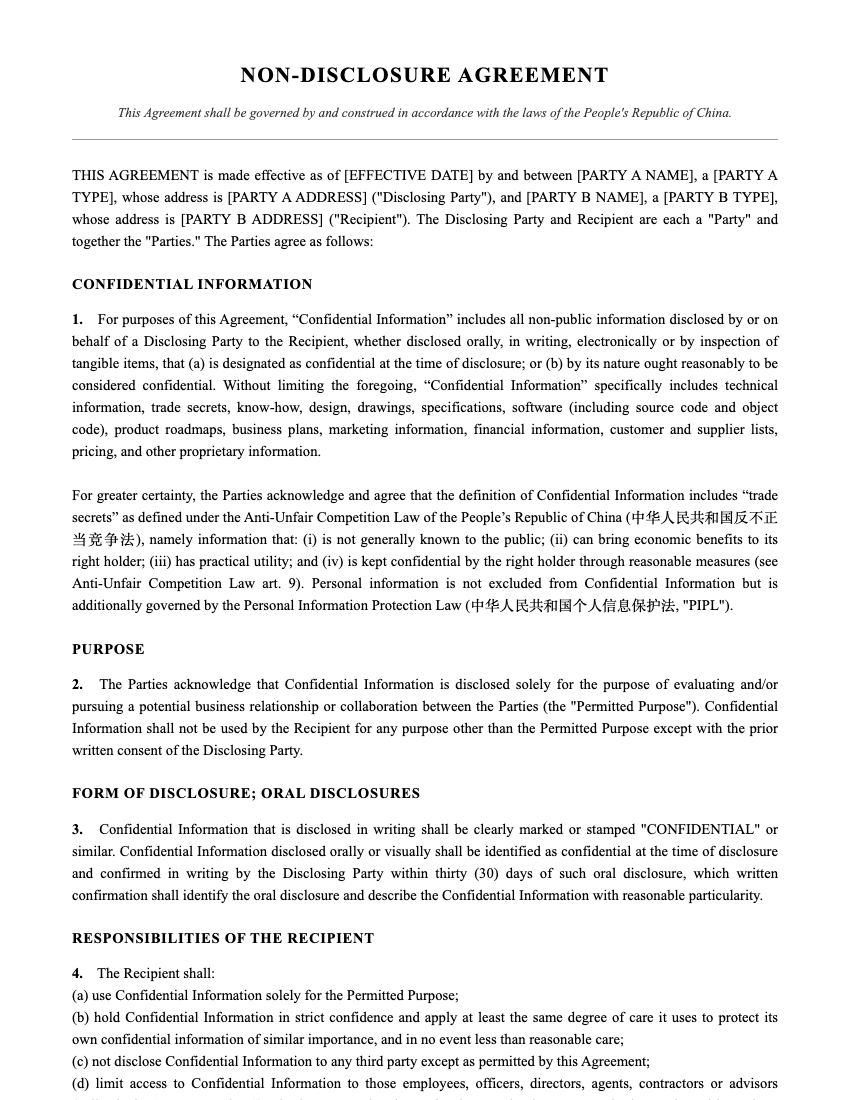
- Purpose and scope: narrowly worded business purpose and defined categories of Confidential Information (trade secrets, technical data, business information, personally identifiable information).
- Trade secret carve and preservation steps: required secrecy measures (marking, access controls, employee training) that support a later trade secret claim under the Anti-Unfair Competition Law.
- Employment restraints: a carefully drafted post‑termination restriction clause limited to eligible personnel (per Labor Contract Law Articles 23–24), with a maximum 24‑month duration and explicit monthly compensation mechanism (amount or formula).
- Compensation mechanism: language requiring monthly payments during the restraint period and remedies for missed payments (e.g., suspension of enforcement until paid), reflecting Chinese judicial practice.
- Data protection (PIPL) clause: allocation of responsibilities for lawful processing, retention limits, security measures, and cross-border transfer obligations where applicable.
- Permitted disclosures: legal compulsion, whistleblowing to authorities, and advice from counsel; include a limited notice requirement to the disclosing party to allow protective steps.
- Remedies and jurisdiction: injunctive relief and civil damages; specify Chinese courts/PRC law if appropriate for enforceability in China.
Who needs this document?
| User Persona | Usage Scenario | Key Benefit |
|---|---|---|
| Chinese tech startup | Hiring R&D staff and sharing source code with contractors | Protects technical know-how while limiting restraints to eligible staff and providing required compensation |
| Foreign investor | Due diligence on a Chinese target | Allows safe information exchange while aligning with PIPL and Chinese trade secret standards |
| Manufacturer | Sending prototypes to a factory in China | Ensures factory obligations on confidentiality and trade secret protection are enforceable locally |
| HR teams | Drafting employee confidentiality and limited non-compete addendums | Aligns employment clauses with Labor Contract Law and compensation rules |
How to execute a valid China NDA (practical steps)
- Choose the right type: one-way for unilateral disclosure; mutual when both parties exchange confidential information.
- Identify eligible employees if you need a post‑employment restraint and set compensation: only senior management, senior technicians, or others with confidentiality duties qualify; specify the monthly payment and the 24‑month cap.
- Mark and secure documents: label files "CONFIDENTIAL/Trade Secret," implement access controls, and retain evidence of secrecy measures to prove trade secret status later.
- Sign and preserve: get a written signed agreement (paper or electronic under PRC Electronic Signature Law). If enforcing a non-compete, ensure the agreement and compensation records are clear and stored.
an AI contract review tool can instantly flag China-specific risks—missing compensation language for non‑competes, PIPL compliance gaps, or weak trade‑secret safeguards—helping you fix issues before signing.
Related NDA Templates
Get the Template
Sign up for our newsletter to receive the template.
Frequently Asked Questions

About Designer Content
Designer Content creates practical legal document resources for landlords, contractors, and small business owners. We simplify complex legal concepts into actionable guidance. Connect with us on LinkedIn.