
A Master Services Agreement (MSA) in Colombia is a B2B “framework” contract that sets the legal, commercial, and operational rules for multiple future projects between a service provider and a client, allowing each specific job to be detailed in a Service Order or Statement of Work (SOW). Instead of renegotiating price, payments, intellectual property, and responsibilities for every assignment, you sign the MSA once and then attach short SOWs for each project. For SMEs, agencies, and consultants, this reduces friction, speeds up approvals, and avoids “scope creep” with clear rules from the outset.
Definition: A Colombian MSA is a master civil or commercial agreement that establishes permanent terms (payments, acceptance of deliverables, confidentiality, personal data, intellectual property, liability and indemnities) applicable to all services the Provider will render to the Client. Each project is made concrete through an SOW that defines scope, deliverables, timeline, fee, and acceptance criteria. The MSA functions as an “umbrella” contract: if there is a conflict between the MSA and the SOW, the document should indicate which prevails. In Colombia, a good MSA should align with the Civil Code (e.g., fault and due diligence in art. 1604), the Commercial Code (late interest in art. 884) and Law 1581 of 2012 for personal data processing.
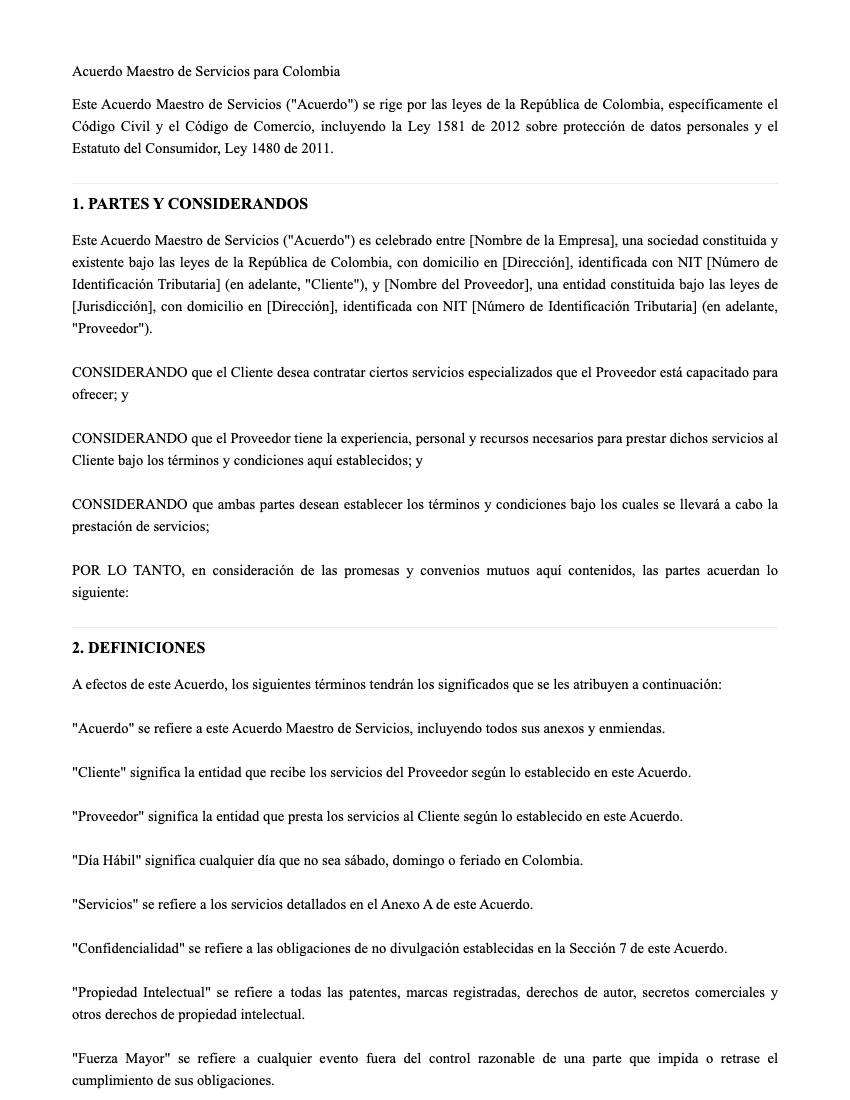
Why You Cannot Use a Generic MSA in Colombia
Using a generic template “for LATAM” or “for any country” tends to miss points that matter in Colombia in a dispute: (i) how to prove that the relationship is services and not employment; (ii) whether a non-compete clause is valid or collapses; (iii) how copyright rights are transferred and what happens with software, designs, or content; (iv) how late payment interest is calculated and what liability limits are defensible; and (v) how to comply with data protection. In a dispute, contract text is read in light of local norms and judicial practice; therefore, a well-grounded MSA tailored to Colombia reduces the risk of partial nullities, wage/benefit claims, and disputes over IP ownership.
3a. Worker Classification Rules
In Colombia, the principal risk is not an “ABC test” as in some US states, but the distinction between an employment contract and a service-for-hire contract. The key criterion is subordination: if in practice the Client imposes permanent orders, hours, disciplinary control, or functional integration as if the person were an employee, a judge may declare that an employment contract existed even if the document says “services.” This distinction is in the Código Sustantivo del Trabajo (CST), artículo 23, which defines the elements of an employment contract (personal activity, remuneration, and subordination). Additionally, article 24 of the CST enshrines a presumption in favor of the existence of an employment contract when personal service is provided.
For a comprehensive guide to structuring MSAs and SOWs that protect your business, see our Freelancer Contracts Guide.
What does this mean for an MSA? A generic template sometimes includes contradictory clauses (e.g., “the Client may set hours” or “will follow internal policies as an employee”) that increase risk. A Colombian MSA should reinforce that the Provider acts with technical and administrative autonomy, defines its method, can provide services to third parties, and bears its burdens (without prejudice to what actually happens in operation). If there is reclassification, the Client could face claims for wages, social benefits, and contributions to the social security system, in addition to administrative penalties in labor inspections. Therefore, align the contract and daily operation: deliverables by results, not by hours controlled; milestone-based communication; and absence of a disciplinary command structure.
3b. Non-Compete Enforceability
In Colombia, non-compete clauses are analyzed with scrutiny, especially when they affect the freedom to work. In labor relationships, the traditional rule is restrictive: the CST, article 44 contemplates prohibition/limitation of competition for the worker during the term of the contract in certain circumstances, but broad post-contractual covenants are problematic if they are not reasonable or if they amount to preventing work. In the B2B world (independent provider/company), there is more room for non-compete covenants, but they must also be proportional: bounded in time, territory, and activity, and justified by a legitimate interest (e.g., protection of know-how or client portfolio).
A generic template often copies a 24–36 month “global” and for “any activity” non-compete, which increases the risk of being deemed abusive or hard to enforce. In Colombia, a more robust alternative is usually to replace (or complement) with: (i) strong confidentiality and protection of trade secrets; (ii) non-solicitation of employees and clients for a reasonable period; (iii) clear intellectual property clauses; and (iv) proportionate contractual remedies. If you still need a non-compete, define: the specific market, the types of services prohibited, the short term (e.g., 6–12 months) and the territory where they actually compete. For individual contractors who operate similarly to employees, aggressive non-compete provisions can increase the risk that the relationship is viewed as disguised employment.
3c. IP/Work-for-Hire Considerations
In Colombia, the “work made for hire” concept in the American sense does not fit the same. The practical rule is to expressly and in writing provide for assignment or license of copyright rights, specifying scope, modalities, and territory. If the provider creates software, content, designs, or documents, a generic template may leave ownership ambiguous (“everything is the Client’s” without formalities), generating disputes. A Colombian MSA should include: (i) ownership of the Provider’s pre-existing tools; (ii) assignment/license of paid deliverables; (iii) transfer timing (ideally upon payment); and (iv) authorization to use the Client’s marks or materials. It’s also wise to separate “background IP” vs. “foreground IP” and define whether there are open-source components.
What's Included in This Template
Flexible SOW Structure. The MSA sets constant terms and each SOW defines the project: scope, deliverables, dates, fees, acceptance criteria, and assumptions. This allows you to manage monthly retainers, milestone-based projects, or hourly bundles without rewriting the entire contract. The SOW governs the specifics.
Colombia-Specific Indemnification. Indemnity and liability should reflect Colombian standards of fault and due care. The Código Civil, art. 1604 guides fault attribution and the standard of care according to the type of obligation. The template includes reasonable limits, exclusions for lost profits where applicable, and carve-outs for willful misconduct.
Dispute Resolution and Venue. The template provides arbitration in Bogotá, Colombia as a dispute-resolution mechanism for technical or monetary disputes, avoiding lengthy litigation. It also sets Colombian law and notice rules. Important: the “jury trial waiver” is irrelevant in Colombia (there is no civil jury), but it may be included as clarification for international contracts.
Additionally, includes:
- Late interest for overdue payments: Código de Comercio, art. 884 (late interest rate and commercial rules).
- Personal data protection: duties of the data controller/processor under Law 1581 of 2012, arts. 17 and 18 (measures, handling inquiries and claims, data processing policy).
- Consumer clause: notice that this is a B2B contract; if there are consumers, the applicable law would be Law 1480 of 2011 (Consumer Statute).
Who Needs This Document?
| User Type | Relationship | Key Benefit |
|---|---|---|
| Marketing agency | Recurring projects + campaigns | Quick SOWs and change control to avoid “scope creep” |
| Business consultant | Monthly advisory (retainer) | Clear payments, deliverables, and confidentiality without renegotiating every month |
| Software studio | Milestone-based development | Intellectual property and acceptance by stages, with payment on deliverables |
| IT/support provider | Ongoing services | SLA in the SOW and liability limits aligned to risk |
How to Use This MSA Template
Step 1: Identify the parties
Include the legal name, tax ID (NIT), address, and legal representative (if applicable). In Colombia, these details reduce disputes over who is responsible for invoicing, taxes, and notices.
Step 2: Define the term and termination
Choose a fixed term (e.g., 12 months) or indefinite with notice. Clarify termination for breach and what happens to outstanding payments, materials, and return of information.
Step 3: Attach your first SOW
Describe scope, deliverables, schedule, price, acceptance criteria, and assumptions. If services are subject to changes, define a change-control process with additional fees.
Step 4: Sign and operate under the contract
Sign (paper or electronic) and align daily operation: milestone-based communication, provider autonomy, and invoicing per the agreement. What you do in practice weighs as much as what the document says.
Related MSA Templates
Get the Template
Sign up for our newsletter to receive the template.
Frequently Asked Questions

About Designer Content
Designer Content creates practical legal document resources for landlords, contractors, and small business owners. We simplify complex legal concepts into actionable guidance. Connect with us on LinkedIn.