
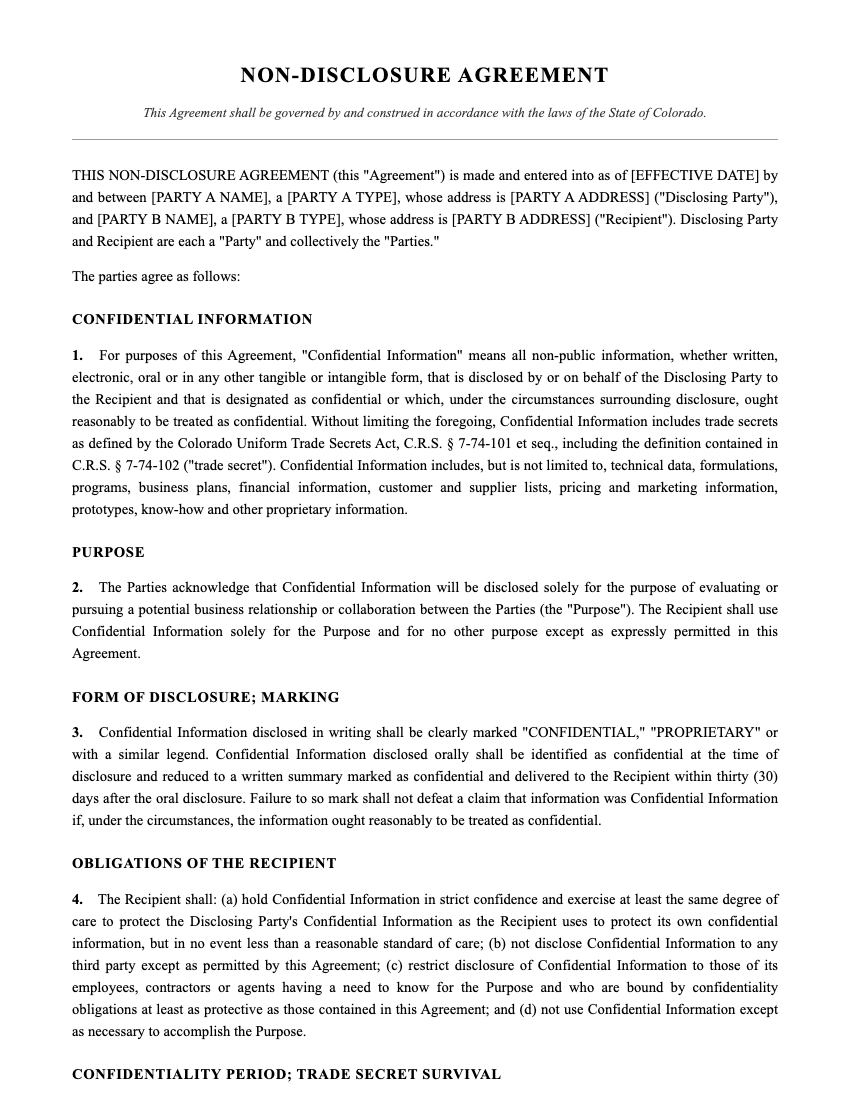
A Colorado Non-Disclosure Agreement (NDA) is a contract designed to protect confidential business information and trade secrets while complying with Colorado's recently strengthened limits on post-employment restraints. This template is tuned to Colorado statutory law—especially C.R.S. § 8-2-113 (non-compete restrictions) and the Colorado Uniform Trade Secrets Act (CUTSA), C.R.S. § 7-74-101 et seq.—and includes the DTSA whistleblower notice (18 U.S.C. § 1833(b)) that preserves federal remedies.
What is a Colorado NDA?
Definition: A Colorado Non-Disclosure Agreement is a written contract that obligates a receiving party to keep confidential certain information disclosed by a disclosing party. In Colorado, NDAs must be drafted so they protect legitimately protectable interests—like trade secrets under CUTSA (C.R.S. § 7-74-101)—without operating as an unlawful restrictive covenant under C.R.S. § 8-2-113.
Colorado law preserves contractual freedom but draws clear lines around post‑employment restraints. Non‑compete clauses are generally unenforceable except in narrow categories: (1) agreements for the sale of a business, (2) agreements entered into as a condition of ownership or dissolution, and (3) narrowly tailored protections for executive or management personnel or for the protection of trade secrets permitted by statute. See C.R.S. § 8-2-113.
For a complete guide to NDA terms, duration, and standard exclusions, see our NDA Agreement Guide.
Why “Generic” NDAs are dangerous in Colorado
Many online NDA templates assume broad enforceability of restrictive language. In Colorado, that approach creates three risks:
- Backdoor non-competes: Broad prohibitions on “using confidential information to compete” or blanket restrictions on employment activities can be treated as disguised non‑competes and rendered unenforceable under C.R.S. § 8-2-113.
- Lost federal remedies: If your NDA doesn’t include the DTSA whistleblower immunity notice (18 U.S.C. § 1833(b)), you may be unable to recover enhanced damages or attorneys’ fees in a federal trade secret action.
- Overbroad trade secret labels: Calling everything a “trade secret” without meeting CUTSA’s elements (see C.R.S. § 7-74-102) risks courts refusing injunctive relief or damages for any of the information.
Paradigm-shifting insight: Colorado’s unique trap is that an NDA can be invalidated not only for an explicit covenant not to compete but also for any confidentiality language whose practical effect is to prevent someone from using general skills, clients, or routine knowledge—especially when targeted at non-executive employees. In short: overbroad confidentiality = potential ban under C.R.S. § 8-2-113.
Recent legal development (real-world context)
Colorado codified modern limits on non-competes in C.R.S. § 8-2-113, enacted and clarified in recent legislative cycles, reflecting a national trend to limit worker restraints. Businesses and practitioners in Colorado have rapidly adjusted NDAs to emphasize trade secret protection and narrow, time-limited confidentiality obligations rather than sweeping restrictions on future employment (see sources below).
Key clauses in this Colorado NDA template
- Purpose clause: Limits the permitted use of information to a specific evaluation or transaction; avoids open-ended “business discussions.”
- Narrow confidentiality definition: Differentiates “Confidential Information” (time-limited protection) and “Trade Secrets” (protected indefinitely while still secret), following CUTSA (C.R.S. § 7-74-101 et seq.).
- Permitted disclosures & whistleblower carve-out: Includes the DTSA whistleblower immunity notice (18 U.S.C. § 1833(b)) so federal remedies remain available.
- No backdoor non-compete language: Removes or narrows wording that could be read as restricting employment, solicitation, or “use of general skills.” Instead, the template prohibits the misuse or disclosure of identified trade secrets.
- Residuals clause (optional): Allows for unaided memory use of general skills/ideas while protecting against misappropriation of trade secrets.
- Carve-outs: Standard exceptions for information already public, independently developed, or lawfully obtained from a third party, and for disclosures compelled by law (with notice to the disclosing party).
- Remedies and statute of limitations: States remedies available under CUTSA and reminds users of Colorado’s contract limitations (see C.R.S. § 13-80-101 for actions on written contracts) where applicable.
Who needs this document?
| User Persona | Scenario | Why this Colorado Template Helps |
|---|---|---|
| Startups (Denver/Boulder) | Pitching investors or hiring contractors | Protects pitch decks and prototypes without unlawful restraints on future hires |
| Software companies | Engaging freelance developers | Protects source code as trade secrets while allowing developers to continue their careers |
| Small businesses | M&A due diligence or buyer conversations | Enables safe document sharing without creating a non‑compete risk |
| Manufacturers | Disclosing designs to vendors | Limits misuse and includes DTSA notice to preserve federal relief |
How to execute a valid Colorado NDA
Step 1: Choose the right form. Use One‑Way (unilateral) when only you disclose; use Mutual only when both parties truly exchange confidential information.
Step 2: Precisely define the Purpose. Narrow, concrete purpose language limits allowable uses and avoids broad “work restrictions.”
Step 3: Mark and protect documents. Label materials “CONFIDENTIAL,” keep access limited, and use basic security measures—these help satisfy CUTSA’s “reasonable efforts” element (C.R.S. § 7-74-102).
Step 4: Sign before sharing. Use an enforceable signature method recognized by federal E‑SIGN (15 U.S.C. § 7001) and Colorado's electronic transaction laws to ensure admissibility.
Cross-sell: If you’re receiving NDAs from others, use an AI contract review tool to flag Colorado-specific red flags—disguised non‑compete language, missing DTSA notice, overly broad definitions—so you can negotiate safer terms quickly.
Related NDA Templates
Get the Template
Sign up for our newsletter to receive the template.
Frequently Asked Questions

About Designer Content
Designer Content creates practical legal document resources for landlords, contractors, and small business owners. We simplify complex legal concepts into actionable guidance. Connect with us on LinkedIn.