
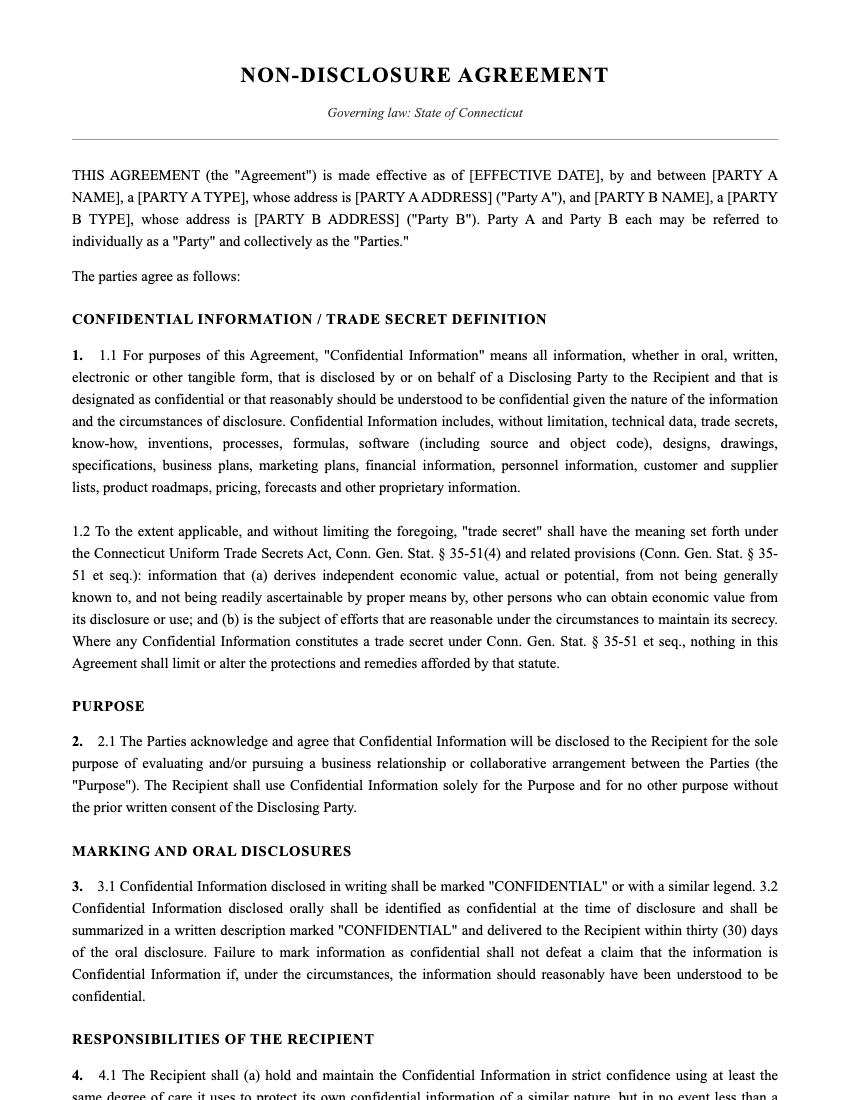
A Connecticut Non-Disclosure Agreement (NDA) is a written contract that controls how proprietary information and trade secrets are shared and used between parties. Because Connecticut applies traditional contract principles plus a reasonableness test to restraints, a well-drafted NDA must balance strong secrecy protections with enforceability under state law.
What is a Connecticut NDA?
Definition: A Connecticut NDA is a contractual promise, enforceable under Connecticut common law and statutory law, that a receiving party will keep specified information confidential and use it only for a defined business purpose. Trade secret protections in Connecticut overlap with the federal Defend Trade Secrets Act (DTSA) and state unfair trade practices law (CUTPA, Conn. Gen. Stat. § 42-110a et seq.). The statute of limitations for written contract claims (including many NDA breach claims) is six years under Conn. Gen. Stat. § 52-576.
Connecticut does not bar non-compete clauses outright. Instead, courts evaluate restraints for reasonableness in scope, duration, and geographic reach and examine whether the restraint protects a legitimate business interest.
For a complete guide to NDA terms, duration, and standard exclusions, see our NDA Agreement Guide.
Why "Generic" NDAs Are Dangerous in Connecticut
Many off-the-shelf NDA forms are drafted for jurisdictions that either have different non-compete rules or a different public-policy balance. Using a generic template in Connecticut creates three common risks:
- Overbroad use restrictions that a Connecticut court may treat as an unenforceable restrictive covenant and either refuse to enforce the restraint or refuse to reform it.
- Missing DTSA whistleblower notice language (18 U.S.C. § 1833(b)), which limits remedies in federal trade-secret litigation if absent.
- Clauses that attempt to silence reports of unlawful conduct—these can trigger CUTPA claims or be found against public policy.
Paradigm-shifting insight for Connecticut: because the state enforces reasonable restraints, the principal drafting trap is not a flat ban on covenants, but mislabeling or overreaching confidentiality language so it functions as a disguised non-compete. Connecticut courts will examine the NDA’s actual effect: a blanket prohibition on “using Confidential Information to compete” or an unlimited-scope prohibition on “soliciting customers” can convert your NDA into a disfavored restraint. That conversion exposes the employer to unenforceability and potential CUTPA scrutiny if the clause is used to conceal harmful or deceptive business conduct.
Real case study / development
Connecticut practitioners increasingly emphasize the need for narrowly tailored NDAs. For example, leading Connecticut firm client alerts and court decisions across New England show judges enforcing covenants that are limited and supported by legitimate business interests, while rejecting those that broadly curtail an employee’s ability to earn a living. The practical takeaway from Connecticut authority: focus on protectable interests (trade secrets, customer lists developed by the employer, confidential processes) and make the restrictions no broader than necessary.
Key Clauses This Connecticut NDA Includes
- Definition of Confidential Information: distinguishes between transient business info (time-limited, e.g., 2–5 years) and true trade secrets (protected indefinitely while secret; DTSA and state law apply).
- Use Limitation / Purpose Clause: narrowly limits use to evaluating a transaction or performing contracted services. This helps prevent the NDA from being read as a restraint on employment.
- Non-solicitation vs. Confidentiality: separate clauses for non-solicitation or non-compete (if used). If you include a restrictive covenant, the template frames it to survive Connecticut’s reasonableness test: limited duration, geographic scope tied to where the business actually operates, and a narrow activity scope.
- Residuals clause (optional): permits use of unaided memory concepts while protecting specific trade secrets—framed to reduce disputes over overbreadth.
- DTSA whistleblower notice: includes the federal notice required by 18 U.S.C. § 1833(b) so you preserve the ability to recover enhanced damages in a federal trade-secret claim.
- Exclusions and mandatory carve-outs: information already public, independently developed, or disclosed under legal compulsion; plus a compliance carve for government reporting.
- Remedies and limitations: injunctive relief, damages, and preservation of statute of limitations (note: six-year period under Conn. Gen. Stat. § 52-576 for written contract claims).
Who Needs This Document?
| User Persona | Usage Scenario | Why a Connecticut-specific NDA Helps |
|---|---|---|
| Small Connecticut tech startup | Pitching to local investors | Protects product specs while keeping covenants narrow so courts don’t treat the NDA as a non-compete |
| Manufacturers in CT | Sharing tooling drawings with vendors | Preserves trade-secret protection indefinitely while documenting reasonable secrecy efforts |
| Businesses doing M&A | Due diligence with a Connecticut buyer | Limits use to evaluation and prevents misuse of confidential data post-deal |
| Employers | Hiring sales staff or executives | Offers tailored non-solicit language and trade-secret protection designed to meet Connecticut’s reasonableness review |
How to Execute a Valid Connecticut NDA
Step 1: Choose One-Way vs. Mutual — Pick based on who discloses. Mutual agreements are suitable for joint projects; unilateral NDAs for pitch decks and vendor disclosures.
Step 2: Be Specific About Purpose — Narrow purpose clauses reduce the risk that a court will interpret the NDA as a broader employment restraint.
Step 3: Mark and Protect Your Documents — Label files “CONFIDENTIAL,” control access, and log disclosures. Connecticut (and federal) trade-secret protection depends on reasonable secrecy measures.
Step 4: Sign Before You Share — Get signatures (wet or electronic); document the date and parties involved. Remember the six-year limitations period in Conn. Gen. Stat. § 52-576 for written-contract claims.
If someone sends you an NDA, review it for disguised restrictive covenants or clauses that attempt to prevent reporting illegal conduct. Use the DTSA notice language if you expect federal trade-secret litigation, and watch for CUTPA exposure if the NDA could be used to conceal unfair or deceptive practices.
an AI contract review tool: Want a faster review? an AI contract review tool flags Connecticut-specific risks—overbroad use restrictions, disguised non-competes, missing DTSA notice, and potential CUTPA exposure—so you can negotiate with confidence.
Related NDA Templates
Get the Template
Sign up for our newsletter to receive the template.
Frequently Asked Questions

About Designer Content
Designer Content creates practical legal document resources for landlords, contractors, and small business owners. We simplify complex legal concepts into actionable guidance. Connect with us on LinkedIn.