
What Is a Delaware NDA?
A Delaware Non-Disclosure Agreement (NDA) is a contract that protects trade secrets and other confidential information under Delaware law and federal statutes. Delaware is a freedom-of-contract jurisdiction—its courts (especially the Court of Chancery) will enforce reasonable confidentiality and restrictive covenants, and will fashion equitable relief (including injunctions) when trade secrets are at stake.
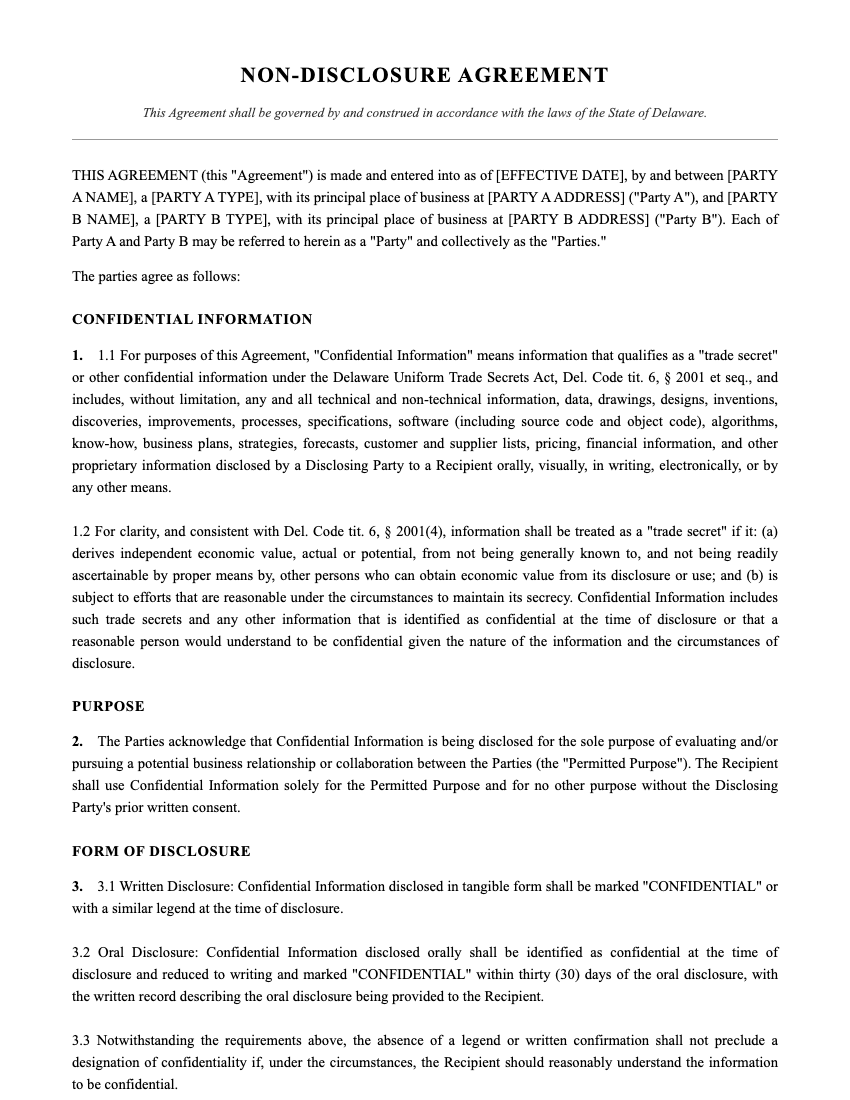
Delaware’s trade-secret law is codified in the Delaware Code (Title 6), which implements the Uniform Trade Secrets Act framework and aligns with the federal Defend Trade Secrets Act (DTSA). Contract claims in Delaware are also governed by state statutory limitations (three years for many contract-based actions), so timing matters.
Why "Generic" NDAs Are Dangerous in Delaware
Using a one-size-fits-all NDA drafted for another state risks three Delaware-specific problems:
- Overbroad restraints that invite judicial rewriting. Delaware courts enforce reasonable covenants; but overbroad language can be severed, narrowed, or rejected—leading to unpredictability and potential loss of injunctive relief.
For a complete guide to NDA terms, duration, and standard exclusions, see our NDA Agreement Guide.
2. Failure to include DTSA notice and Delaware trade-secret-specific definitions. Without a compliant DTSA notice (see 18 U.S.C. § 1833(b)) a plaintiff may be limited in recovering enhanced damages and attorneys’ fees in federal trade-secret litigation.
3. Timing and procedural missteps. Delaware’s Court of Chancery is an equity forum that favors early injunctive relief; delayed enforcement or failure to document secrecy efforts can doom an application for quick relief.
Paradigm-shifting insight: Delaware’s combination of contractarian judicial philosophy and a powerful equity court means NDAs are most valuable when narrowly tailored and backed by demonstrable secrecy procedures. Unlike in jurisdictions that nullify restraints as a matter of policy, Delaware rewards precision: a targeted NDA supported by evidence of confidentiality and prompt equitable remedies often yields injunctive relief (not merely money damages).
A Real-World Development
Delaware’s courts repeatedly emphasize the availability of equitable remedies for misappropriation of trade secrets. Practitioners routinely bring preliminary injunction or temporary restraining order applications in the Court of Chancery to stop an employee from using confidential information at a competitor—an approach that has driven businesses to tighten NDA drafting and evidence of secrecy (document labeling, limited access, and contemporaneous secrecy policies).
(See Court of Chancery procedural guidance at the Delaware Courts website listed in Sources.)
Key Clauses — What This Template Includes
- Purpose & Scope: Narrowly describe the business purpose and the categories of Confidential Information (e.g., source code, customer lists, pricing models). Limiting use to an expressly defined purpose strengthens enforceability.
- Trade Secret Definition: Conforms to Delaware’s statutory framework and DTSA (federal) standards: information that derives independent economic value from secrecy and is subject to reasonable efforts to maintain secrecy.
- Term & Survival: Two-tier protection — (1) non-trade-secret confidential information (typical 2–5 year period), (2) trade secrets (protected so long as secrecy is maintained). This mirrors how Delaware courts balance reasonableness with the parties’ expectations.
- Non-Compete/Non-Solicit Carve-Outs: Because Delaware enforces reasonable restrictive covenants, this template avoids unnecessary or overly broad non-compete language in the NDA itself. If a separate, narrowly tailored non-compete is required, it should be a standalone agreement with adequate consideration, geographic/time limits, and specificity.
- DTSA Whistleblower Notice: Includes the 18 U.S.C. § 1833(b) safe-harbor language that preserves eligibility for enhanced DTSA remedies.
- Remedies & Equitable Relief: Gives the disclosing party the right to seek injunctive relief in the Delaware Court of Chancery and preserves damages and attorneys’ fees to the extent allowed by law.
- Carve-Outs: Standard exclusions for public information, prior knowledge, independently developed information, and compelled disclosure under law.
- Choice of Forum & Governing Law: Delaware law and exclusive forum selection for disputes (consistent with Delaware’s corporate-law ecosystem), which matters for business entities incorporated in Delaware.
Who Needs This Document?
- Corporate Boards & General Counsel: For M&A due diligence and vendor access to confidential data.
- Delaware Corporations & Startups: Especially those incorporated in Delaware where the Court of Chancery is the likely forum.
- Tech Companies & Biotech: To protect source code, formulas, and clinical data where swift injunctive relief may be needed.
- Service Providers & Consultants: For contractor engagements—use a unilateral NDA when only one side discloses.
How to Execute a Valid Delaware NDA
Step 1: Pick the right form—Unilateral (one-way) if only you disclose; Mutual if both sides exchange information.
Step 2: Define the purpose precisely. Example: "Evaluating a potential strategic partnership regarding Disclosing Party's inventory-optimization software module" — narrower purposes enhance enforceability.
Step 3: Demonstrate reasonable secrecy efforts. Label documents, restrict access, use password controls, and maintain a written confidentiality policy. Delaware courts expect concretely demonstrated effort to maintain secrecy.
Step 4: Sign and preserve contemporaneous evidence. Execute before disclosure. If you need equity relief, date-stamped signatures and logs showing limited access make injunctive relief applications more persuasive.
Already Receiving NDAs from Clients?
If someone sends you an NDA governed by Delaware law, watch for overly broad non-compete language, indefinite perpetual confidentiality without justification, or forum-selection clauses that conflict with incorporation documents. an AI contract review tool can flag Delaware-specific red flags, compare clauses to Court of Chancery practice, and recommend edits.
Related NDA Templates
Get the Template
Sign up for our newsletter to receive the template.
Frequently Asked Questions

About Designer Content
Designer Content creates practical legal document resources for landlords, contractors, and small business owners. We simplify complex legal concepts into actionable guidance. Connect with us on LinkedIn.