
A Dominican Republic Master Services Agreement (MSA) is a B2B master contract that sets the general terms (payments, intellectual property, confidentiality, liability, and dispute resolution) for multiple projects between a service provider and a client. Instead of renegotiating every engagement, the parties sign the MSA once and then issue “Statements of Work” (SOW) or Service Orders for each engagement. For SMEs, consultants, and agencies, this speeds up approvals and reduces conflicts over scope and billing.
Definition: A Dominican MSA serves as an “umbrella” master agreement for recurring projects and is complemented by SOWs that describe the scope, deliverables, timeline, and price of each job. In the Dominican Republic, a good MSA must align with the principle of the binding force of the contract (Código Civil, art. 1134), define precisely the civil/commercial nature of the relationship to avoid labor claims, and address the handling of personal data in accordance with Ley 172-13 (arts. 15 y 16). It is also advisable to set jurisdiction/arbitration in Santo Domingo and clear rules on interest for late payment.
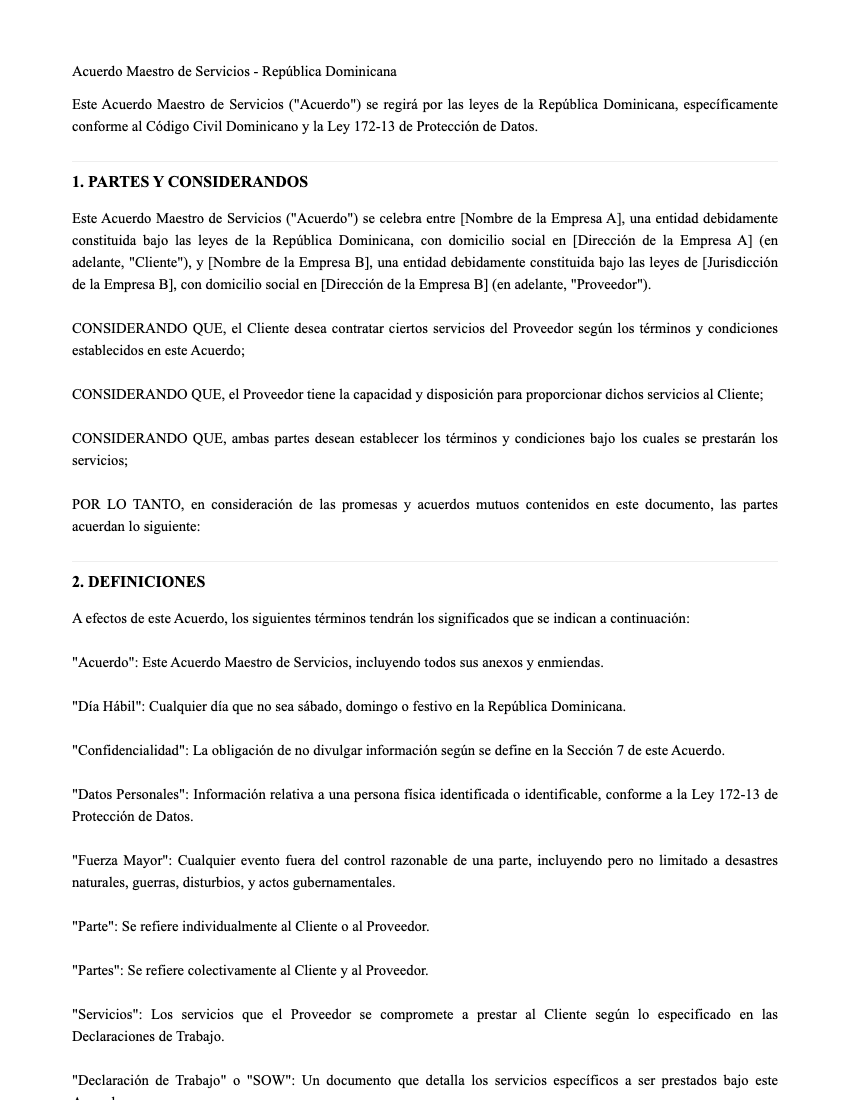
Why You Cannot Use a Generic MSA in Dominican Republic
A generic MSA (for example, copied from the U.S. or Europe) usually fails in three critical points in the Dominican Republic: (1) the boundary between a civil services relationship and an employment relationship is different; (2) non-compete clauses are analyzed under labor and public policy rules, not as mere “freedom of contract”; and (3) intellectual property and copyright require a clear and formal assignment/license, especially when there is creation of works (software, designs, content).
3a. Worker Classification Rules (República Dominicana)
The Dominican Republic does not use an “ABC test” like some U.S. states; classification focuses on the reality of the provision of services: subordination, dependence, and direction. The basic framework is in the Código de Trabajo (Ley 16-92), which defines the employment contract and relies on the criterion that, if there is legal subordination (imposed schedules, direct instructions, continuous supervision, integration into the client’s organization), an employment relationship may be established even if the contract says “independent.” In practice, this opens the door to claims before the Ministerio de Trabajo and labor courts for benefits, vacation, Christmas bonus, notice, and severance.
For a comprehensive guide to structuring MSAs and SOWs that protect your business, see our Freelancer Contracts Guide.
A well-drafted Dominican MSA helps, but it does not “bulletproof” you if the real operation is employment. Therefore, the template should include: (i) representations of independence and control over means and methods; (ii) the provider’s ability to use its own staff or subcontract (if applicable); (iii) absence of exclusivity unless specifically agreed; and (iv) an SOW-based structure to prevent the client from imposing open-ended tasks like a permanent “position.” It is also advisable to require that the provider be registered and invoice formally, to evidence business activity. The risks of misclassification usually materialize in retroactive payments and labor contingencies, in addition to reputational friction.
3b. Non-Compete Enforceability
In the Dominican Republic, non-compete clauses are not treated the same as in California (where they are broadly prohibited). Here the analysis is usually one of reasonableness and compatibility with the right to work and freedom of enterprise, especially when the restriction affects a natural person providing services. In the labor sphere, the Código de Trabajo (Ley 16-92) limits agreements that excessively restrict the right to work; therefore, a broad “non-compete” with no territorial limit, no time limit, or no compensation is vulnerable.
In B2B (company vs. company), a restriction may be more defensible if tied to protection of trade secrets, customer lists, or the client’s specific investment; even so, it should be drafted as a proportionate obligation: short duration (for example, 6–12 months), territory related to the real market, and scope limited to “identical” services for direct competitors. When the provider is an individual freelancer, the safer alternative is usually to avoid a “total” non-compete and use more typical and enforceable tools: (i) robust confidentiality; (ii) non-use/non-disclosure of information; (iii) non-solicitation of employees or clients for a reasonable period; and (iv) return/deletion of information. In addition, if there is personal data, protection is not optional: Ley 172-13 requires a basis and duties of security and confidentiality (arts. 15 y 16), which reinforces the need for a data processing addendum.
3c. IP/Work-for-Hire Considerations
Foreign templates often assume automatic “work made for hire.” In the Dominican Republic, for works protected by copyright (e.g., designs, content, software), the prudent approach is to expressly agree whether it is an assignment or a license and when it transfers (for example, upon full payment). If the provider reuses frameworks, templates, or know-how, the MSA should reserve those rights and grant the client only the necessary license. It is also key to describe deliverables and formats in each SOW to avoid disputes about what IP is included.
What's Included in This Template
Flexible SOW Structure: The MSA sets the permanent rules and each SOW defines scope, milestones, deliverables, and fees. This reduces “scope creep” because any change is documented as a change order or additional SOW. For agencies and consultants, it facilitates monthly retainers with bounded tasks.
Dominican Republic-Specific Indemnification: Indemnification is drafted to allocate risks realistically: the provider is responsible for IP infringement if it uses unauthorized material; the client is responsible for illegal inputs or instructions that cause harm. Limits and exclusions consistent with Dominican contractual practice and with the principle of the binding force of the contract (Código Civil, art. 1134) are included.
Dispute Resolution and Venue: The template allows choosing arbitration in Santo Domingo (arbitration clause) or ordinary courts, avoiding costly foreign forums. It also defines notices, language (Spanish), and rules for urgent measures.
It also includes: (i) data protection compliance and duty of confidentiality in accordance with Ley 172-13, arts. 15 y 16; (ii) agreed interest for late payment and a suspension mechanism for non-payment (practical reference to the usual default interest of 1% monthly in civil contracts); (iii) guideline statute of limitations for personal actions under Código Civil, art. 2279 (20 años); (iv) limitation of liability clause “up to the amount paid” with carve-outs for willful misconduct/gross negligence, aligned with applicability in the DR; and (v) express exclusion of consumer relationships, noting that in B2B the typical consumer regime does not apply (see Ley 358-05, art. 92 as a reference for practices and sanctions when there is consumer activity).
Who Needs This Document?
| User Type | Relationship | Key Benefit |
|---|---|---|
| Marketing agency | Monthly retainer with companies | Fast SOWs and scope control |
| Software developer | Milestone-based projects | Defined IP and delivery against payment |
| Business consultant | Recurring advisory services | Clear invoicing, late fees, and interest |
| BPO/operations provider | Ongoing services | SLAs and delineated responsibilities |
How to Use This MSA Template
Step 1: Identify the parties correctly
Use the exact legal name (company or natural person), RNC/ID if applicable, address, and notice email. This prevents challenges and facilitates collection.
Step 2: Define the term and termination
Establish whether it is for a fixed term or indefinite with termination upon prior notice. Add grounds for immediate termination for material breach or non-payment.
Step 3: Attach your first SOW
Do not put the scope in the MSA. In the SOW define deliverables, acceptance criteria, timeline, price, taxes, and who provides inputs.
Step 4: Sign and operate with change orders
Sign the MSA once and then sign SOWs for each project. Any change must go through a written change order to avoid unpaid “extra” work.
Related MSA Templates
Get the Template
Sign up for our newsletter to receive the template.
Frequently Asked Questions

About Designer Content
Designer Content creates practical legal document resources for landlords, contractors, and small business owners. We simplify complex legal concepts into actionable guidance. Connect with us on LinkedIn.