
A Dominican Republic Non-Disclosure Agreement (NDA) is a civil contract that creates obligations of secrecy over confidential information and trade secrets under the country’s codified legal framework. NDAs in the Dominican Republic must be drafted with an eye to the Código Civil (civil law contract doctrine), Ley No. 172-13 de Protección de Datos de Carácter Personal (data protection), and the Industrial Property regime (Ley No. 20-00) that governs know-how, trade secrets, and unfair competition.
What Is a Dominican Republic NDA?
Definition: In the Dominican Republic, an NDA is a bilateral or unilateral contractual promise—grounded in the Código Civil—that obliges the recipient not to disclose or misuse Confidential Information. Confidential Information can include trade secrets (know‑how, formulas, client lists) protected under industrial property principles (Ley No. 20-00) and personal data protected by Ley No. 172-13.
Because the legal system is civil law, courts interpret NDAs according to contract doctrine (good faith, cause and object), statutory rules on industrial property and data protection, and labor law when employees are involved. Unlike common-law jurisdictions, formalities, the civil-law concept of cause (causa), and prescribed limitation periods (prescripción) play a larger role in remedies and duration.
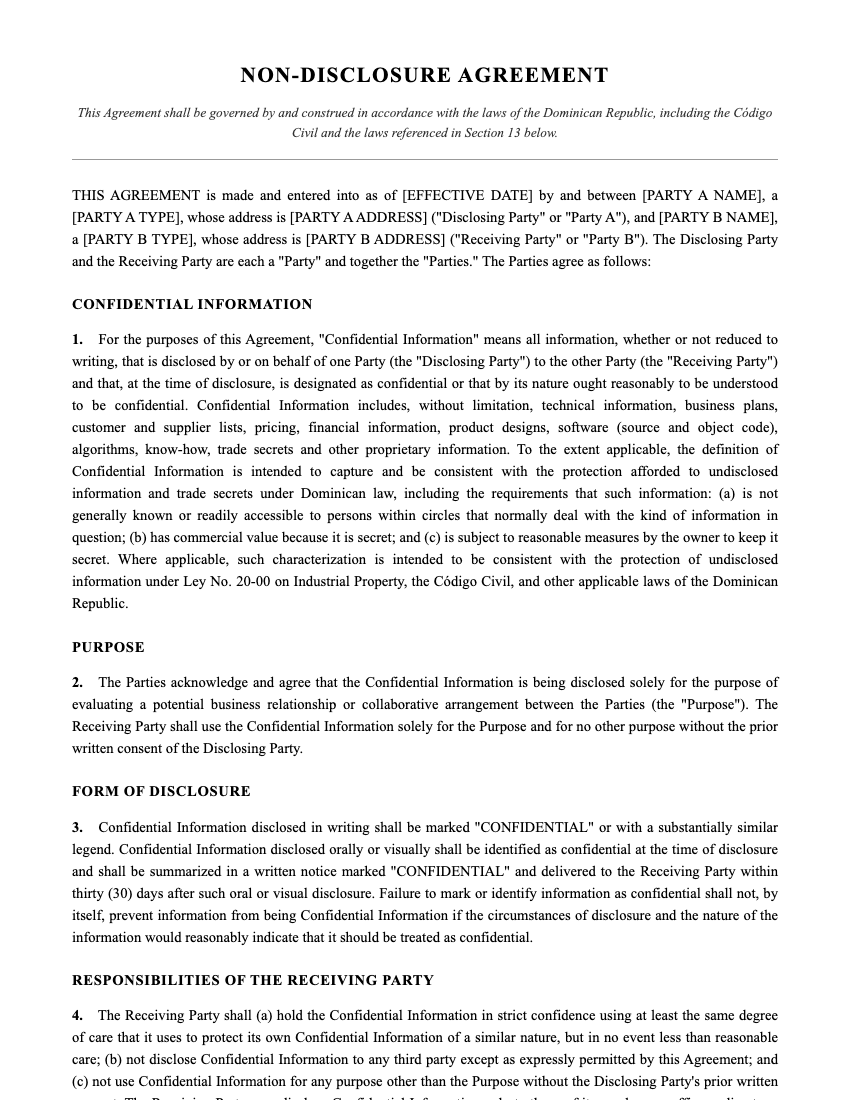
For a complete guide to NDA terms, duration, and standard exclusions, see our NDA Agreement Guide.
Why Generic NDAs Are Dangerous in the Dominican Republic
Using a cookie‑cutter NDA from another country risks three local traps that routinely break confidentiality strategies here.
- Data-protection noncompliance (Ley No. 172-13). If your NDA treats personal data as merely "confidential" without allocating processing responsibilities—controller vs. processor, technical/security measures, cross-border transfer rules—you may violate Ley 172-13 and face administrative fines. NDAs that require the receiving party to process personal data must expressly allocate GDPR-like duties created by local law.
- Perpetual or vague obligations that clash with contract principles. Under the Código Civil, open-ended duties that lack a lawful cause or that are manifestly disproportionate can be reduced or nullified by judges applying good faith and reasonableness. An NDA that attempts to bind a recipient forever for general business knowledge may be reformed or partially struck down.
- Employment restraints and hidden non-competes. The paradigm-shifting insight for the Dominican Republic: unlike jurisdictions with categorical bans, restraint-of-trade clauses (including non-competes embedded inside NDAs) are not automatically void — they are enforceable only if they meet civil‑law standards of legality, proportionality, and adequate consideration, and—critically—if they do not contravene mandatory labor protections. Employers relying on an NDA to restrain post‑employment activity without express, compensatory terms risk a labor claim that can transform a private civil covenant into a public-order violation under the Código de Trabajo. In short: hidden non-competes can be treated as unlawful labor penalties or be judicially reduced for excess.
Real case study: In a 2018 commercial-civil dispute, Dominican courts reduced an excessive confidentiality clause tied to post‑termination restrictions where the clause lacked temporal limits and clear compensation (Tribunales de Primera Instancia and appellate commentary emphasized reasonableness and contractual good faith). That line of decisions has pushed practitioners to draft NDAs with clear duration, scope, and reward for restraints.
Key Clauses Adapted for Dominican Practice
- Precise definition of Confidential Information: separate personal data (subject to Ley 172-13), bona fide trade secrets (know‑how protected under Ley No. 20-00), and general confidential commercial information. Require the disclosing party to mark or otherwise identify confidential materials when feasible.
- Purpose and limited use: limit use to a specific lawful purpose (e.g., "evaluate a potential distribution agreement for Product X in the Dominican Republic"). Under the Código Civil, a clear causa and object avoid nullity risks.
- Duration and survival: use a two-tier approach—time‑limited confidentiality for most business information (e.g., 2–5 years) and indefinite protection for bona fide trade secrets while secrecy is maintained. This balances enforceability with civil-law reasonableness.
- Data protection addendum: allocate controller/processor roles, mandatory technical/security measures, notification obligations in case of breach, and compliance with Ley No. 172-13’s cross-border transfer rules.
- Residuals clause (optional): allow unaided memory use of general skills/ideas while protecting specific trade secrets—this avoids implicit non-compete effects.
- Remedies and limitation: specify injunctive relief, civil damages, and applicable limitation periods, noting that civil prescripción rules (lengthy personal action prescriptive terms) may apply but are subject to judicial interpretation.
- Electronic signature and execution: reference local electronic signature law (for example, the statutory framework governing electronic documents and signatures) so executed NDAs are admissible in court.
Who Needs This Document?
| User Persona | Usage Scenario | Key Local Benefit |
|---|---|---|
| Exporting manufacturer | Sharing production know‑how with overseas factories | Protects proprietary manufacturing know‑how while complying with Ley No. 172-13 for personal data on clients |
| Tech startups | Sharing source code or algorithms with local developers | Balances skills-transfer with civil‑law limits on perpetual secrecy; includes data processing rules for user data |
| Employers | Employee onboarding or contractor agreements | Avoids hidden non‑competes; limits post‑employment restraints to reasonable, compensatory terms |
| Investors / M&A | Due diligence in Dominican-targeted transactions | Permits data room access while allocating data-protection duties and minimizing litigation risk |
How to Execute a Valid Dominican Republic NDA
Step 1: Choose the right form (One‑Way vs Mutual) based on who shares information.
Step 2: Define the purpose with specificity (the object of the contract must be lawful and determinate under the Código Civil).
Step 3: Identify data flows and comply with Ley No. 172-13—if personal data will be transferred, include a data-processing annex assigning roles and security obligations.
Step 4: Sign and keep originals. Prefer signed PDF or electronic signature compliant with local electronic signature rules so the agreement is admissible in court.
Cross-sell: If you regularly receive NDAs, an AI contract review tool can flag Dominican-specific red flags—hidden non-competes, missing data-processing allocations, and overbroad perpetual duties—helping you negotiate before you sign.
Related NDA Templates
Get the Template
Sign up for our newsletter to receive the template.
Frequently Asked Questions

About Designer Content
Designer Content creates practical legal document resources for landlords, contractors, and small business owners. We simplify complex legal concepts into actionable guidance. Connect with us on LinkedIn.