
A Master Services Agreement (MSA) in Ecuador is a B2B framework contract that sets the legal and commercial rules for multiple service projects between a provider and a client. Instead of renegotiating each time the price, intellectual property, confidentiality, or liability, the MSA is signed once and each engagement is defined with a Statement of Work (SOW) or 'Service Order'. For SMEs, agencies, consultants and freelancers, this reduces friction, speeds up internal approvals, and avoids common “scope” and payment disputes.
Definition: An MSA in Ecuador is a principal agreement (framework contract) between two businesses or independent professionals that establishes permanent conditions for the provision of services: how pricing and invoicing are handled, when payment is due, what happens in case of delays (interest), how intellectual property rights are allocated, what personal data are processed and with what measures, what confidentiality applies and for how long, and how disputes are resolved. Then, each project is described in a SOW (scope, deliverables, timelines, fees) which is incorporated by reference into the MSA and is subject to its rules.
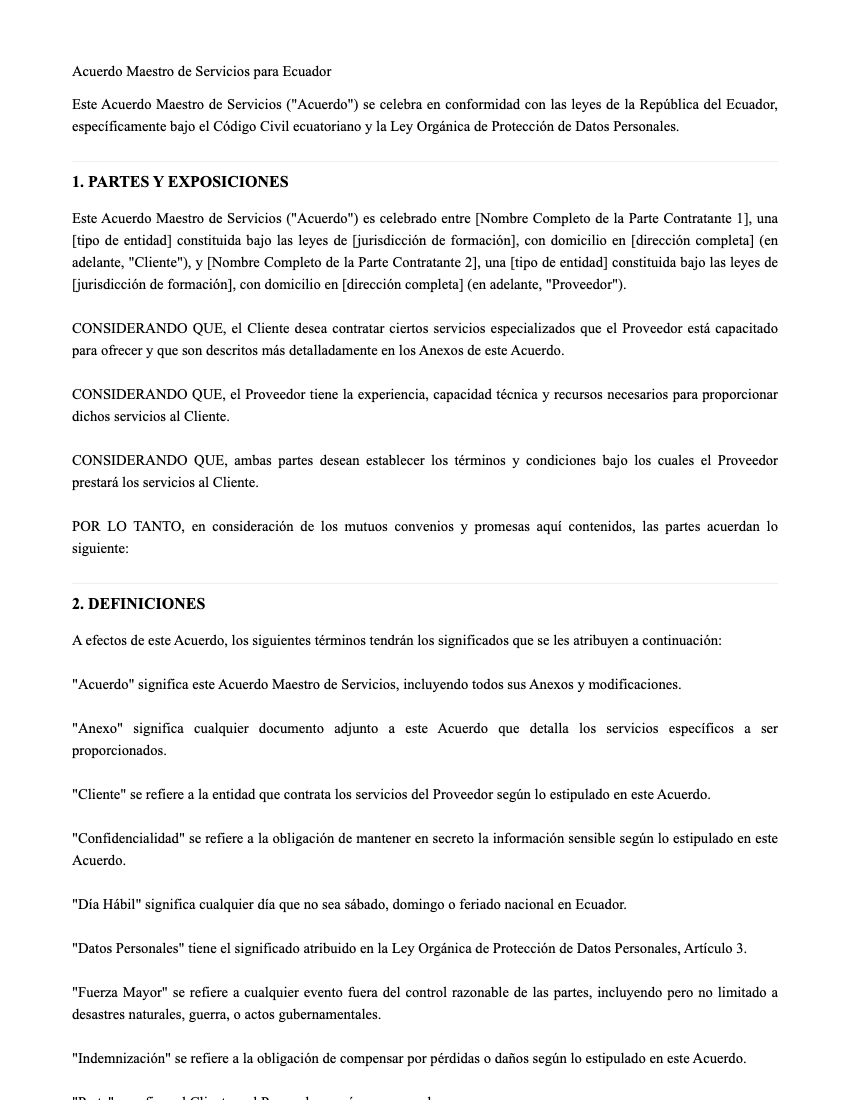
Why You Cannot Use a Generic MSA in Ecuador
A generic MSA (copied from the US, Europe, or another country) typically fails in Ecuador for three reasons: (1) the Ecuadorian civil and labor framework requires coherence between what the contract says and how it is executed in practice; (2) the validity and scope of restrictive clauses (such as non-compete) are analyzed under local labor rules and good faith, with risks of ineffectiveness if drafted disproportionately; and (3) intellectual property and the handling of personal data have specific rules, especially after the Organic Law on Personal Data Protection (LOPDP). Moreover, contracts in Ecuador are interpreted under principles of the Civil Code, including binding force and contractual good faith, which requires obligations to be clear and enforceable.
3a. Worker Classification Rules
Ecuador does not use the US “ABC test.” The key difference is whether there exists a labor relationship (subordination and dependence) or an independent civil/commercial service. The Labor Code defines the individual employment contract as the agreement by which a person agrees to provide lawful and personal services, under dependence, in exchange for remuneration (Labor Code, art. 8). It also states that the work must be personal and that subordination (instructions, time control, de facto exclusivity, integration into the organization) is a central indicator.
For a comprehensive guide to structuring MSAs and SOWs that protect your business, see our Freelancer Contracts Guide.
A generic MSA that treats a person as a “contractor” but in practice imposes schedule, daily supervision, client tools, performance reports, and exclusivity can be re-characterized as an employment relationship. The risk is not just theoretical: the typical consequence is the obligation to pay employment benefits and contributions, plus possible surcharges and contingencies. Therefore, an Ecuadorian MSA should include: (i) declaration of independence, (ii) technical autonomy, (iii) absence of working hours and subordination, (iv) subcontracting rights (if applicable), and (v) that the deliverables are measured by results. It is also advisable to align the SOW to describe deliverables and acceptance criteria, not “daily tasks” as if it were a job position.
3b. Non-Compete Enforceability
In Ecuador, a non-compete prohibition is especially sensitive when there is or is alleged a labor relationship. The Labor Code regulates the worker’s obligation to keep secrets and, in certain circumstances, the prohibition of unfair competition linked to the employment relationship (Labor Code, art. 46). Outside the employment relationship (B2B), it is possible to agree to restrictions, but their practical validity depends on not being abusive nor contrary to freedom of work and good faith; hence, a clause of “no competition in any country for 5 years” copied from a foreign template is a magnet for nullity or non-enforcement.
In a B2B MSA in Ecuador, the most defensible approach is to avoid broad non-compete and replace it with executable alternatives: (1) robust confidentiality with post-termination term (for example, 3 to 5 years, or indefinite for trade secrets), (2) no use of client information to benefit third parties, (3) limited non-solicitation (clients or personnel) with a reasonable term, and (4) intellectual property clauses that prevent reusing specific deliverables without permission. This approach rests on the principle that contracts bind the parties and must be performed in good faith (Civil Code, art. 1507), but avoiding disproportionate restrictions that a judge or arbitrator might deem contrary to public order.
3c. IP/Work-for-Hire Considerations
Ecuador does not operate with the Anglo-Saxon notion of “work made for hire” as a universal solution. The practical approach is to agree on an assignment/transfer of proprietary rights over the deliverables (software, designs, texts, reports) from the provider to the client, conditioned on full payment, while preserving pre-existing rights (tools, templates, know-how). For software or content, the MSA should separate: (i) provider’s pre-existing IP, (ii) IP developed specifically for the client, and (iii) third-party components (open source or licenses). Without a clear assignment/license clause, the client may think that “paid for and owns it,” and the provider may think “only delivered a copy,” leading to conflict.
What's Included in This Template
Flexible SOW Structure
The MSA sets permanent rules, and each SOW details the project: scope, deliverables, milestones, prices, applicable taxes, responsibilities, and acceptance criteria. This helps you control scope creep: anything not in the SOW is out of scope and priced separately.
Ecuador-Specific Indemnification
Indemnification is adapted to a civil-law framework: each party is liable for damages arising from breach, fault, or intent, with negotiated limits and exclusions. The template includes a cap on liability and carve-outs for fraud or gross negligence, and provides for a duty to mitigate damages.
Dispute Resolution and Venue
Includes the option of arbitration in Quito (useful for B2B) or ordinary jurisdiction, with clear rules on language (Spanish), venue, number of arbitrators, and notices. This prevents a foreign template from forcing impracticable forums.
Additionally, the template incorporates:
- Interest on late payment and the agreed rate under the Civil Code, art. 2411 (controlling how interest is calculated in case of delay).
- Personal data clauses aligned to the LOPDP: definitions (art. 3) and protection measures (art. 7).
- Confidentiality with post-termination obligation for a number of years (defined in the MSA) and special treatment for trade secrets.
- Rules of interpretation and contractual good faith under the Civil Code, art. 1507.
Who Needs This Document?
| User Type | Relationship | Key Benefit |
|---|---|---|
| Marketing agency | Retainers and campaigns by SOW | Scope control and fast approvals |
| Business consultant | Monthly or project-based advisory | Payment, late interest, and limited liability |
| Software developer | Milestone-based implementations | IP assignment/license conditioned on payment |
| Outsourcing company | Recurring B2B services | Confidentiality and data protection (LOPDP) |
How to Use This MSA Template
Step 1: Correctly identify the parties
Use the exact legal name, RUC (if applicable), address, and legal representative. In Ecuador, precise identification reduces disputes over who is bound.
Step 2: Define the term, termination, and post-termination confidentiality
Choose a fixed term or indefinite term with termination on notice. Ensure that confidentiality survives for “X” years after termination and that there is return/deletion of information.
Step 3: Attach the first SOW with measurable deliverables
Do not place the scope in the MSA. In the SOW define deliverables, acceptance criteria, schedule, and assumptions; add a change procedure with rates.
Step 4: Sign and manage via service orders
Once the MSA is signed, each new project is documented with a brief SOW. Maintain a repository of signed SOWs for audit and collection.
Related MSA Templates
Get the Template
Sign up for our newsletter to receive the template.
Frequently Asked Questions

About Designer Content
Designer Content creates practical legal document resources for landlords, contractors, and small business owners. We simplify complex legal concepts into actionable guidance. Connect with us on LinkedIn.