
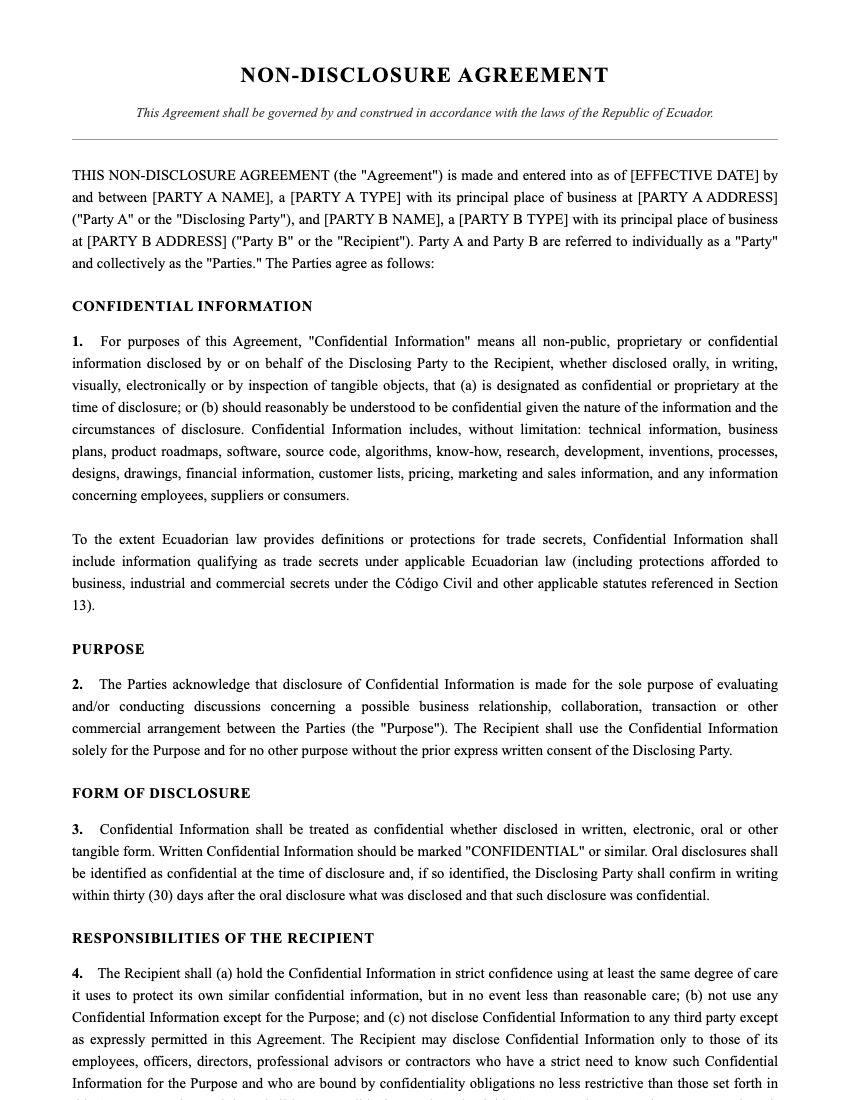
A tailored Ecuador Non-Disclosure Agreement (NDA) is a written contract that protects confidential business information, trade secrets, and personal data while following Ecuadorian statutory rules (Código Civil), data-protection obligations (Ley Orgánica de Protección de Datos Personales — LOPDP), and local commercial practice. This template focuses on what Ecuadorian courts and regulators expect: clear purpose, limited duration where appropriate, data-protection clauses, and enforceable remedies.
What Is an Ecuador NDA?
Definition: An Ecuador NDA is an agreement by which one or both parties commit to keep certain information secret and restrict its use. In Ecuador, confidentiality intersects with civil obligations (Código Civil), criminal or administrative protections for business secrets, and the LOPDP when personal data are involved. Note: general civil obligations (including contract enforcement and prescription) are governed by the Código Civil; in practice, many contractual claims prescribe after 10 years under Ecuadorian law.
Two features make Ecuadorian NDAs different from many common-law templates: the need to include explicit data-processing terms where personal data is shared (LOPDP), and the civil-law approach to duration and remedies (Código Civil principles on good faith and proportionality).
For a complete guide to NDA terms, duration, and standard exclusions, see our NDA Agreement Guide.
Why Generic NDAs Are Dangerous in Ecuador
Using an NDA built for another jurisdiction—or a generic template—creates multiple local risks.
- Data-protection gaps (LOPDP). Ecuador's Ley Orgánica de Protección de Datos Personales (LOPDP) requires a legal basis for processing personal data, clear retention periods, security measures, and subject-rights procedures. An NDA that shares personal data without naming controller/processor roles, lawful basis, retention, and security commitments can trigger administrative fines and make enforcement of confidentiality harder.
- Hidden restraints disguised as confidentiality. Unlike California's outright ban on non-competes, Ecuadorian courts analyze restrictions under Código Civil principles and labor law. A confidentiality clause that effectively prevents a former employee from working in their profession risks being recharacterized as an unlawful restraint or a clause of abuse of rights—courts will scrutinize duration, scope, and whether compensation or legitimate business interest exists.
- Prescription and long-term claims. Civil claims in Ecuador commonly run up against a 10-year prescriptive period (Código Civil). If you attempt to assert a perpetual contractual obligation without demonstrating ongoing measures to keep information secret, you may face procedural bar to relief after the statutory prescription period.
Paradigm-shifting insight for Ecuador: NDAs that mix personal data and commercial secrets must be drafted first as a data-processing agreement compliant with LOPDP and only then layered with confidentiality covenants. If you treat shared information first as "confidential business info" and neglect LOPDP obligations, you risk administrative sanctions that can defeat private enforcement of trade-secret claims.
Real legal development to note
Ecuador enacted comprehensive personal-data legislation (Ley Orgánica de Protección de Datos Personales) in 2021–2022, establishing clearer duties for controllers and processors and administrative sanctions for non-compliance. Since then, companies sharing client lists, employee records, or customer analytics under NDAs have faced closer scrutiny by regulators and increased demands to document security measures and legal bases for data transfers.
Key Clauses Adapted for Ecuador
- Purpose and Scope: Narrowly state the reason for disclosure and restrict use to that purpose. Ecuadorian courts favor precision.
- Definition of Confidential Information vs. Personal Data: Distinguish between pure commercial secrets (e.g., formulas, manufacturing processes) and personal data (e.g., customer names with contact details). For personal data, include LOPDP-compliant processing language: lawful basis, controller/processor designation, retention period, rights-assistance procedures, and security measures.
- Duration and Prescription: For general confidential information use a limited period (commonly 2–5 years). For true trade secrets, note that protection continues while secrecy is preserved, but state any contractual limitation and remind parties of the Código Civil prescription rules (10-year general prescriptive term).
- Restrictions that aren’t covert non-competes: Avoid wording that prohibits employment or competition unless you have supporting legal justification. If you need a post-employment restraint, make it separate, reasonable, limited in time/geography, and (where appropriate) compensated per local labor principles.
- Remedies and injunctive relief: Provide for injunctive relief, accounting, and damages. Also include cooperation on regulatory inquiries (e.g., data-protection authorities) and indemnities for breaches of LOPDP obligations.
- Security and Return/Destruction: Specify technical and organizational safeguards and a timeframe for returning or destroying confidential information and personal data.
- Governing law and dispute resolution: Choose Ecuadorian law and practical dispute resolution venues (courts or arbitration) with local addresses for service.
Who Needs This Document?
| User Persona | Usage Scenario | Local Benefit |
|---|---|---|
| Local startups | Pitching to investors or service providers | Protects investor-sensitive metrics while complying with LOPDP when customer data is shown |
| Manufacturers | Sharing prototypes with suppliers | Protects designs and manufacturing methods within Ecuadorian contract framework |
| HR departments | Hiring executives or consulting firms | Adds LOPDP-compliant clauses when resumes and employee data are exchanged |
| Professional services | Advising clients and subcontracting work | Clarifies controller/processor duties and limits liability in engagements |
How to Execute a Valid Ecuador NDA (Practical Steps)
- Identify whether personal data will be shared. If yes, include LOPDP clauses (controller/processor, legal basis, retention, security, subject-rights assistance).
- Define and limit the purpose and duration; avoid perpetual, vague clauses.
- Add specific security and return/destruction obligations to demonstrate "reasonable secrecy efforts." This strengthens trade-secret protection under civil doctrine.
- Sign and date before any disclosure. Preserve execution evidence (scanned signed copies, verifiable electronic signatures under Ecuador's electronic-signature rules).
When a Client Sends You an NDA
If someone sends you an NDA, check for disguised restraints (employment prohibitions), missing data-protection obligations, overly broad confidentiality definitions, and mismatched governing-law selections. This template includes negotiation notes aimed at protecting service providers and employees within Ecuadorian law.
an AI contract review tool can instantly flag clauses that raise risks under Ecuadorian data protection or civil-law principles, suggest LOPDP-compliant wording, and highlight disguised non-compete language—saving you hours of manual review.
Related NDA Templates
Get the Template
Sign up for our newsletter to receive the template.
Frequently Asked Questions

About Designer Content
Designer Content creates practical legal document resources for landlords, contractors, and small business owners. We simplify complex legal concepts into actionable guidance. Connect with us on LinkedIn.