
A Florida Non-Disclosure Agreement (NDA) is a contract that protects confidential business information and trade secrets under Florida law while remaining enforceable under state statutory rules on restrictive covenants and trade-secret remedies.
What is a Florida NDA?
Definition: A Florida NDA is an agreement in which one or more parties promise to keep certain information confidential and use it only for permitted purposes. In Florida, confidentiality promises intersect with two statutory regimes you must know:
- Restrictive-covenant enforcement under Fla. Stat. § 542.335 (rules courts use to evaluate non-competes and ancillary restrictions).
- Trade-secret protection under the Florida Uniform Trade Secrets Act (Fla. Stat. ch. 688), which mirrors the Uniform Trade Secrets Act and works alongside the federal Defend Trade Secrets Act (DTSA).
The practical consequence: Florida enforces reasonable restraints that are ancillary to the protection of legitimate business interests. Unlike states that broadly ban non-competes, Florida expects NDAs to be precise, limited in scope and duration, and tethered to a legitimate business interest.
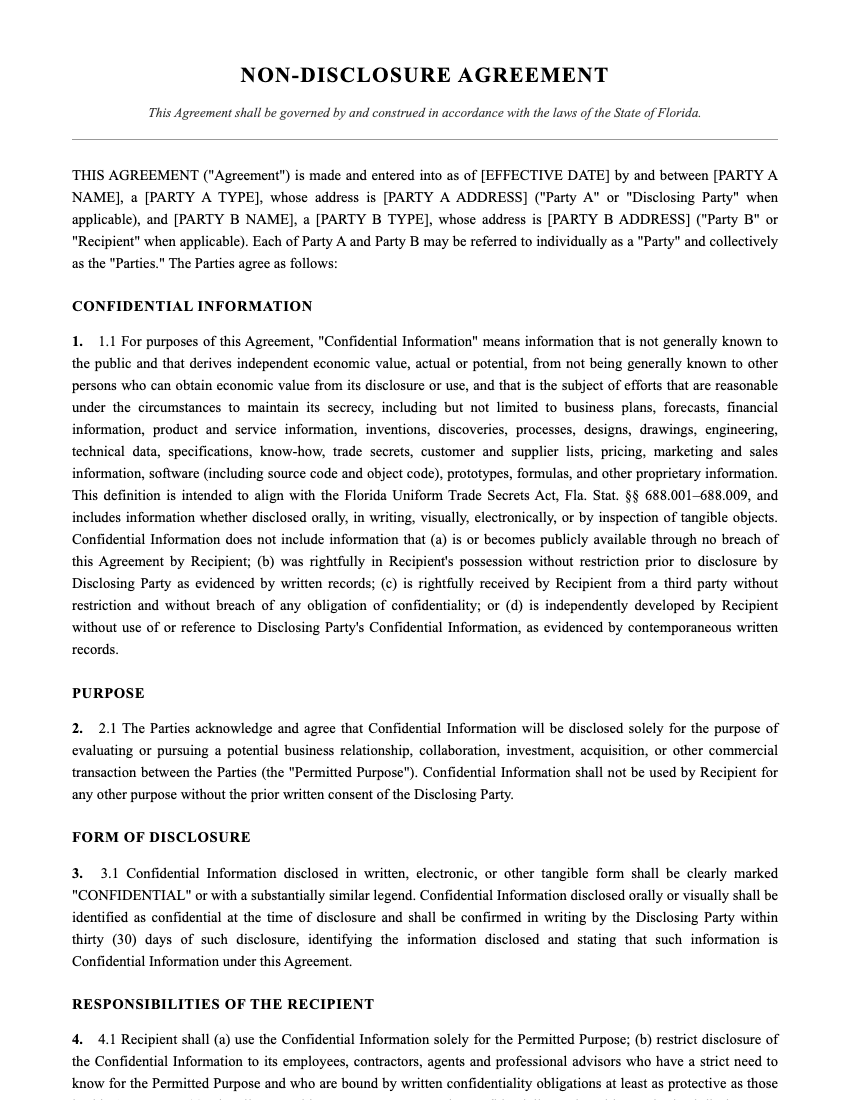
For a complete guide to NDA terms, duration, and standard exclusions, see our NDA Agreement Guide.
Why generic NDAs are dangerous in Florida
Many free NDA forms are written for jurisdictions with different rules about non-competes, blue‑penciling and trade‑secret remedies. Using a generic template in Florida creates three classic traps:
- Overbroad "anti-compete" language
A clause that effectively prevents a person from working in their field may be enforceable in Florida only to the extent it protects a legitimate business interest and is reasonable in time, area and line of business under Fla. Stat. § 542.335. Overbroad wording can lead to costly litigation and a court-ordered narrowing or invalidation of the covenant.
Paradigm-shifting insight (Florida): Florida statute § 542.335 explicitly sets out the enforceability criteria and grants courts power to modify or enforce covenants to make them reasonable rather than automatically striking the whole agreement. That means carefully drafted NDAs that tie restrictions to specific business interests and limited durations are more likely to be enforced rather than discarded. The flip side: sloppy, catch-all language invites reformation or rejection.
- Confusing "trade secret" vs. general confidential info
Under Fla. Stat. ch. 688, a trade secret must (a) derive independent economic value from not being generally known and (b) be subject to reasonable efforts to maintain secrecy. Calling all data a "trade secret" dilutes enforceability and may undermine remedies in court. Distinguish limited-term confidential business information (e.g., proposals, financial forecasts) from true trade secrets (formulas, source code, client lists maintained as secret).
- Missing DTSA whistleblower notice
If you plan to sue under the federal DTSA (18 U.S.C. § 1836), ensure your NDA includes the DTSA whistleblower notice (that employees may disclose secrets to government officials or in private communications for reporting violations). Without it, you can still pursue trade-secret claims, but you may lose eligibility for enhanced damages and attorney's fees. Most generic templates omit this protective notice.
A recent development to know
Florida codified modern restrictive-covenant standards and procedures in Fla. Stat. § 542.335 (enacted and amended in recent legislative sessions). That statute is the governing framework courts use to evaluate whether a confidentiality-related restriction is enforceable—so compliance with § 542.335 is not optional for employers who want enforceable NDAs.
Key clauses adapted for Florida practice
- Purpose and scope: narrow, specific description of the permitted use (e.g., "to evaluate a potential license of Disclosing Party's inventory-management software"). Broad-purpose clauses invite attacks under § 542.335.
- Definitions: separate "Confidential Information" (time-limited, examples) from "Trade Secrets" (indefinite protection while secret) to match Fla. Stat. ch. 688.
- Limited duration: set reasonable confidentiality terms for non-trade-secret information (commonly 1–5 years). For trade secrets, specify indefinite protection "while the information remains a trade secret."
- Geographic/line-of-business limitations: if you include restrictions that touch on employment or competition, tie them to a legitimate business interest (customer relationships, specialized training) and reasonable limits in time and area per Fla. Stat. § 542.335.
- Residuals: optional clause dealing with unaided memory; useful in tech but should be narrowly drafted to avoid appearing as an employment restraint.
- Carve-outs: public information, independently developed information, previously known, and compelled disclosures (subpoena/government) must be explicit.
- DTSA notice: include the DTSA whistleblower immunity language required to preserve enhanced federal remedies.
- Remedies and arbitration: specify injunctive relief and, if desired, an arbitration clause (Florida strongly enforces arbitration agreements; federal Arbitration Act often applies).
Who needs this document?
| User Persona | Usage Scenario | Key Florida Benefit |
|---|---|---|
| Tech startups (Miami/Tampa) | Pitching to investors, hiring dev contractors | Protects source code and client pipelines while keeping restrictions reasonable under Fla. Stat. § 542.335 |
| Employers | Onboarding employees with access to client lists | Preserves trade-secret remedies while avoiding overbroad non-compete language that may be reformed by courts |
| Manufacturers | Sharing prototypes with contract manufacturers | Ensures trade-secret protection across supply chain; includes DTSA notice for federal remedies |
| Service firms | Selling customer lists in M&A due diligence | Allows disclosure during due diligence while preserving confidentiality and enforceability in Florida courts |
How to execute a valid Florida NDA
- Choose the right form: One-way (unilateral) if only you disclose; Mutual when both parties exchange confidential info.
- Be specific: Define the Purpose, identify categories of Confidential Information, and list trade secrets separately.
- Mark your materials: Label documents "CONFIDENTIAL" and record steps you take to maintain secrecy—courts look for reasonable efforts under Fla. Stat. ch. 688.
- Sign before sharing: Florida recognizes electronic signatures under the Uniform Electronic Transactions Act (UETA), Fla. Stat. § 668.50 et seq., but retain execution records and timestamps. For high-value disclosures, get wet signatures or a signed PDF through a reliable e-sign platform.
Already receiving NDAs from clients?
Before signing, check for overbroad non‑compete language, unbounded durations, or language that attempts to outsource court-friendly clauses into the NDA without meeting Florida's § 542.335 standards. Use an AI contract review tool to flag risky clauses, compare to Florida law, and prioritize negotiation points.
Related NDA Templates
Get the Template
Sign up for our newsletter to receive the template.
Frequently Asked Questions

About Designer Content
Designer Content creates practical legal document resources for landlords, contractors, and small business owners. We simplify complex legal concepts into actionable guidance. Connect with us on LinkedIn.