
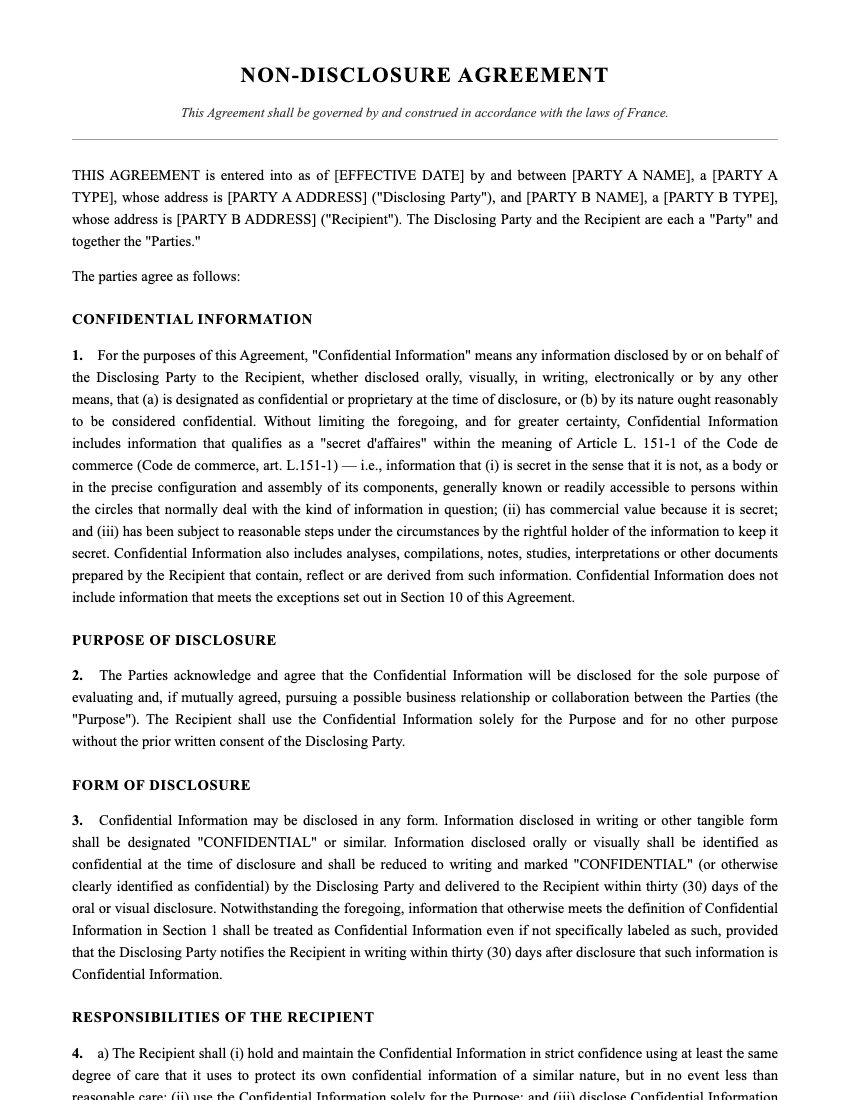
A France Non-Disclosure Agreement (NDA) is a contract that limits disclosure and use of confidential information while complying with French civil and commercial law, national privacy rules and labor protections.
What is a France NDA?
Definition: A France NDA describes confidential information and obliges the recipient to preserve secrecy and use the information only for a defined purpose. Key French legal anchors are the trade secret rules in the Code de commerce (Article L.151‑1 et seq.), data-protection law (GDPR / Loi Informatique et Libertés), and employee-protection principles in French labor law.
Trade secrets in France are defined by Article L.151‑1 of the Code de commerce (transposition of the EU Trade Secrets Directive). To qualify, information must: (1) derive commercial value from being secret; (2) be subject to reasonable secrecy measures. NDAs are a primary evidence of those reasonable measures.
For a complete guide to NDA terms, duration, and standard exclusions, see our NDA Agreement Guide.
Why "generic" NDAs are dangerous in France
Templates drafted for common-law jurisdictions often miss several civil‑law traps in France. Using them can create three serious risks:
- Disguised non‑compete (clause de non‑concurrence déguisée)
French courts scrutinize confidentiality clauses that effectively prevent someone from working. If a confidentiality covenant is so broad that it restricts professional activity, a court may treat it like a hidden non‑compete. Unlike the U.S., French non‑compete clauses are enforceable only if they meet strict conditions, including a clear geographic/scope limit and financial compensation (indemnité de non‑concurrence). Failure to provide compensation or reasonable limits can make the clause void or lead to damages in favor of the employee.
Paradigm-shifting insight: In France the real risk is not that an NDA contains an explicit non‑compete, but that an overbroad confidentiality clause functions as one—triggering requirements (duration, compensation, proportionality) you must satisfy or risk nullity.
- GDPR and CNIL requirements
Any NDA that contemplates sharing personal data must comply with the EU General Data Protection Regulation (Regulation (EU) 2016/679) and the French Data Protection Act (Loi Informatique et Libertés). That means documenting lawful bases, implementing data‑processing clauses, and ensuring data subjects’ rights are respected. CNIL guidance treats overly broad retention and transfer clauses as unlawful.
- Whistleblower and public‑interest disclosures
French whistleblower protections (Sapin II and subsequent legislation, plus EU whistleblower protections) mean you cannot lawfully use an NDA to silence a person making protected disclosures. NDAs must not penalize or prevent lawful reporting to competent authorities.
Recent legal development: France implemented the EU Trade Secrets Directive into national law (changes to the Code de commerce adopted in 2018–2019), strengthening judicial remedies for misappropriation but also clarifying that secrecy measures (like NDAs) are evidence, not an automatic monopoly over information.
Key clauses to include (France-focused)
- Precise definition of Confidential Information: distinguish trade secrets (Article L.151‑1) from ordinary confidential business information. Reserve indefinite protection for true trade secrets; set reasonable time-limits (often 2–5 years) for other categories.
- Purpose clause: narrowly state the permitted use (e.g., "evaluation of X project"). French judges favour specificity.
- Obligations of the recipient: confidentiality, limited copies, secure storage, prompt return/destruction on request.
- Data protection clause: controller/processor roles, legal basis, security measures, CNIL-contact and data-subject rights process (GDPR compliance).
- Exceptions and carve-outs: prior knowledge, public domain, independent development, compelled disclosure (with notice to disclosing party when allowed).
- No‑silencing / whistleblower clause: confirm that the NDA does not prevent protected disclosures to public authorities or the courts.
- Optional: residuals clause—carefully drafted to avoid appearing as an undue restriction on future employment.
- If including non‑compete language: explicitly state indemnité de non‑concurrence, duration, geographic scope, and calculation method to meet French enforceability requirements.
Who needs this document?
| User Persona | Usage Scenario | Key Benefit (France) |
|---|---|---|
| Startups (Paris tech) | Sharing pitch decks with investors | Protects business know‑how while meeting GDPR notice duties |
| Employers | Confidential HR data & projects | Creates evidence of secrecy measures and complies with labor constraints |
| Manufacturers | Sharing designs with suppliers | Preserves trade‑secret status under Code de commerce L.151‑1 |
| Consultants & Freelancers | Working with multiple clients | Limits use of client materials without creating hidden restraints on work |
How to execute a valid France NDA
- Choose the right form: One‑way (disclosing party only) versus mutual (both share). Use one‑way when only you disclose.
- Be precise about the Purpose and categories of information—French judges disfavor vague omnibus clauses.
- Include GDPR-compliant processing terms if personal data is involved; identify controller/processor and retention periods.
- Sign before sharing; electronic signatures are valid under Civil Code rules and EU eIDAS (use a qualified electronic signature for high-risk exchanges).
Practical tip: If you need any restraint on future work, do not hide it inside a confidentiality clause. Draft a separate non‑compete clause with explicit financial compensation and limits.
Cross-sell: an AI contract review tool
an AI contract review tool can instantly flag French‑specific red flags: disguised non‑competes, missing GDPR wording, or lack of CNIL‑friendly processing terms. Use it to compare incoming NDAs against French law before signing.
Related NDA Templates
Get the Template
Sign up for our newsletter to receive the template.
Frequently Asked Questions

About Designer Content
Designer Content creates practical legal document resources for landlords, contractors, and small business owners. We simplify complex legal concepts into actionable guidance. Connect with us on LinkedIn.