
A Georgia Non-Disclosure Agreement (NDA) is a contract that protects confidential business information and trade secrets while operating within Georgia’s contract and employment law framework. Unlike in California, Georgia courts will enforce properly drafted restrictive covenants and confidentiality obligations so long as they protect a legitimate business interest and are reasonable in scope, duration, and geography.
What is a Georgia NDA?
Definition: A Georgia NDA is a written agreement that limits the recipient’s use and disclosure of confidential information, including trade secrets protected under the Georgia Trade Secrets Act (O.C.G.A. § 10-1-760 et seq.). In Georgia, confidentiality provisions are analyzed under traditional contract rules plus the reasonableness and protectable-interest tests developed by Georgia courts.
Georgia does not categorically ban non-competes. Instead, restrictive covenants are enforceable when they are reasonable and protect a legitimate business interest such as trade secrets, customer relationships, or confidential financial information. Keep in mind that written contract claims generally carry a six-year statute of limitations under O.C.G.A. § 9-3-24, which affects how long you can bring suit for breach of an NDA.
For a complete guide to NDA terms, duration, and standard exclusions, see our NDA Agreement Guide.
Why "Generic" NDAs Are Dangerous in Georgia
Using a boilerplate NDA drafted for another state can create three key risks in Georgia:
- Enforceability risk: Georgia courts will enforce covenants that are reasonable and supported by consideration. Boilerplate language that is overbroad in time or territory risks being reformed or struck down; worse, a court might invalidate the restrictive portions and leave the confidentiality remedies uncertain.
- Consideration and formality trap: Georgia treats continued employment and new consideration differently than some states. An NDA signed as part of consideration for hiring or a promotion must show adequate consideration; ambiguous consideration language can jeopardize enforcement.
- Statute of limitations exposure: Because O.C.G.A. § 9-3-24 provides a six-year limitation for written contracts, claims for breach of an NDA can be brought many years after signing. Don’t assume a short-duration clause extinguishes litigation risk—Georgia’s SOL determines when a claim must be filed.
Paradigm-shifting insight: in Georgia the real drafting trap is not that restrictive covenants are illegal, but that overly broad NDAs can unintentionally create enforceable non-competes or be reformed in ways that change your remedies. In short: Georgia enforces restraints if reasonable — so the drafting focus should be precision (protectable interest + reasonable scope), not avoidance.
Real development to watch: Georgia’s codification of trade secret protections under O.C.G.A. § 10-1-760 et seq. (the Georgia Trade Secrets Act) aligned state remedies with the Defend Trade Secrets Act (DTSA). That means NDAs used in Georgia should add the DTSA whistleblower notice language (18 U.S.C. § 1833(b)) when federal remedies may be sought.
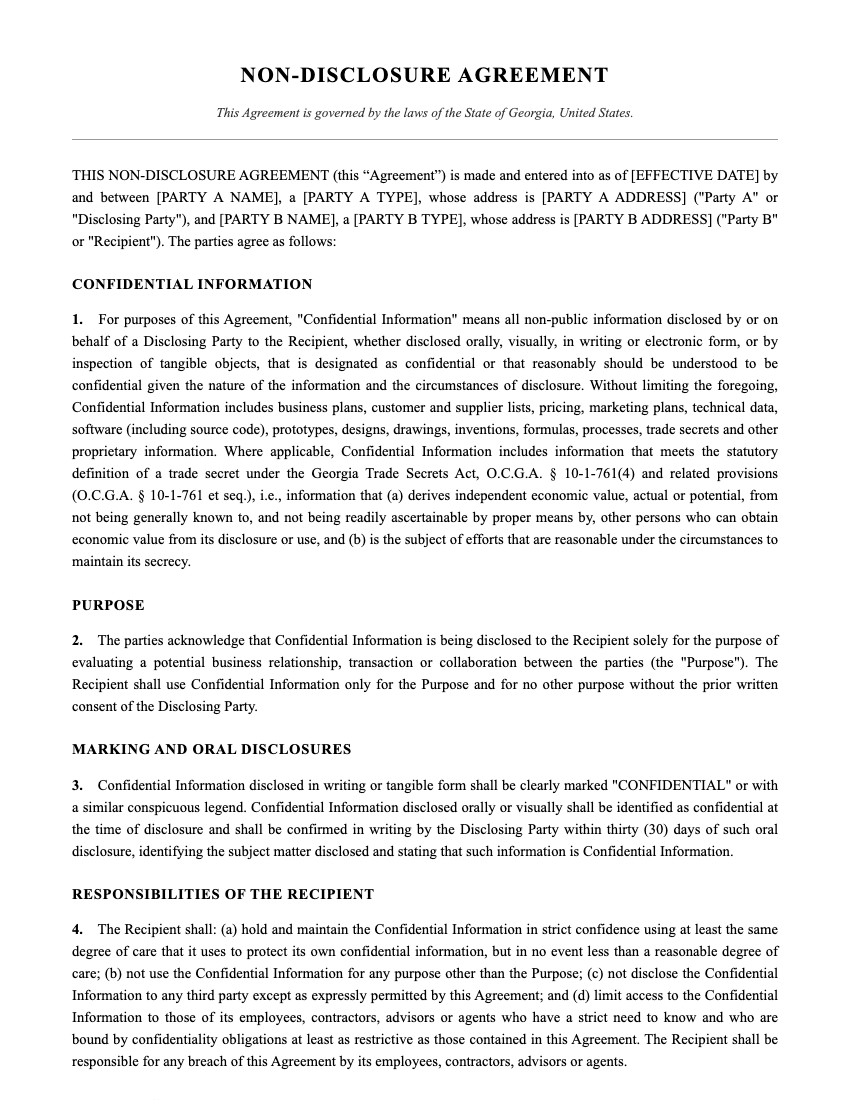
Key Clauses — What this template includes
- Purpose clause: Narrow purpose language limits permissible uses (e.g., "evaluating software licensing for Project X"). Georgia courts emphasize purpose specificity when assessing reasonableness.
- Clear trade secret definition: Uses O.C.G.A. § 10-1-760 et seq. elements — information deriving independent economic value from not being generally known and subject to reasonable secrecy efforts.
- Use and non-disclosure obligations: Bars use of confidential information except for the agreed purpose; carves out independently developed or publicly available information.
- Limited covenant (if applicable): If you include a post-employment restraint, the template provides two options: narrowly tailored non-solicit and non-use clauses (preferred) and a conservative non-compete clause with negotiation notes to ensure reasonableness in time, geography, and activity.
- Consideration recital: Language showing what the receiving party received (employment, access, payment) to avoid the consideration trap.
- DTSA whistleblower notice: Preserves federal enhanced remedies under 18 U.S.C. § 1833(b) by including the required notice about reporting to government officials.
- Remedies and injunctive relief: Georgia courts regularly grant injunctive relief for trade secret misappropriation; the template states injunctive relief is appropriate and reserves contractual damages.
- Choice-of-law and venue: You can designate Georgia law and specified county courts, but be mindful of forum non-conveniens if the other party is out of state.
Who needs this document?
| User Persona | Typical Use Case | Why Georgia Version Matters |
|---|---|---|
| Software companies in Atlanta | Sharing prototype code with contractors | Protects source code as trade secret under O.C.G.A. § 10-1-760 et seq. |
| Medical practices | Hiring staff with access to patient lists | Limits solicitation and use of client lists while respecting HIPAA and Georgia confidentiality norms |
| Small manufacturers | Sending drawings to suppliers | Prevents misappropriation and supports injunctive relief in Georgia courts |
| Investors/Buyers | M&A due diligence | Ensures sensitive financials and customer lists remain protected and clarifies survival of confidentiality post-closing |
How to execute a valid Georgia NDA (practical steps)
- Narrow the Purpose: Be specific. Courts look to the stated purpose when measuring permissible use.
- Identify the Protectable Interest: Label trade secrets per O.C.G.A. § 10-1-760 et seq. and show secrecy efforts (watermarks, access logs).
- Confirm Consideration: For employee NDAs, show the exchange (offer letter, promotion, or other benefit) to avoid a challenge to enforceability.
- Sign and Date Before Disclosure: Do not share secret information before execution; preserve evidence of signature and delivery.
Negotiation notes
- Prefer non-use and non-solicit language over broad non-competes.
- Limit duration (common employee restraints: 6–24 months depending on industry) and geographic scope to where the business operates.
- Provide carve-outs for whistleblowing and legally compelled disclosure.
Already receiving NDAs from clients?
Review incoming NDAs for overbroad non-use language that could be read as a non-compete, ambiguous consideration, or choice-of-law that disfavors Georgia enforcement. an AI contract review tool can quickly flag clauses that raise Georgia-specific enforcement or SOL issues and compare your version against enforceability checklists.
Related NDA Templates
Get the Template
Sign up for our newsletter to receive the template.
Frequently Asked Questions

About Designer Content
Designer Content creates practical legal document resources for landlords, contractors, and small business owners. We simplify complex legal concepts into actionable guidance. Connect with us on LinkedIn.