
Opening
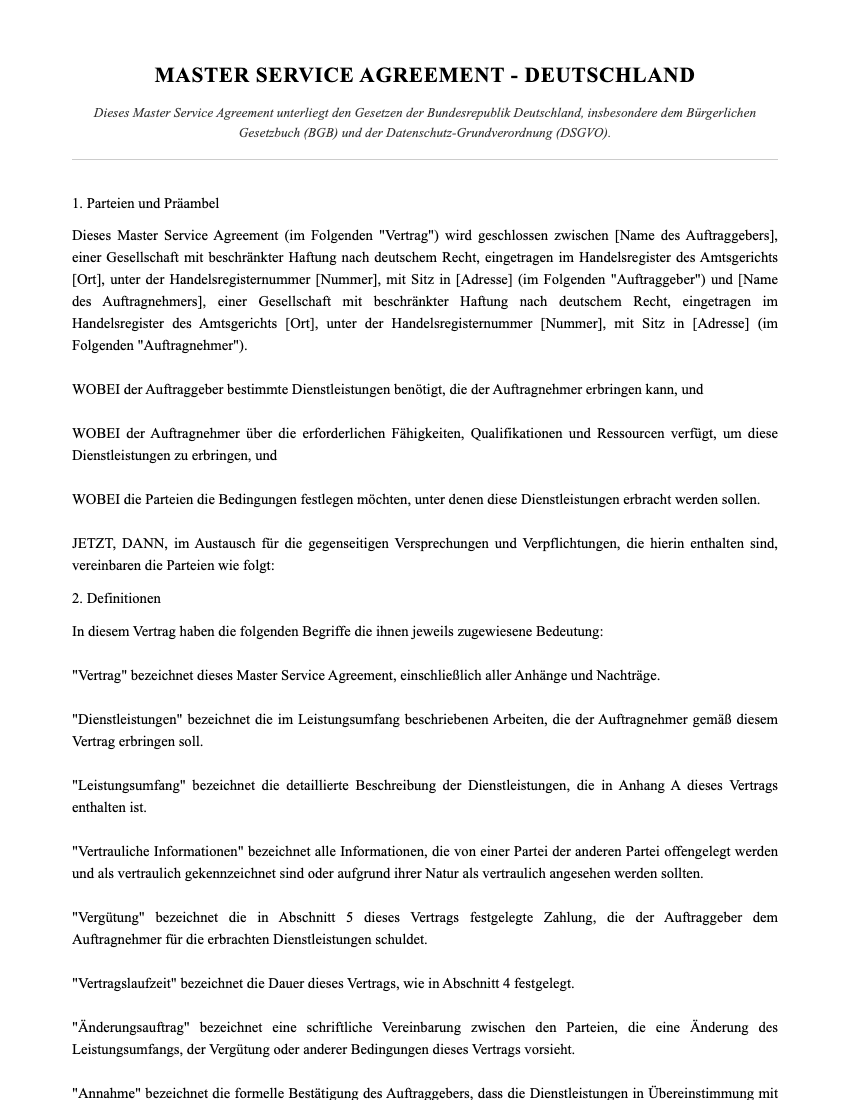
A German Master Services Agreement (MSA) is a framework contract under German law that sets the baseline terms for recurring services between the client and the service provider and governs individual projects via Statements of Work (SOWs). For German companies this matters because the BGB's rules on statute of limitations, liability and late payment, as well as GDPR obligations for data processing, must be taken into account. A well-drafted MSA speeds up project start-ups, reduces disputes over scope creep and creates predictable payment and risk allocation.
For a comprehensive guide to structuring MSAs and SOWs that protect your business, see our Freelancer Contracts Guide.
Definition Box
Definition: A German Master Service Agreement (MSA) is a reusable B2B framework contract that establishes the legal baseline terms for multiple future service engagements. Rather than negotiating a full service- or works contract each time, the MSA governs, among other things, remuneration, payment deadlines, acceptance logic, liability limitation, confidentiality, data protection (including processing under GDPR Art. 28), as well as dispute resolution. The concrete service (scope, dates, milestones, prices) is agreed in separate SOWs/descriptions of services, which automatically fall under the MSA rules.
Why You Cannot Use a Generic MSA in Germany
Many international templates are tailored for Common Law countries and fail in Germany due to mandatory protections, AGB control, and data protection formalities. Particularly SMBs and freelancers underestimate that a "standard MSA" from the USA or UK can be signed in Germany, but individual clauses may be ineffective or cause side effects (e.g., misclassification as a dependent contractor, impermissible liability limitation, missing DPA). A German template must also clearly distinguish between a service contract and a works contract, because this affects, among other things, acceptance, warranty rights, and remuneration.
Worker Classification Rules
Germany does not use an ABC test. What matters is whether there is actually an employment, i.e., a dependent relationship with subordination to instructions and integration into the work organization. This follows from § 7 Abs. 1 SGB IV and is assessed in practice based on the totality of circumstances. If a "Freelancer" effectively works like an employee (fixed hours, use of internal tools as staff, reporting like employees), back payments of social security contributions may be required; in addition, the Deutsche Rentenversicherung may conduct a status determination procedure (Statusfeststellungsverfahren under § 7a SGB IV). In contract, the MSA should therefore safeguard genuine entrepreneur characteristics (own tools, freedom to schedule work, no right of direction) and define processes (e.g., a point of contact rather than technical directives).
Non-Compete Enforceability
Non-compete restrictions are not categorically "banned" in Germany, but they are tightly limited. For employees: a post-employment non-compete is only binding if it is in writing and provides a non-compete consideration of at least 50% of the last contractual services (§ 74 Abs. 2 HGB). It must also be subjectively and temporally reasonable (typically up to 2 years in employment practice). For pure B2B freelancer contracts, an overly broad non-compete may be challengeable under the AGB control or as an undue restriction on professional practice. A good MSA often substitutes hard non-competes with effective alternatives: strict confidentiality / trade secret protection, narrowly tailored project-specific client protections, and clear rules on the use of know-how.
IP / Work-for-Hire Considerations
"Work made for hire" is a US concept and does not map 1:1 in Germany. With copyrights, the general rule is that the author (natural person) initially retains the rights; usage rights are licensed. For software, the rights transfer within an employment relationship is specifically regulated (§ 69b UrhG), while with freelancers a clear, written grant of exclusive rights is essential (purpose-transfer rule, § 31 Abs. 5 UrhG). A German MSA should therefore precisely define which usages, territories, duration, and modification rights are transferred and whether pre-existing background IP stays with the service provider.
What's Included in This Template
Flexible SOW Structure
The MSA provides the "legal umbrella": Sign once, then per project only one SOW with a description of services, milestones, acceptance criteria, daily rates or fixed prices. This prevents every new project from starting at zero in terms of liability, delays, IP or data protection.
Germany-Specific Indemnification
Rather than generic, Anglo-American "indemnities," the template features a German-suitable risk allocation: liability corridor, indemnification only for clearly defined third-party claims (e.g., IP infringement), and clean exceptions for intent/gross negligence as well as bodily/health damages.
Dispute Resolution and Venue
You can choose either state courts in Germany or arbitration under the DIS Arbitration Rules (suitable for B2B, confidential, often faster). The template also governs contract language, service of process, escalation steps, and applicable law (German law).
Additional Clauses (with statutory references):
- Statute of limitations baseline and clarity on deadlines under § 195 BGB
- Interest and caps for late payment under § 288 BGB
- DPA / data protection annex for processing under GDPR Art. 28
- Employee data, if processed at the client: guidance per § 26 BDSG
Who Needs This Document?
| User Type | Relationship | Key Benefit |
|---|---|---|
| IT & Software Agencies | Ongoing projects with mid-market | Uniform IP / acceptance and payment rules per SOW |
| Freelancers (Dev/Design/Consulting) | Recurring client engagements | Protection against scope creep, clear usage rights, late payment interest |
| Consulting & Interim Services | Retainers / monthly quotas | Clean service requests, liability corridor, escalation process |
| Marketing Teams (in-house) | External specialists | GDPR / DPA integrated, clear responsibilities |
How to Use This MSA Template
Step 1: Parties & Representation Clarify
Enter the exact company names, legal forms, registration data, and authorized signatories. Errors here will complicate later reminders or lawsuits.
Step 2: Contract Type & Service Model Set
Define whether services are organized more as a service contract (effort-based) or a works contract (concrete result with acceptance). This drives acceptance, warranty rights, and payment logic.
Step 3: Attach the First SOW
Describe the scope, deliverables, timeline, pricing logic, travel expenses, acceptance criteria, and client cooperation duties. The SOW bridges business and law.
Step 4: Add Data Protection & Security
If personal data is processed, enable the DPA annex under GDPR Art. 28 and define TOMs, subprocessors, and deletion concepts.
Already Receiving Contracts from Clients?
Often, clients send their own MSA ("Supplier Terms") and expect a quick signature. Especially in Germany you should watch out for AGB pitfalls: unilateral liability, too-short payment terms without default consequences, excessive IP transfers, or a non-compete without reasonable limits. Also check whether a DPA under GDPR Art. 28 is actually included if you process data. For this, an AI contract review tool can serve as a quick initial check.
Download Options
Free PDF Version: Ideal for reading through, internal alignment, and as a reference in negotiations.
Editable Word/Google Docs Version: Fully editable with placeholders, SOW templates, and data protection annex (DPA). This lets you tailor liability, IP models, payment terms, and the DIS arbitration clause to your business model.
Disclaimer
This article does not constitute legal advice. For your specific case, particularly regarding misclassification, IP rights and GDPR, seek legal counsel.
Related MSA Templates
Get the Template
Sign up for our newsletter to receive the template.
Frequently Asked Questions

About Designer Content
Designer Content creates practical legal document resources for landlords, contractors, and small business owners. We simplify complex legal concepts into actionable guidance. Connect with us on LinkedIn.