
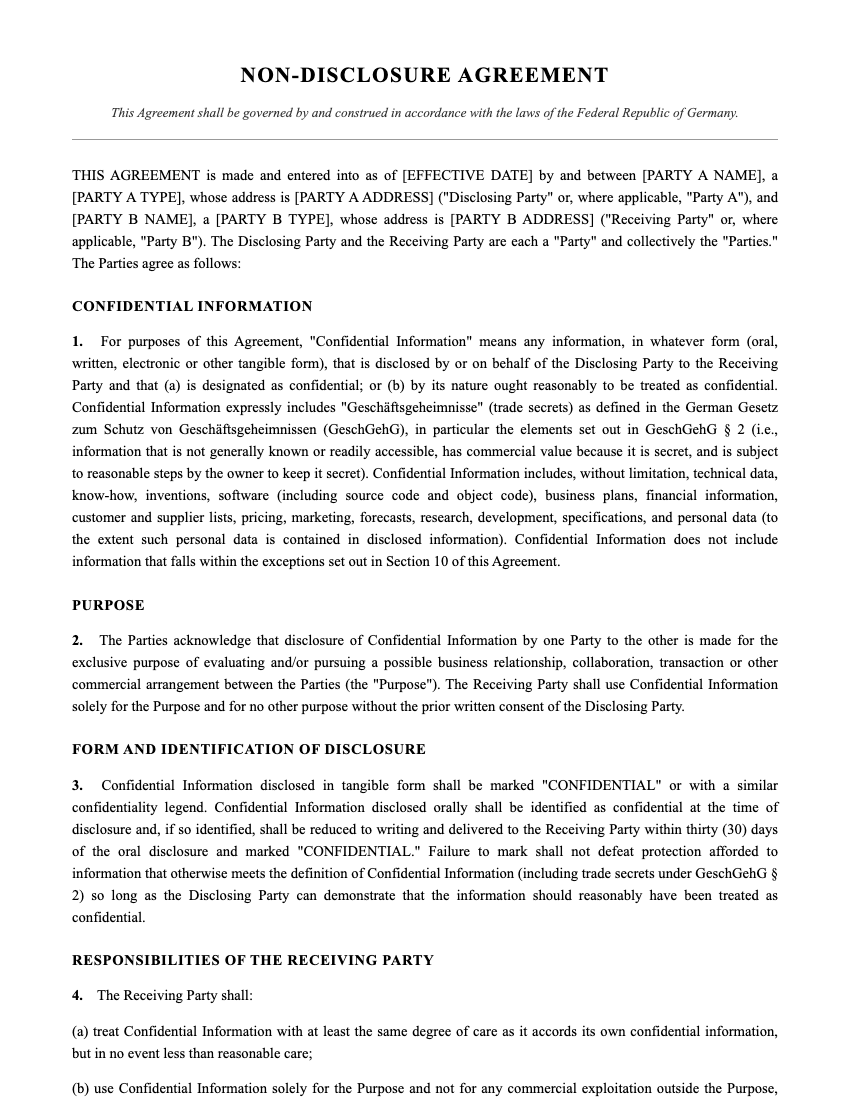
A Germany Non‑Disclosure Agreement (NDA) is a contractual tool to protect confidential business information and trade secrets while complying with Germany’s codified rules on trade secrets, employment restraints, and data protection. Unlike many common online templates created for common‑law jurisdictions, German law imposes statutory limits on post‑employment restraints (Karenz), specific compensation requirements, and strict data‑processing obligations under the GDPR and BDSG.
What is a Germany NDA?
Definition: In Germany an NDA is a bilateral or unilateral contract that obliges the recipient to keep disclosed information confidential and to use it only for a defined Purpose. Trade‑secret protection is primarily governed by the Act on the Protection of Trade Secrets (Gesetz zum Schutz von Geschäftsgeheimnissen, GeschGehG, 2019) which codifies the EU Trade Secrets Directive. Employment‑related restraints are governed by the Commercial Code (Handelsgesetzbuch, HGB), notably § 74a HGB for post‑contractual non‑competes.
This matters because German courts will treat ordinary confidential information differently from "Geschäftsgeheimnisse" (trade secrets) under GeschGehG, and employment restraints must meet statutory form, compensation and duration rules to be valid.
For a complete guide to NDA terms, duration, and standard exclusions, see our NDA Agreement Guide.
Why “Generic” NDAs Are Dangerous in Germany
Many English‑language NDA templates ignore European and German specifics. Using them risks three common traps:
- Post‑employment restraints without lawful compensation. Under § 74a HGB a post‑contractual non‑compete (Karenz) against an employee is only valid if the employer pays a Karenzentschädigung — statutorily at least 50% of the employee’s contractual remuneration for the restriction period — and the agreed duration cannot exceed two years. A template that attempts to bar future competitive activity without compensation is void and may give rise to employee claims.
- Overbroad trade‑secret claims. The GeschGehG (2019) protects information that (a) is secret, (b) has commercial value from being secret, and (c) has been subject to reasonable secrecy measures. Calling everything a "trade secret" can backfire: courts may refuse injunctive relief or damages if the employer hasn’t shown reasonable protective steps.
- GDPR and processor rules. If your NDA contemplates personal data processing, it must respect GDPR obligations — including Article 28 on processor contracts — and Germany’s Bundesdatenschutzgesetz (BDSG). An NDA that ignores data processing agreements (DPAs), security measures, or cross‑border transfer rules will not satisfy supervisory authorities.
Paradigm‑shifting insight: In Germany the real drafting danger is not a "backdoor non‑compete" ban (like California) but the "Karenzentschädigung trap": any post‑employment restraint must either be a civil law non‑compete compliant with § 74a HGB (with at least 50% compensation and max two years), or it will be void. In practice that means NDAs and employment‑related confidentiality clauses must avoid wording that functions as a disguised Karenz unless you intend to pay statutory compensation.
Recent legal development (real and verifiable)
Germany implemented the EU Trade Secrets Directive through the GeschGehG (effective April 2019), aligning trade‑secret remedies with EU standards. At the same time, § 74a HGB remains the controlling provision for post‑employment restraints and Karenzentschädigung (compensation). These statutory anchors are the baseline for any enforceability analysis.
Key Clauses in the German NDA Template
- Purpose and scope: narrowly define the purpose to avoid open‑ended restrictions under BGB contract law.
- Trade‑secret definition: follow GeschGehG criteria — secrecy, commercial value, and protective measures — instead of blanket labels.
- Employee carve‑outs: for employment relationships, avoid post‑employment restraints disguised as confidentiality. If a post‑contractual restriction is intended, include explicit reference to § 74a HGB and the agreed Karenzentschädigung amount and duration.
- Data processing: if personal data is processed, include or attach a GDPR‑compliant Data Processing Agreement (DPA) meeting Article 28 requirements and specify security measures.
- Exceptions: public domain, prior knowledge, independent development, and compelled disclosure (lawful reporting to authorities, courts) — German public policy bars clauses preventing statutory whistleblowing.
- Remedies and injunctive relief: reflect GeschGehG remedies and German procedural norms; consider cost‑shifting language consistent with BGB.
Mutual vs. Unilateral
- Unilateral (One‑Way): Use when you alone disclose (e.g., sharing tech specs with a supplier). Simpler, fewer obligations.
- Mutual (Two‑Way): Use for co‑development, M&A due diligence, or partnership talks where both sides exchange secrets.
Using a mutual NDA when only one party discloses can create unnecessary reciprocal obligations; using a unilateral NDA where both disclose can leave gaps.
Who Needs This Document?
| User Persona | Usage Scenario | Key German Benefit |
|---|---|---|
| German startups | Pitching to investors or OEMs | Protects pitch material while showing reasonable secrecy measures required by GeschGehG |
| Employers | Hiring employees and seeking confidentiality | Avoids disguised Karenz — prevents invalid post‑employment restraints without statutory compensation |
| Software vendors | Licensing code to clients | Adds GDPR‑compliant DPA and trade‑secret protections for source code |
| Manufacturers | Sharing prototypes with contract manufacturers | Limits disclosure and documents protective steps to meet GeschGehG standards |
How to Execute a Valid Germany NDA
- Choose the correct type (Unilateral vs Mutual) and specify the Purpose.
- Mark and document secrecy measures (watermarks, access logs, nondisclosure stamping) — necessary evidence under GeschGehG.
- If the recipient will process personal data, attach a GDPR Article 28 DPA describing technical and organizational measures.
- Sign before sharing. While e‑signatures are recognized across the EU (eIDAS Regulation), keep written evidence of execution and date to meet German evidentiary expectations.
Already Receiving NDAs from Clients?
Review incoming NDAs for any disguised Karenz language, ambiguous purposes, missing DPA terms, or clauses that attempt to prevent lawful reporting to authorities. If you see a post‑employment restraint with no compensation spelled out, negotiate it out or require proper Karenzentschädigung and § 74a HGB compliance.
an AI contract review tool (our AI contract review) can instantly flag German‑law red flags — disguised Karenz, weak trade‑secret proof, missing GDPR DPA terms — and point you to corrective language to use in negotiations.
Related NDA Templates
Get the Template
Sign up for our newsletter to receive the template.
Frequently Asked Questions

About Designer Content
Designer Content creates practical legal document resources for landlords, contractors, and small business owners. We simplify complex legal concepts into actionable guidance. Connect with us on LinkedIn.