
A Guatemala Master Services Agreement (MSA) is a master framework contract that sets the legal and commercial rules for a recurring services relationship in Guatemala, with each specific project defined by a “Statement of Work” (SOW) or scope of work.
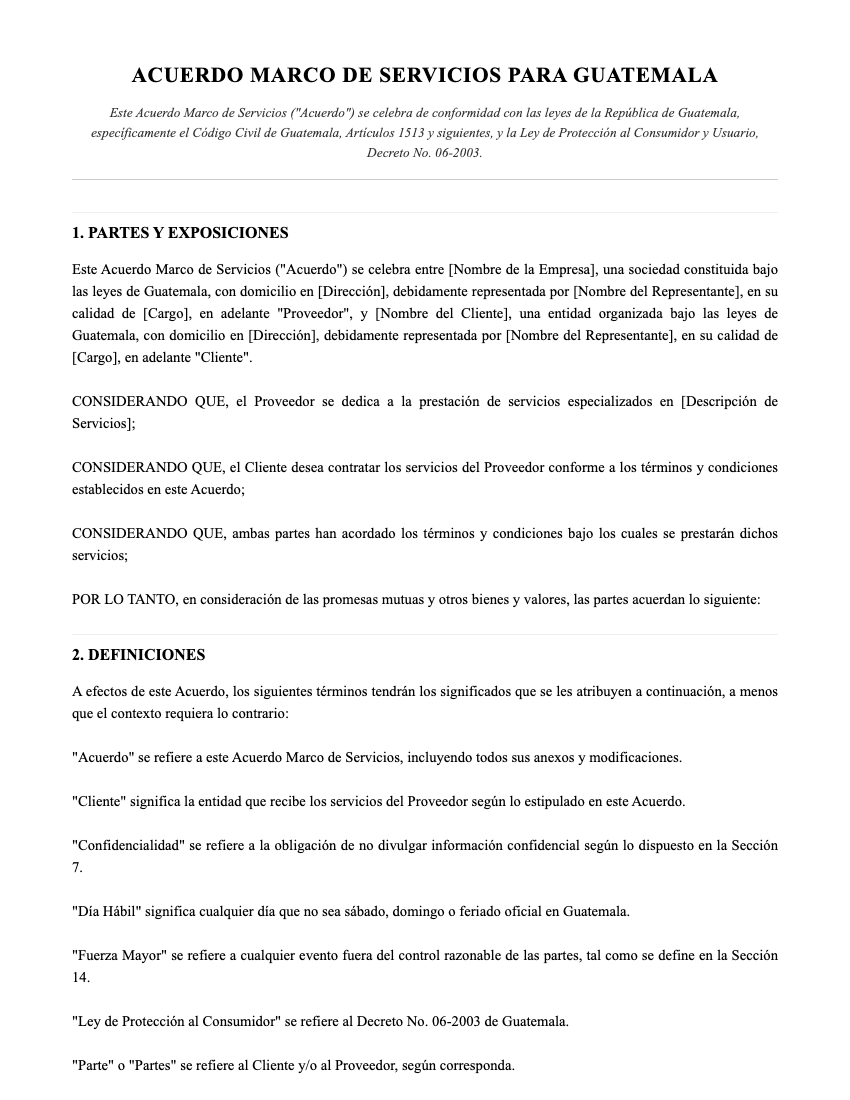
What is an MSA in Guatemala and why is it used?
In Guatemalan B2B practice, the MSA acts as an umbrella: it defines payments, terms, confidentiality, intellectual property, liability, and dispute resolution for all future projects between the same parties. This means you don’t renegotiate the essentials every time there is a new requirement; you simply sign an SOW with deliverables, schedule, price, and responsible parties. For SMEs, consultants, and agencies, this reduces commercial friction and lowers the risk of misunderstandings.
Definition: A Master Services Agreement (MSA) in Guatemala is a civil/mercantile contract of ongoing execution between a “Provider” and a “Client” that establishes general conditions applicable to multiple future services, complemented by SOWs that detail each project. It must comply with the contractual validity requirements of the Civil Code (for example, capacity, consent and lawful object) and provide how scope changes, acceptance of deliverables, and payments will be documented. Being in a system of civil law, what is agreed in writing (and its proof) is key: the MSA orders the relationship and facilitates enforcement, collection, and indemnities.
For a comprehensive guide to structuring MSAs and SOWs that protect your business, see our Freelancer Contracts Guide.
Why You Cannot Use a Generic MSA in Guatemala
Using a generic template (for example, copied from the U.S. or another country) typically falls short in Guatemala for three reasons: (1) the line between “independent services” and an employment relationship depends on the reality of the service provision, not merely on a contractual label; (2) non-compete clauses require careful handling under labor law and the freedom of industry/commerce; and (3) intellectual property (IP) and assignment of rights require clear formalities to avoid the client paying but not acquiring rights sufficient to exploit the work.
3a. Worker Classification Rules
Guatemala does not use an “ABC test” like certain U.S. states. Instead, classification is determined by the reality of the relationship under the Labor Code (Decree 1441): if typical features of an employment relationship exist, the contract will be treated as subordinate work even if the document says “contractor.” In simple terms, the focus is on subordination/dependence (direction, time control, orders, integration into the client’s structure) and on personal, continuous performance.
This matters because a generic MSA often includes excessive client control (schedules, broad exclusivity, employee-style reporting) that, in a dispute, can support a labor claim. The practical consequence can be the obligation to pay benefits and labor rights (for example, vacation, Aguinaldo/bonus, severance) and related charges, in addition to administrative fines depending on the case. Therefore, a Guatemalan MSA that is well drafted should: (i) describe the service as independent, (ii) limit controls to results/deliverables, (iii) allow subcontracting when applicable, and (iv) document payments against invoices/receipts and milestone acceptance. It is also advisable to reinforce the contractual requirements of the Civil Code, Article 1513 (elements and validity of the contract) so that the SOW structure is enforceable.
3b. Non-Compete Enforceability
In Guatemala, “no competition” clauses are not regulated as a single block in the Civil Code; their validity depends on compatibility with labor/constitutional principles and whether they are reasonable and tied to a legitimate interest. In the labor context, post-employment restrictions are particularly sensitive because they can clash with the right to work and the freedom of industry. In B2B relationships (independent supplier/company), restrictions can be agreed, but they must be proportional: limited duration, geographically/sectorally bounded scope, and a clear purpose (to protect secrets, clientele, or know-how), avoiding absolute prohibitions.
A generic template typically includes a broad prohibition (“do not compete for 2–5 years anywhere in the world”) that can become hard to defend. A stronger approach for Guatemala is to use alternatives usually more defensible: robust confidentiality, protection of trade secrets, limitation on use of information, and non-solicitation (not soliciting identified employees or clients) with reasonable limits. If you still need a non-compete, it helps to: (i) define precisely the prohibited line of business/activity, (ii) limit the term (for example, 6–12 months, depending on the case), (iii) limit the territory to where the client actually operates, and (iv) justify the legitimate interest.
In any case, the enforceability base anchors in the validity of consent/object lawful (e.g., Civil Code, Article 1513) and in general rules of obligations and civil liability (e.g., Civil Code, Article 1645 on liability for breach/damages, as drafted in the Code). The MSA should draft realistic remedies: cessation, return or destruction of information, and provable damages, avoiding disproportionate penalties.
3c. IP/Work-for-Hire Considerations
Guatemala typically requires written clarity for the assignment of proprietary rights in works (software, designs, texts, photos) and to authorize their exploitation by the client. A foreign template that merely says “work made for hire” may not be sufficient if there is no explicit and detailed transfer of rights (scope, territories, modes of exploitation). Therefore the MSA should: (i) differentiate IP preexisting to the provider vs. IP created in the project, (ii) specify whether there is a transfer or license, and (iii) condition the delivery of source files/final assignment on full payment, reinforcing traceability with SOWs.
What’s Included in This Template
Flexible SOW Structure
The MSA sets permanent rules (invoicing, acceptance, changes, confidentiality), and each SOW describes deliverables, milestones, price, and acceptance criteria. This reduces “scope creep” because any change is documented in writing before execution.
Guatemala-Specific Indemnification
Indemnification is structured as an obligation to compensate for breach or for damages caused, aligned with the general rules of contractual liability under the Civil Code (e.g., Article 1645) and with reasonable limits (cap per SOW, exclusions for force majeure and for client fault).
Dispute Resolution and Venue
The template fixes jurisdiction and venue in the courts of the Guatemala City, avoiding distant forums or boilerplate clauses that refer to foreign laws. It also includes escalation: executive negotiation and formal prior notice before filing.
Other provisions included (with citations):
- Guatemalan Civil Code (references to Arts. 1513, 1572, 1574 and 1645) — Superintendence of Banks (SIB) - Regulations
- Consumer Protection and User Law, Decree Number 06-2003 — DIACO (Consumer Protection and Assistance Directorate)
- Guatemala Labor Code, Decree 1441 (criteria for employment relationship and obligations) — Ministry of Labor and Social Welfare (MINTRAB)
- Guatemala Judicial Branch (institutional information and locations/jurisdiction) — Judicial Branch
- Guatemala Intellectual Property Registry (procedures and IP framework) — Intellectual Property Registry (RPI)
Who Needs This Document?
| User Type | Relationship | Key Benefit |
|---|---|---|
| Marketing agency | Monthly retainers with companies | Quick SOWs for campaigns and scope changes |
| Software developer | Milestone-based projects | IP and deliverables conditioned on payment and acceptance |
| Consultant (finance/operations) | Recurring advisory | Defines rates, reimbursements, and confidentiality |
| Creative studio | Production of pieces and content | Clear assignment/license and review rules |
How to Use This MSA Template
Step 1: Identify the parties correctly
Use the full legal name, entity type, and address. If someone signs on behalf of a company, document their authority to avoid capacity/consent disputes.
Step 2: Define the term and termination
Choose a fixed term or an open term with prior notice. Define what happens to ongoing SOWs, outstanding payments, and the return of information upon termination.
Step 3: Attach your first SOW
Do not put the scope in the MSA. In the SOW include deliverables, schedule, acceptance criteria, price, taxes, and who approves changes.
Step 4: Sign and operate with written changes
Sign the MSA once and then sign SOWs per project. Any extension should go in a change order to avoid unpaid work.
Related MSA Templates
Get the Template
Sign up for our newsletter to receive the template.
Frequently Asked Questions

About Designer Content
Designer Content creates practical legal document resources for landlords, contractors, and small business owners. We simplify complex legal concepts into actionable guidance. Connect with us on LinkedIn.