
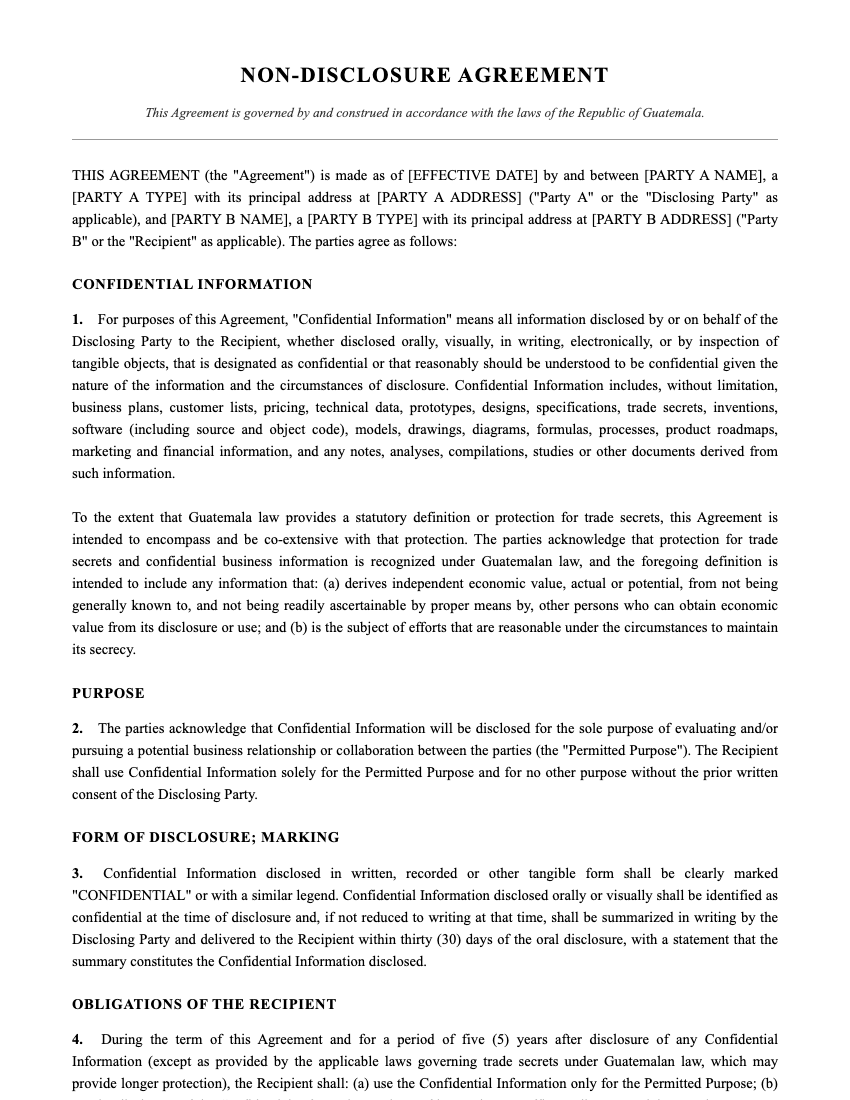
A Guatemala Non-Disclosure Agreement (NDA) is a written contract used to preserve confidentiality of business information in a civil‑law system where formalities and evidentiary proof matter. Because Guatemala does not have a single, modern federal statute called a “Trade Secrets Act,” confidentiality is enforced through contract, general civil delict principles in the Código Civil, criminal provisions for theft or industrial espionage, and sectoral laws such as the Ley de Protección al Consumidor y Usuario. This template helps you draft an NDA that works within that layered framework.
What is a Guatemala NDA?
Definition: A Guatemala NDA is a contractual instrument that obliges one or both parties to refrain from disclosing or misusing confidential information. It establishes the information scope, permitted uses, term, remedies for breach, and any special formalities required by civil practice.
In Guatemala, contractual freedom is broad, but courts and enforcement mechanisms follow the Código Civil and Código Penal principles. Importantly, most contractual claims in Guatemala prescribe in five years for ordinary obligations—so you should be aware of the prescripción period when drafting enforcement strategies.
For a complete guide to NDA terms, duration, and standard exclusions, see our NDA Agreement Guide.
Why generic NDAs are dangerous in Guatemala
Generic NDA templates (often written for common‑law U.S. states) miss three Guatemala‑specific traps:
- Formality and evidence: Guatemala’s civil procedure values written instruments and proof of secrecy measures. An NDA that isn’t clearly written, dated, and signed can be ineffective when you must prove “reasonable secrecy efforts.”
- Fragmented protection for trade secrets: There is no single Guatemalan statute titled “Trade Secrets Act.” Trade secrets are protected by contract, tort principles in the Código Civil, criminal provisions for theft or unfair competition, and sectoral rules (e.g., consumer protection for deceptive practices). Templates that rely on a specific statutory scheme (like the U.S. DTSA/CUTSA) will not translate directly.
- Consumer‑protection and employment constraints: The Ley de Protección al Consumidor y Usuario limits certain contractual clauses in consumer relationships and may make sweeping confidentiality language unenforceable in consumer contracts. Likewise, restraints in employment contexts may be scrutinized under labor rules and public policy.
Paradigm‑shifting insight: In Guatemala the real enforcement problem is not the existence of a trade‑secret statute but proving the secrecy and managing prescripción. Because civil claims generally prescribe in five years, an NDA must (1) define secrecy measures, (2) document disclosure and access control, and (3) include contractual acknowledgment of the prescriptive period or alternative remedies (e.g., injunctive relief) to preserve interim protection.
Real case study / development: In recent years Guatemalan courts and enforcement authorities have emphasized documentary proof of secrecy and the consumer‑protection overlay. See decisions and guidance where courts declined to grant contractual damages when the disclosing party failed to show adequate confidentiality measures or used overly broad "trade secret" labels. (Refer to Diario de Centro América publications and court rulings from the Organismo Judicial on contract evidence.)
Key Clauses adapted for Guatemala practice
- Clear definition of Confidential Information: Distinguish tangible documents, electronic files, customer lists, formulas, and processes. Avoid labeling everything a "trade secret" without facts that show secrecy and commercial value.
- Purpose limitation: Limit use to a specific purpose (e.g., "evaluation of a proposed distribution agreement for Product X in Guatemala"). Civil courts enforce contractual limits closely.
- Term and prescripción: State the confidentiality term (typical: 2–5 years for general commercial information; indefinite protection for bona fide secrets), and address the five‑year prescripción for civil claims—include language preserving interim injunctive relief.
- Reasonable secrecy measures: Specify marking, access controls, and return/destruction procedures. Guatemalan tribunals look for these to find a breach of duty.
- Employee and contractor flowdowns: Require recipients to bind employees/contractors by written obligations and keep records.
- Remedies and injunctive relief: Include explicit injunctive relief provisions and choice of forum (Guatemalan courts; consider arbitration for international disputes). Consider declaring the governing law as Guatemalan law if parties agree.
- Exclusions: Public domain, independently developed information, prior knowledge, and compelled disclosure.
Mutual vs Unilateral
- One‑way (Unilateral): Use when only you disclose—investor pitches, supplier specs to a manufacturer.
- Mutual: Use when both sides exchange sensitive data—JV talks, M&A due diligence.
Choosing mutual when only one side shares creates avoidable reciprocal obligations; choosing unilateral when both share leaves gaps.
Who needs this document?
| User Persona | Usage Scenario | Key Guatemala Benefit |
|---|---|---|
| Exporters/importers | Sharing product specs with local manufacturers | Keeps manufacturing methods confidential while complying with contract evidence rules |
| Technology startups | NDA with developers and early investors | Documents secrecy measures essential for later enforcement in Guatemalan courts |
| Lawyers & advisors | Due diligence in asset sales | Limits data use and fits civil‑law evidentiary expectations |
| Employers | Protecting client lists and processes | Flowdown clauses to contractors and employees; watch labor limits |
How to execute a valid Guatemala NDA
- Put it in writing and sign: Civil practice favors signed documents. Include dates and signatory capacity (e.g., "Gerente General").
- Identify the signatory capacity and attach corporate documents if signed on behalf of a company.
- Mark confidential materials and keep records showing who accessed them and when.
- Sign before sharing: never send sensitive files before execution.
an AI contract review tool: Use an AI contract review tool to spot risky clauses, compare terms against Guatemalan civil‑law norms, and flag missing secrecy‑proof language—saving hours of manual review.
Related NDA Templates
Get the Template
Sign up for our newsletter to receive the template.
Frequently Asked Questions

About Designer Content
Designer Content creates practical legal document resources for landlords, contractors, and small business owners. We simplify complex legal concepts into actionable guidance. Connect with us on LinkedIn.