
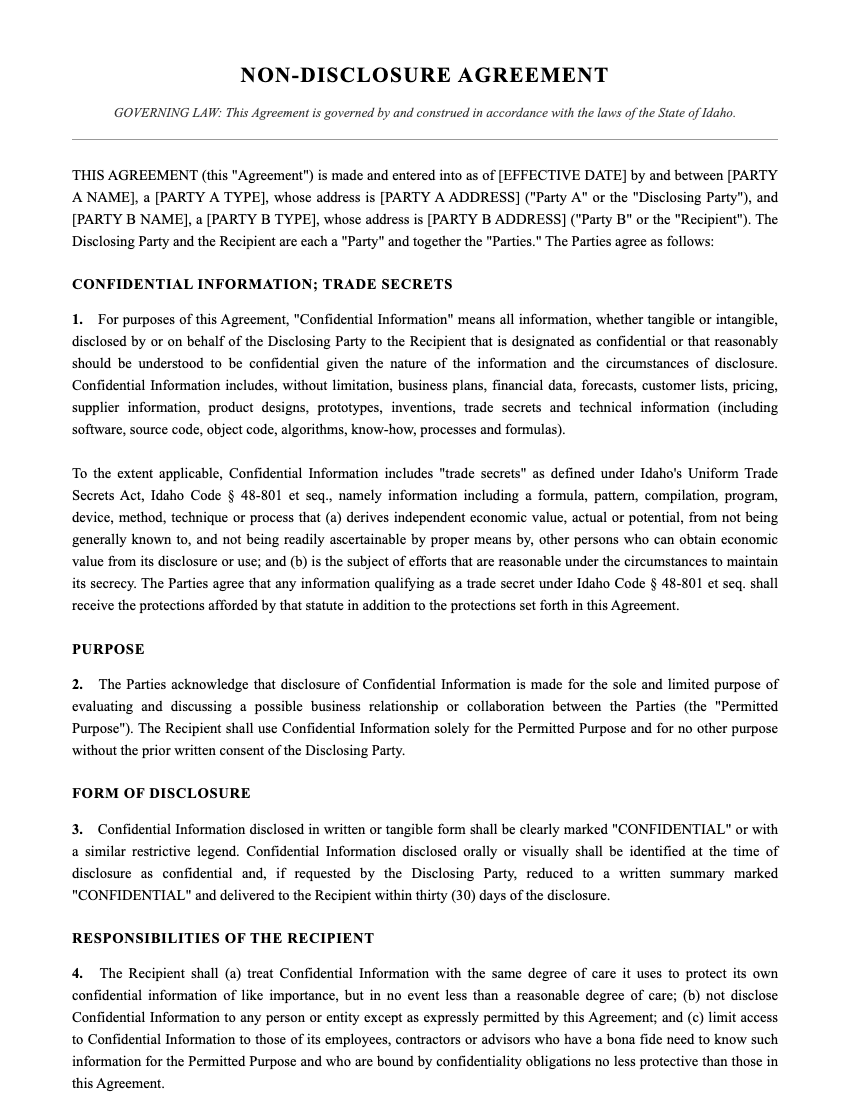
An Idaho Non‑Disclosure Agreement (NDA) is a contract that lets businesses, founders, and service providers share confidential information while protecting trade secrets and other proprietary assets under Idaho law. Unlike some states that void most non‑competes, Idaho courts generally enforce non‑compete and restrictive covenants if they are reasonable and supported by legitimate business interests. This template is drafted for Idaho: it balances enforceability, statutory limits, and best practices.
What Is an Idaho NDA?
Definition: An Idaho NDA is a written contract in which one or both parties agree to keep specified information confidential and to use it only for a defined purpose. Breach claims for written contracts in Idaho are governed by a five‑year statute of limitations (Idaho Code § 5‑216), so NDAs should be written, dated, and signed to preserve remedies.
In Idaho there is no statewide ban on non‑competes. Instead, courts apply traditional reasonableness tests—examining scope, duration, geography, and legitimate business interests such as protecting trade secrets or goodwill. Idaho also treats trade secrets under a statutory scheme adapted from the Uniform Trade Secrets Act; those claims often overlap with NDA enforcement.
For a complete guide to NDA terms, duration, and standard exclusions, see our NDA Agreement Guide.
Why Generic NDAs Are Dangerous in Idaho
Many downloadable NDAs are written for either permissive or hostile jurisdictions. Using a generic NDA in Idaho can create three serious risks:
- Overbroad restrictions that exceed what Idaho courts will enforce
- Missing statutory hooks (trade secret definitions and DTSA notice) that affect remedies
- Procedural problems that cut off claims (unsigned or oral NDAs subject to I.C. § 5‑216 timing and evidentiary issues)
Local drafting traps to avoid
- "Catch‑all" non‑compete language: A one‑sentence ban on competing may be enforceable or may be rejected as overbroad. Idaho courts evaluate reasonableness; your clause should tie restrictions to specific legitimate interests (sale of a business, protection of customer lists, trade secrets).
- Failing to define trade secrets: Treat trade secrets as a distinct, more durable category. Labeling everything a “trade secret” dilutes claims. Use objective criteria—economic value from secrecy, reasonable efforts to keep it secret (passwords, marked documents, limited distribution).
- Missing DTSA whistleblower/filing notice: If you might litigate in federal court under the Defend Trade Secrets Act (DTSA, 18 U.S.C. § 1833(b)), include the federal whistleblower notice to avoid losing the ability to recover enhanced damages and attorney’s fees.
Paradigm‑shifting insight specific to Idaho
Idaho combines broad contractual freedom with a strict statute of limitations for written claims (I.C. § 5‑216). That means: get it in writing, get it signed, and tie restrictions to a legitimate, documented interest. An enforceable non‑compete or confidentiality obligation in Idaho is often less about forbidding competition outright and more about (a) showing adequate consideration, (b) proving a protectable interest (trade secrets, unique client lists, goodwill), and (c) drafting scope and duration narrowly. Because Idaho will enforce reasonable restraints, careless or vague drafting can convert an otherwise valuable protection into a costly, litigable issue.
Real case study / development
Idaho courts have consistently enforced reasonable restrictive covenants when tailored to protect trade secrets or the sale of a business. Local counsel and Idaho employment practitioners regularly note that NDAs tied to clear business interests (customer lists created by the employer, technical formulas, source code with documented access controls) survive judicial scrutiny. Bear in mind: litigation outcomes turn on facts; a narrowly tailored NDA that documents secrecy measures and consideration is far more defensible than a boilerplate, catch‑all agreement.
Key Clauses — Idaho‑focused
- Definitions: Distinguish "Confidential Information" (time‑limited, specified categories) from "Trade Secrets" (indefinite protection while secret; follow the elements adopted under Idaho’s trade secret law).
- Scope & Purpose: Limit use to a narrow business purpose (e.g., "evaluating the purchase of X product line") and prohibit disclosure except to employees or advisors who need to know and are bound by similar obligations.
- Duration: For general confidential info, pick a fixed term (e.g., 2–5 years). For trade secrets, allow protection for the life of the secret.
- Non‑Compete / Non‑Solicit: If included, state specific geographic scope, time, and the business interest being protected (sale of business, customer relationships, trade secrets). Draft narrowly to survive Idaho’s reasonableness review.
- Residuals: Optional clause addressing unaided memory and general skills; consider including a limited residuals provision if you expect dispute in knowledge‑intensive roles.
- Mandatory Carve‑Outs: Exclude information that is public, already known, independently developed, or required by law to be disclosed. Include DTSA whistleblower notice language to preserve federal remedies.
- Remedies & Limitations: Include injunctive relief and liquidated damages only if reasonable under Idaho law; punitive or unconscionable remedies may be struck down.
Who Needs This Document?
| User Persona | Usage Scenario | Idaho Benefit |
|---|---|---|
| Tech startups (Boise, Idaho Falls) | Sharing source code with contractors | Preserves trade secret claims while allowing developers to work in the industry if residuals language is reasonable |
| Manufacturers (Magic Valley) | Providing designs to vendors | Prevents unauthorized manufacture and enforces confidentiality tied to trade secrets |
| Employers | Hiring executives with client relationships | Narrow non‑competes/non‑solicits protect legitimate customer goodwill under Idaho precedent |
| Sellers of a business | Due diligence in M&A | Protects buyer’s access to confidential financials during negotiations |
How to Execute a Valid Idaho NDA (Practical Steps)
Step 1 — Put it in writing: Idaho’s five‑year statute for written contracts (I.C. § 5‑216) favors written, dated agreements.
Step 2 — Define the purpose: A specific Purpose limits use and supports enforceability. General "business discussions" are weaker.
Step 3 — Show secrecy measures: Mark documents "CONFIDENTIAL," restrict distribution, and log access—evidence courts expect for trade secret claims.
Step 4 — Sign before sharing: Get signatures (wet or electronic) before disclosure. Preserve proof of execution and transmission dates; this matters for deadlines and damages.
Receiving an NDA? Read these Idaho red flags
If a counterparty sends you a one‑sided NDA with broad non‑compete language, ask for specificity: duration, geography, and stated business interest. Without that, Idaho courts may refuse to rewrite an overly broad clause but could also enforce it in part—meaning a negotiated precise clause is safer than a litigation gamble.
an AI contract review tool can instantly flag ambiguous non‑compete language, missing DTSA notice, and other Idaho‑specific hazards—saving review time and negotiation risk.
Related NDA Templates
Get the Template
Sign up for our newsletter to receive the template.
Frequently Asked Questions

About Designer Content
Designer Content creates practical legal document resources for landlords, contractors, and small business owners. We simplify complex legal concepts into actionable guidance. Connect with us on LinkedIn.