
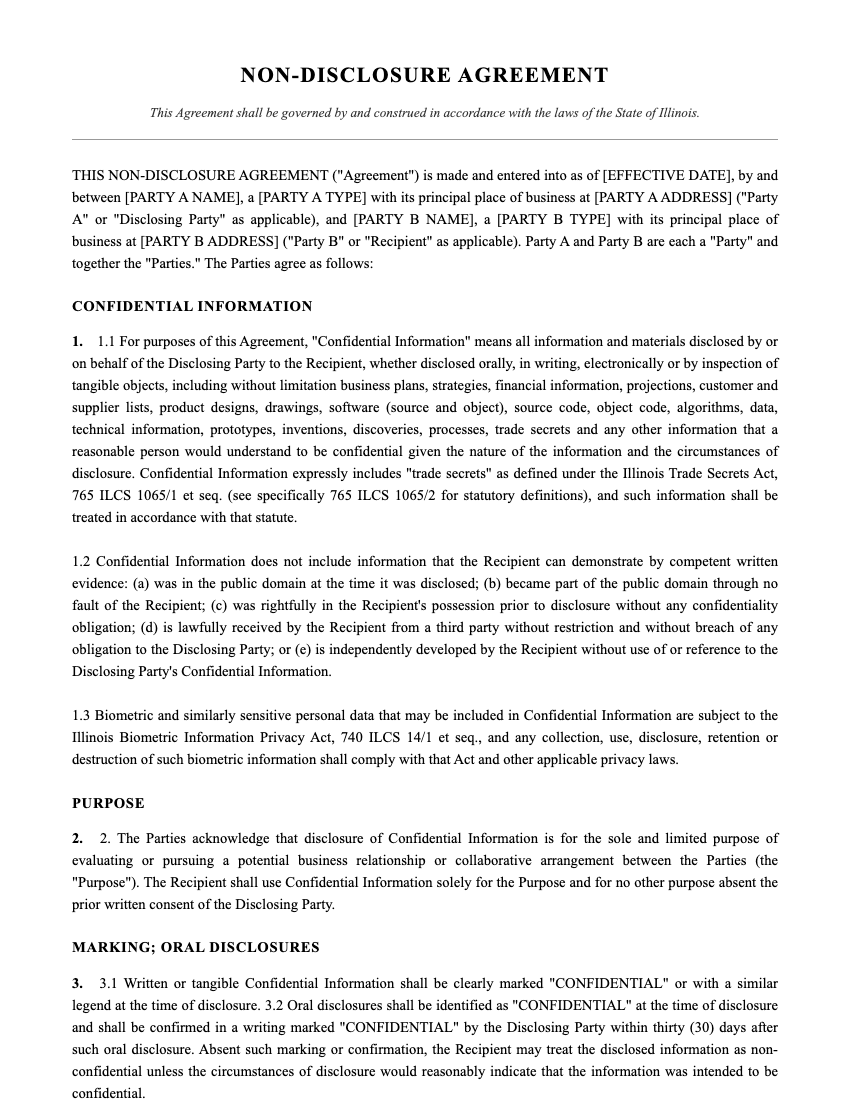
An Illinois Non-Disclosure Agreement (NDA) is a contract that protects confidential business information and trade secrets while respecting Illinois statutes limiting enforceable restraints on employment. This template is tailored to Illinois law: it protects what courts and statutes recognize as confidential or secret (765 ILCS 1065) while avoiding clauses that may be treated as prohibited non-competes under the Freedom to Work Act (820 ILCS 90) or reformed by Illinois courts.
What Is an Illinois NDA?
Definition: An Illinois NDA is a written agreement where a party (Receiving Party) promises to keep another party’s (Disclosing Party’s) confidential information from disclosure or improper use. In Illinois, a valid NDA focuses on protecting trade secrets under the Illinois Trade Secrets Act (765 ILCS 1065) and other confidential business information without unlawfully restraining the Receiving Party’s right to work.
Illinois law strikes a practical balance: employers and businesses can protect trade secrets and customer lists, but restrictions that function as employment restraints can be limited or void—especially for low‑wage workers protected by the Freedom to Work Act (820 ILCS 90). Courts in Illinois also apply doctrinal tools (including severability/blue‑pencil approaches) to reform or strike overbroad language rather than void entire agreements in some cases.
For a complete guide to NDA terms, duration, and standard exclusions, see our NDA Agreement Guide.
Why "Generic" NDAs Are Dangerous in Illinois
Generic NDA forms often borrow broad restrictive language from jurisdictions that permit wider non‑competes. In Illinois those same clauses can create three distinct hazards:
- Backdoor employment restraints. Language that forbids the Receiving Party from "using Confidential Information to compete" or contains broad "no solicitation/no hire" provisions can be recharacterized as a non‑compete. If the covered worker falls within statutory protections (e.g., the Freedom to Work Act’s low‑wage protections) or the clause is deemed an unreasonable restraint, courts may refuse to enforce it or strike the problematic portions.
- Missing DTSA whistleblower notice. The federal Defend Trade Secrets Act requires employers to include notice of whistleblower immunity (18 U.S.C. § 1833(b)) in certain circumstances if they want access to enhanced damages or attorney’s fees in a federal trade‑secret action. Many templates omit this and thereby limit remedies in federal court.
- Biometric and privacy traps. Illinois’s Biometric Information Privacy Act (BIPA, 740 ILCS 14) creates private rights and statutory damages for mishandling biometric data. NDAs that attempt to waive BIPA rights or improperly require disclosure of biometric data can be unenforceable and expose the disclosing party to litigation (see Rosenbach v. Six Flags, Ill. 2019).
Paradigm-shifting insight for Illinois: Don’t treat NDAs as a substitute for enforceable restrictive covenants. Because the Freedom to Work Act and Illinois case law target overbroad employment restraints, NDAs must be narrowly drafted to protect information (not careers). Additionally, biometric and privacy rules can create separate litigation risk that an NDA cannot cure by blanket waiver.
Real case study / recent development
Rosenbach v. Six Flags Entertainment Corp., 2019 IL 123186 (Illinois Supreme Court), confirmed that BIPA creates individual standing and a private right of action—making biometric clauses in NDAs particularly sensitive. On the statutory front, Illinois’s Freedom to Work movement (codified at 820 ILCS 90) increased scrutiny of clauses that appear to limit mobility for low‑wage employees; employers should check current wage thresholds before relying on broad restraints.
What’s Included in This Template? (Key Clauses)
- Purpose clause: Narrowly defines why information is shared (e.g., "evaluating a potential vendor relationship for Project X").
- Precise Confidential Information definition: Separates "Trade Secrets" (as defined under 765 ILCS 1065) from general confidential business information.
- Use and non‑disclosure obligations: Limits use to the stated Purpose and prohibits disclosure except as required by law (with a protective process for compelled disclosure).
- Exclusions: Typical carve‑outs (public domain, prior knowledge, independently developed).
- Term and survival: Two‑tier protection—limited term (2–5 years) for non‑trade secret confidential info; indefinite protection for trade secrets so long as secrecy is maintained.
- DTSA whistleblower notice: Explicitly includes the 18 U.S.C. § 1833(b) language preserving whistleblower disclosures to government officials and the right to report misconduct.
- Assignment and invention assignment: Narrow drafting to avoid broad assignment clauses that could be interpreted as employment restraints.
- Data privacy and BIPA caution: Recommended language to avoid waiving BIPA rights and to specify biometric data handling only with compliance.
Mutual and unilateral versions are included so you can pick the form that fits whether one or both sides will disclose information.
Who Needs This Document?
| User Persona | Usage Scenario | Key Benefit (Illinois) |
|---|---|---|
| Startups (Chicago/IL) | Sharing pitch materials with investors | Protects deck as confidential without imposing unlawful mobility restraints |
| Employers | Hiring contractors or consultants | Protects IP and trade secrets while avoiding unlawful non‑compete language |
| Manufacturing | Working with suppliers | Limits supplier’s use of proprietary specs and enforces confidentiality in line with 765 ILCS 1065 |
| Healthcare vendors | Handling patient data and biometrics | Flags BIPA risks and avoids unenforceable waivers |
How to Execute a Valid Illinois NDA
- Choose the correct form (One‑Way vs. Mutual). If only you disclose, use One‑Way.
- Be specific about Purpose and listed Confidential Information—vague "business discussions" language invites reformation.
- Label materials as CONFIDENTIAL and keep records of access to show "reasonable efforts" to maintain secrecy under 765 ILCS 1065.
- Include DTSA whistleblower language (18 U.S.C. § 1833(b)) and avoid BIPA waivers; obtain consent and follow BIPA when collecting biometrics.
Illinois recognizes electronic signatures under the Uniform Electronic Transactions Act (UETA, 5 ILCS 175), so DocuSign or signed PDFs are generally enforceable—keep audit trails.
Already Receiving NDAs from Clients?
Review incoming NDAs for overbroad non‑solicit/no‑compete language, sweeping invention assignments, or attempts to waive statutory privacy rights. This template is for outgoing NDAs; use an AI contract review tool to flag Illinois‑specific risks instantly and compare clauses against 820 ILCS 90, 765 ILCS 1065, BIPA (740 ILCS 14), and DTSA standards.
Related NDA Templates
Get the Template
Sign up for our newsletter to receive the template.
Frequently Asked Questions

About Designer Content
Designer Content creates practical legal document resources for landlords, contractors, and small business owners. We simplify complex legal concepts into actionable guidance. Connect with us on LinkedIn.