
A India Master Services Agreement (MSA) is a long-form contract that sets the baseline legal terms for ongoing B2B services in India, so future projects can be added through short Statements of Work (SOWs). For SMBs, agencies, and consultants, an India-specific MSA helps avoid payment disputes, scope creep, and unclear ownership of deliverables. It also aligns your contract with Indian rules on restraint of trade, damages, and data protection. Done right, it speeds up deal cycles because the “legal boilerplate” is agreed once and reused.
Definition: An India Master Services Agreement is a governing contract between a service provider and a client where the parties agree upfront on core legal terms—payment, timelines, liability limits, intellectual property, confidentiality, data security, termination, and dispute resolution—under Indian law. Individual projects are then documented in one or more SOWs that specify deliverables, milestones, acceptance criteria, and fees. The MSA reduces renegotiation and makes enforcement easier by keeping essential terms consistent across engagements. In India, a strong MSA should be drafted with the Indian Contract Act, 1872 (including damages under Section 73), restraint-of-trade limits under Section 27, statutory limitation periods under the Limitation Act, 1963, and modern data duties under the Information Technology Act, 2000 and the Digital Personal Data Protection Act, 2023.
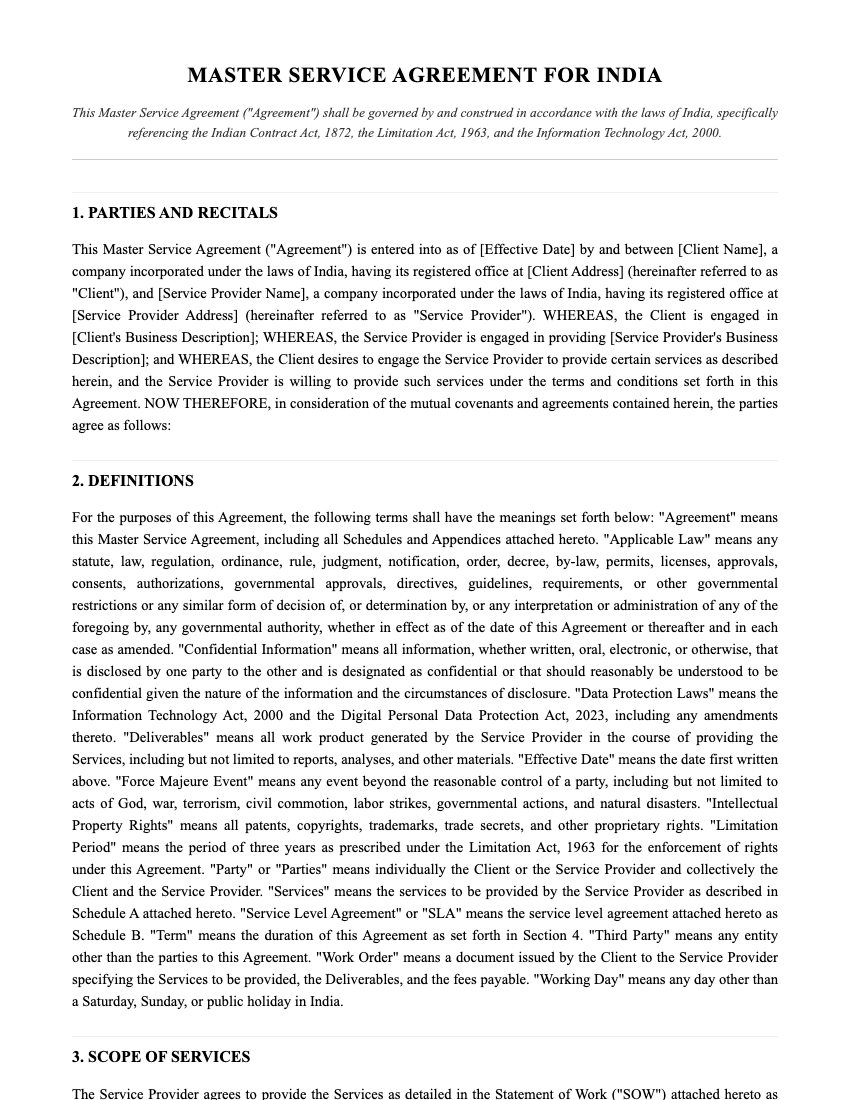
Why You Cannot Use a Generic MSA in India
Using a generic, “global” MSA (often copied from US/UK templates) can create unenforceable clauses or hidden compliance gaps in India. The biggest problems usually appear in worker classification language, non-compete restrictions, and intellectual property ownership—three areas where India’s rules differ sharply from many foreign templates.
3a. Worker Classification Rules
India does not use a single statutory “ABC test” for worker classification in B2B contracting. Instead, courts and regulators typically apply a common-law control-and-integration analysis (who controls how work is done, whether the person is integrated into the business, economic dependence, etc.). For practical contracting, the risk is that a “consultant” arrangement can be treated as an employment relationship when the client controls working hours, tools, place of work, and day-to-day supervision.
For a comprehensive guide to structuring MSAs and SOWs that protect your business, see our Freelancer Contracts Guide.
Misclassification exposure in India often shows up through labour and social-security compliance. For example, the Employees’ Provident Funds and Miscellaneous Provisions Act, 1952 can trigger provident fund obligations where an individual is effectively treated as an employee, and the Employees’ State Insurance Act, 1948 can create ESI contribution issues if conditions apply. In addition, certain shops and establishments laws at the state level can impose recordkeeping and employment-condition duties. A generic MSA that heavily directs “how” work must be performed (rather than “what” must be delivered) increases risk. India-focused MSAs typically emphasize independent business status, deliverable-based SOWs, invoicing, and the provider’s control over personnel—while still allowing reasonable client governance like security and acceptance testing.
3b. Non-Compete Enforceability
India is much stricter than many jurisdictions about non-competes during and after the relationship. Under Section 27 of the Indian Contract Act, 1872, “every agreement by which anyone is restrained from exercising a lawful profession, trade or business of any kind, is to that extent void,” subject to limited exceptions (notably sale of goodwill). In practice, post-termination non-compete clauses in service agreements are commonly unenforceable as a restraint of trade.
This is where generic MSAs fail: many templates include broad restrictions like “Provider shall not provide similar services to any competitor for 12–24 months.” In India, such clauses may be struck down, leaving the client with no effective protection and the provider with unnecessary negotiation friction.
Instead, India-usable alternatives include: (1) strong confidentiality and trade secret protections, (2) non-solicitation of employees or customers drafted narrowly and tied to legitimate interests, and (3) IP ownership and license boundaries that prevent reuse of client-specific materials. Your template should clearly separate an invalid “restraint on trade” from valid protections such as confidentiality and non-disclosure. It should also include survival language so confidentiality continues after termination (for a specified number of years or for trade secrets until they enter the public domain).
3c. IP/Work-for-Hire Considerations
A major India-specific issue is assuming that “work made for hire” language automatically transfers ownership. Under the Copyright Act, 1957, ownership can depend on authorship and the nature of the relationship; certain commissioned works have special rules, but service deliverables do not automatically become the client’s property just because they were paid for. Generic MSAs that rely on “work made for hire” phrasing (more US-centric) may leave gaps.
An India-ready MSA template should include a clear assignment clause for deliverables created under each SOW, along with a license-back (if needed) for provider tools, pre-existing materials, or reusable frameworks. It should also address moral rights considerations and require the provider to ensure its personnel sign compatible IP and confidentiality undertakings.
What's Included in This Template
Flexible SOW Structure
This template treats the MSA as the umbrella contract and each SOW as the project-specific add-on. The MSA covers legal and risk terms once, while the SOW captures scope, milestones, acceptance tests, and pricing. This reduces “scope creep” disputes because changes can be handled through written change requests tied to fees and timelines.
India-Specific Indemnification
The indemnity and damages structure is drafted to work with India’s contract damages framework, including compensation principles under Indian Contract Act, 1872, Section 73. It distinguishes third-party IP infringement claims, confidentiality breaches, and data security incidents, and pairs indemnities with realistic caps, exclusions, and procedures (notice, control of defence, mitigation).
Dispute Resolution and Venue
The dispute clause is built for India, with an arbitration option aligned to the Arbitration and Conciliation Act, 1996, including court appointment support under Section 11. It also specifies governing law (India) and a sensible seat/venue to avoid expensive cross-border enforcement complexity.
Additional India-tailored provisions include:
- Late-payment damages framing under Indian Contract Act, 1872, Section 73 (with a clear interest/charges clause drafted as reasonable pre-estimate where appropriate)
- Limitation period awareness under Limitation Act, 1963, Section 3 (claims filed after limitation may be dismissed)
- Data security and negligence compensation risk under Information Technology Act, 2000, Section 43A
- Personal data processing basis and duties under Digital Personal Data Protection Act, 2023, Section 4
Who Needs This Document?
| User Type | Relationship | Key Benefit |
|---|---|---|
| IT/Software Development Agencies | Milestone-based builds for Indian companies | Clear acceptance criteria and IP assignment tied to payment |
| Marketing & Creative Studios | Retainers and campaign SOWs | Controls scope creep and defines reusable “background IP” |
| Management/Tech Consultants | Advisory, audits, and implementation support | Sets liability caps and deliverable-based billing |
| SaaS Implementation Partners | Ongoing rollout/support services | Aligns data protection, confidentiality, and service levels |
How to Use This MSA Template
Step 1: Identify the right contracting parties
Use the exact legal names and addresses from MCA/registrations, and specify whether the provider is a company, LLP, partnership, or sole proprietor. Add authorized signatory details to avoid later authority disputes.
Step 2: Set the commercial model in the SOW
Keep deliverables, timelines, and fees in the SOW (not the MSA). Include milestones, acceptance tests, dependencies, and a change-control mechanism so extra work is billed and scheduled properly.
Step 3: Confirm IP, confidentiality, and data roles
If the provider will access personal data, clarify whether it acts on client instructions and what security measures apply. Use a clear IP assignment for SOW deliverables, and carve out provider pre-existing tools and templates.
Step 4: Choose dispute resolution (courts vs arbitration)
If you pick arbitration, specify the seat, language, and number of arbitrators, and align appointment language with the Arbitration and Conciliation Act, 1996. Also include escalation (good-faith negotiation) to reduce costs before formal proceedings.
Related MSA Templates
Get the Template
Sign up for our newsletter to receive the template.
Frequently Asked Questions

About Designer Content
Designer Content creates practical legal document resources for landlords, contractors, and small business owners. We simplify complex legal concepts into actionable guidance. Connect with us on LinkedIn.