
A India Non-Disclosure Agreement (NDA) is a contract that protects confidential business information while respecting India’s prohibition on unreasonable restraints of trade. Unlike jurisdictions with statutory trade secret regimes, India relies on contract law, equitable relief, and common-law principles to protect secrets—so drafting matters.
What Is an India NDA?
Definition: An India NDA is a contractual promise by one or more parties to keep specified information confidential and to use it only for a permitted purpose. Drafted correctly, it protects trade secrets and confidential business information without creating an unlawful restraint on trade under Section 27 of the Indian Contract Act, 1872 (Indian Contract Act, s.27).
Because s.27 renders agreements in restraint of trade void, Indian NDAs must avoid clauses that operate as de facto non-compete or blanket employment bans. At the same time, courts will enforce legitimately necessary confidentiality covenants and grant injunctions under the Specific Relief Act, 1963 (see Sections 37–39 on injunctions) where trade secrets are threatened.
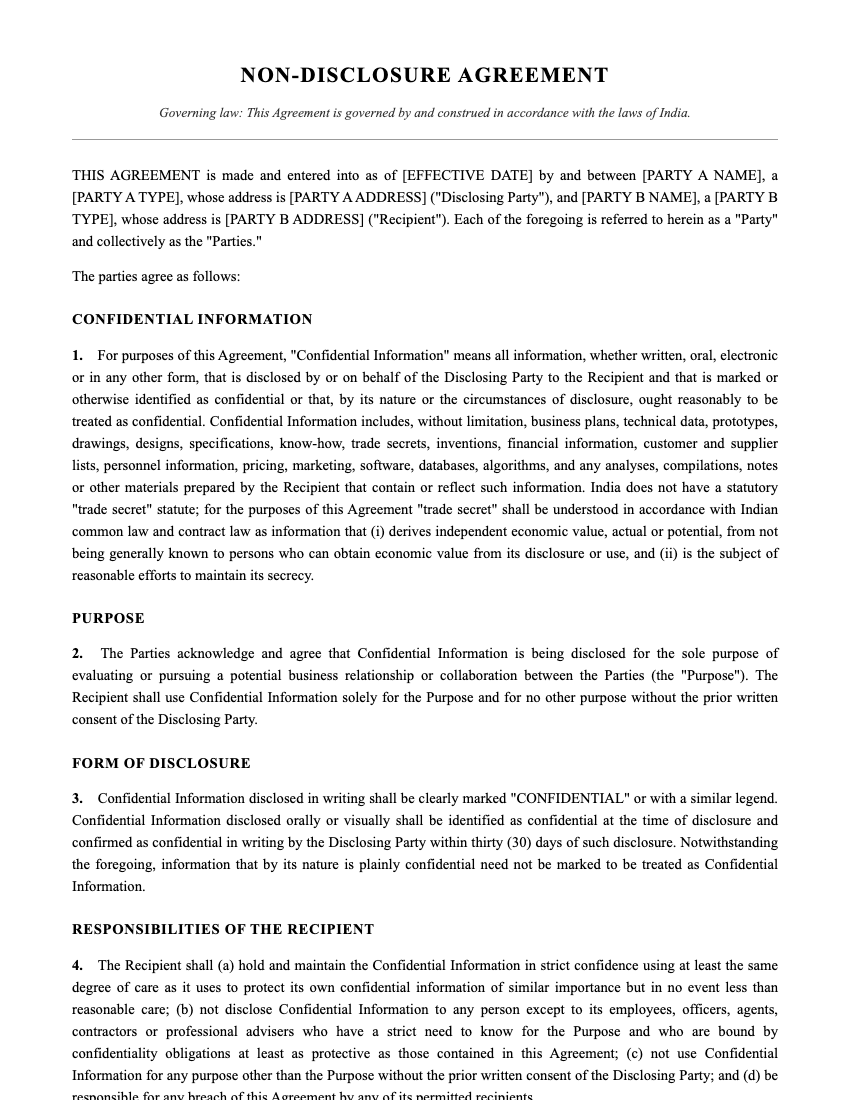
For a complete guide to NDA terms, duration, and standard exclusions, see our NDA Agreement Guide.
Why Generic NDAs Are Dangerous in India
Most online NDA templates are written for U.S. or English law and miss several India-specific traps.
- Section 27: the restraint-of-trade trap
Indian Contract Act, s.27 voids agreements that restrain anyone from exercising a lawful profession, trade or business. Templates that include broad “cannot work” or long territorial restrictions risk being struck down as void in their entirety. The leading Supreme Court authority on this remains Niranjan Shankar Golikari v. Century Spinning & Mfg. Co. Ltd. (1967) — which held that a wide restraint on employment was unenforceable. The paradigm-shifting insight for India: confidentiality clauses must be tailored to protect specific information, not to freeze a person’s career.
- “Colorable restraint” — disguise won’t work
Courts look beyond labels. A clause called “confidentiality” that prohibits a former employee from contacting clients or working in a sector may be treated as a restraint of trade. Draft by reference to protect information (e.g., customer lists, formulas, technical know‑how) and tie remedies to misuse, not to mere employment.
- No statutory “trade secrets” code
India lacks a dedicated trade-secret statute. Protection is contractual and equitable (injunctions and damages). That means your NDA must carefully define trade secrets and show reasonable steps to keep them secret—labelling, access controls, and logs. Courts frequently ask whether the owner took “reasonable efforts” to maintain secrecy.
- Data protection and whistleblowing considerations
If the NDA covers personal data, consider the Digital Personal Data Protection Act, 2023 (DPDP Act, 2023). Even confidentiality promises cannot conflict with obligations to disclose personal data under law. Also be cautious about clauses that prevent whistleblowing or disclosure to regulators—those can be contrary to public policy.
- Electronic execution and admissibility
The Information Technology Act, 2000 (see Sections 4 & 5 for recognition of electronic records and signatures) gives electronic signatures and records legal validity in India. Still, for enforcement, courts appreciate clearly dated, properly stamped documents and evidence of the signing process.
Real Case Study
Niranjan Shankar Golikari v. Century Spinning & Mfg. Co. Ltd. (Supreme Court, 1967) remains the touchstone on what constitutes an unlawful restraint. The Court struck down clauses preventing a clerk from accepting employment anywhere, illustrating how broad restraints are void. Modern decisions apply the same principle: protect data and secrets narrowly; do not try to stop people working generally.
Key Clauses for an India NDA
- Definition of Confidential Information: narrow, with examples (technical data, customer lists, pricing models, source code). Distinguish ordinary business knowledge from trade secrets.
- Purpose Clause: restrict use to a specific permitted purpose (e.g., evaluating a transaction).
- Exclusions: public information, independently developed info, and lawful disclosures.
- Term: two-tiered approach—shorter term (1–3 years) for business information; indefinite protection for true trade secrets so long as secrecy is maintained.
- Non-solicit vs. non-compete: permit non-solicit of employees/clients only if reasonable in scope and duration; avoid blanket non-competes likely to be void under s.27.
- Remedies: injunctive relief under the Specific Relief Act (Sections 37–39), account of profits, and damages.
- Data protection compliance: a clause assigning responsibilities if personal data is processed, referencing the DPDP Act, 2023.
- Electronic execution and admissibility: confirm e-signature validity under the Information Technology Act, 2000 (Sections 4 & 5).
- Governing law & dispute resolution: choice of Indian law; consider arbitration (Arbitration & Conciliation Act, 1996) for commercial disputes and specify seat and language.
Who Needs This Document?
| User Persona | Usage Scenario (India) | Why this template helps |
|---|---|---|
| Startups (Bengaluru/Delhi) | Sharing tech demos with VCs | Protects source code and investor pitches without illegal employment restrictions |
| Software services firms | Engaging offshore contractors | Clarifies IP ownership and confidentiality with e-sign compatible clauses |
| Manufacturers | Sending designs to suppliers | Restricts use of drawings and specifies injunctive remedies in India |
| Businesses selling goodwill | M&A due diligence | Allows targeted NDAs during valuation while preserving permissible post‑sale restrictions |
How to Execute a Valid India NDA
Step 1: Choose the Type
Decide between unilateral (one-way) when only you disclose, or mutual where both parties exchange confidential information.
Step 2: Define the Purpose and Duration
Be specific: e.g., "evaluation of a proposed JV concerning Project X in India". Use a tiered duration: 1–3 years for general confidential info; indefinite for bona fide trade secrets.
Step 3: Take Reasonable Secrecy Steps
Label documents "CONFIDENTIAL", restrict access, maintain logs, and use password-protected transfers. Courts expect active protection to enforce trade secret claims.
Step 4: Sign, Stamp, and Preserve Evidence
Have the parties sign (e-sign under the Information Technology Act, 2000) and consider stamping per the relevant State Stamp Act (unstamped/understamped documents may face admissibility or penalty issues). Preserve email chains, delivery receipts, and access logs.
Already Receiving NDAs from Clients?
Don’t sign first, read later. Look for disguised restraints, overbroad confidentiality definitions, or clauses preventing whistleblowing or statutory disclosures. Use an AI contract review tool to spot risky clauses quickly—comparing terms to Indian law and flagging possible s.27 issues.
Related NDA Templates
Get the Template
Sign up for our newsletter to receive the template.
Frequently Asked Questions

About Designer Content
Designer Content creates practical legal document resources for landlords, contractors, and small business owners. We simplify complex legal concepts into actionable guidance. Connect with us on LinkedIn.