
An Indiana Non-Disclosure Agreement (NDA) is a contract used to protect confidential business information, trade secrets, and proprietary materials while operating inside Indiana’s legal framework — where non-compete and restrictive-covenant jurisprudence is generally enforceable under a reasonableness standard. This template is written to align with the Indiana Uniform Trade Secrets Act (IUTSA), federal Defend Trade Secrets Act (DTSA) notice obligations, and local enforcement realities.
What is an Indiana NDA?
Definition: An Indiana NDA is a written agreement that limits how a Receiving Party may use and disclose Confidential Information and Trade Secrets shared by a Disclosing Party. In Indiana, trade secrets are governed by statutes codified under the Indiana Code (see Indiana Uniform Trade Secrets Act: Indiana Code § 24-2-3-1 et seq.). Unlike jurisdictions that broadly bar non-compete clauses, Indiana enforces covenants that are reasonable in scope, duration, and geography where necessary to protect legitimate business interests.
That enforcement posture creates a practical drafting challenge: NDAs that are overbroad can be treated as restrictive covenants and enforced (or reformed) rather than automatically void. The drafters’ job is to protect secrets while avoiding unnecessary restrictions that could be litigated as restraints on trade.
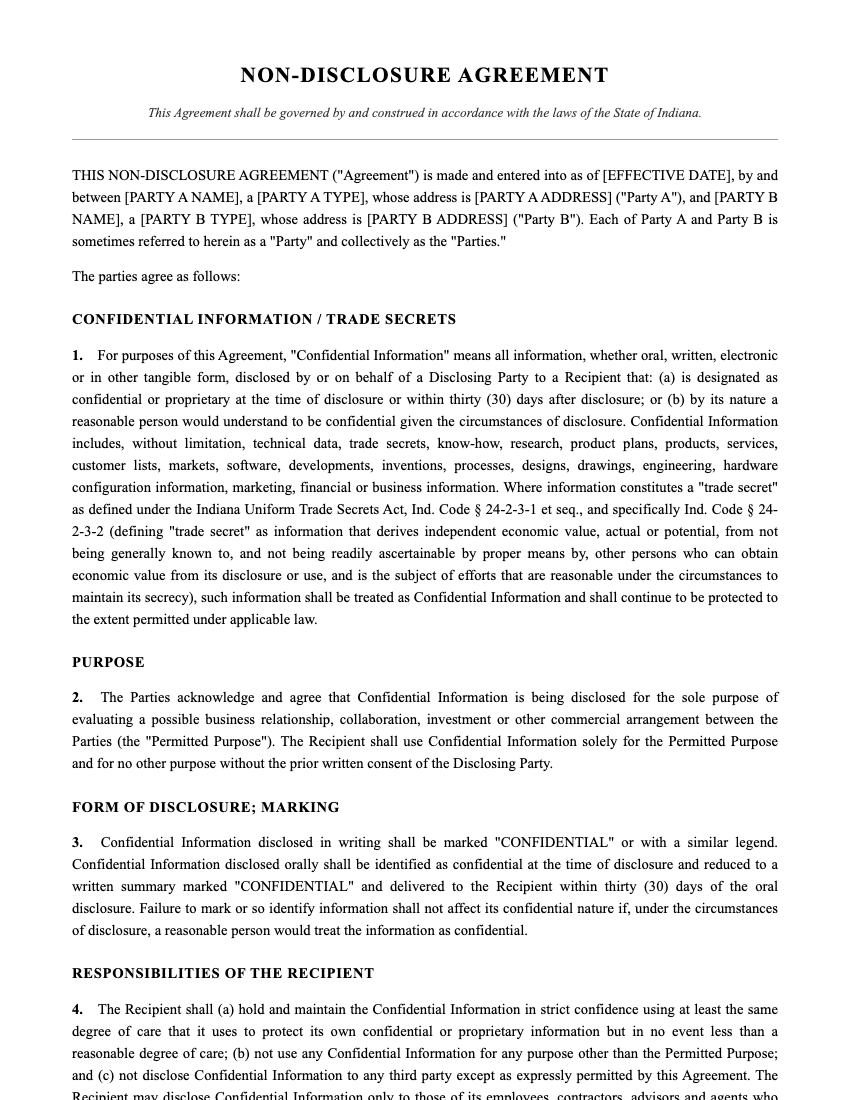
For a complete guide to NDA terms, duration, and standard exclusions, see our NDA Agreement Guide.
Why “Generic” NDAs Are Dangerous in Indiana
Most free templates are written either for states that refuse to enforce non-competes or for jurisdictions that apply different reasonableness tests. In Indiana, those generic forms create three local risks:
- Undisclosed restraint risk — a broad prohibition on "use" can be interpreted as a de facto non-compete. Because Indiana courts analyze the practical effect of a clause, a sweeping "not to use" clause may be enforced as a restrictive covenant if it reasonably protects a legitimate interest.
- Trade secret proof pitfalls — under IUTSA you must show (1) the information has economic value because it is secret, and (2) the owner used reasonable efforts to maintain its secrecy. Labels alone won't do it; your NDA should document marking, access controls, and duration expectations.
- Federal recovery trap — if you intend to preserve the ability to seek enhanced damages and attorney fees in federal DTSA actions, your NDA should include the DTSA whistleblower/authorized disclosure notice. Without that notice (18 U.S.C. § 1833(b)), you may limit remedies in federal trade-secret litigation.
Paradigm-shifting insight for Indiana: Because Indiana enforces reasonable restrictive covenants, an NDA that attempts to be both a confidentiality agreement and a broad use restriction can easily become a de facto non-compete. In practice, that means NDAs in Indiana must be drafted acknowledging enforceability—not avoiding it. Good NDAs narrowly define protected information, state precise permitted uses, and include tailored non-solicit/non-deal restrictions only when supported by consideration and ancillary to employment or a business sale.
Real development to watch
Indiana codified trade-secret protection consistent with the Uniform Trade Secrets Act (see Indiana Code § 24-2-3-1 et seq.), and Indiana’s statute of limitations for written contracts provides a long potential exposure window—IC 34-11-2-11 sets a 10-year limitations period for written agreements. Those two realities mean that overly-broad NDAs can generate long-running litigation exposure in Indiana courts.
What’s Included in This Template (Key Clauses)
- Purpose clause: narrowly limits permitted use (e.g., "for evaluating a potential services agreement for Project X").
- Precise Confidential Information definition: tiered definitions (General Confidential Information vs. Trade Secrets) that map to IUTSA requirements.
- Limited Use covenant: allows the Receiving Party to use Confidential Information only for the Purpose and expressly forbids misuse that would disclose trade secrets.
- Exclusions: publicly available info, prior knowledge, independently developed material, compelled disclosure with notice.
- Residuals clause (optional): expressly permits memory-based retention of non-identifiable skills and high-level ideas, minimizing implied non-compete risk.
- DTSA notice: required language permitting disclosures to government officials or in litigation under 18 U.S.C. § 1833(b).
- Remedies and injunctive relief: clarifies injunctive remedies and acknowledges Indiana’s willingness to enforce reasonable covenants.
- Choice of law and severability: prefers Indiana law; severability helps preserve enforceable portions of an overbroad provision.
Mutual vs. Unilateral: the download includes both versions. Use unilateral when only you disclose (e.g., pitching to vendors or hiring contractors). Use mutual when both sides exchange secrets (e.g., M&A or joint development).
Who Needs This Document?
| User Persona | Usage Scenario | Key Indiana Benefit |
|---|---|---|
| Manufacturers (Midwest supply chain) | Sharing process recipes with a vendor | Protects trade secrets while acknowledging enforceable restraints when needed |
| Software shops & SaaS | Licensing source code to contractors | Tiered trade secret definition and residuals language reduce non-compete exposure |
| Startups seeking investment | Pitching to investors | Narrow purpose clause lets you protect key IP without creating a de facto non-compete |
| Employers | Protecting client lists and goodwill | Template includes optional ancillary non-solicit language consistent with Indiana reasonableness standards |
How to Execute a Valid Indiana NDA
Step 1: Choose the right form — One-Way vs. Mutual.
Step 2: Be specific about the Purpose; vagueness invites disputes in Indiana courts.
Step 3: Mark and protect your materials — labeling, access logs, and password controls demonstrate "reasonable efforts" under IUTSA.
Step 4: Sign before you share — NDAs protect only information disclosed after execution. Electronic signatures are enforceable under federal ESIGN (15 U.S.C. § 7001) and Indiana’s electronic-transaction law; keep signed copies.
If your counterparty sends an NDA, review it for: (i) overbroad "use" restrictions that function as non-competes, (ii) missing DTSA notice language, and (iii) overly long durations or catch-all non-disclosure language that could be litigated as unreasonable in Indiana.
an AI contract review tool can speed up this review—AI flags clauses that functionally operate as restrictive covenants under Indiana law, highlights missing DTSA notice language, and suggests alternative language.
Related NDA Templates
Get the Template
Sign up for our newsletter to receive the template.
Frequently Asked Questions

About Designer Content
Designer Content creates practical legal document resources for landlords, contractors, and small business owners. We simplify complex legal concepts into actionable guidance. Connect with us on LinkedIn.