
A well-drafted Iowa Non-Disclosure Agreement (NDA) protects confidential business information and trade secrets while fitting the state’s contract and employment law landscape. Iowa generally enforces reasonable restraints and confidentiality obligations, but Iowa-specific traps — especially the 10-year statute of limitations for written contracts (Iowa Code §614.1) and consumer-protection exposure — make a tailored NDA essential.
What Is an Iowa NDA?
Definition: An Iowa Non-Disclosure Agreement is a contract in which one or both parties agree to keep specified information confidential, limiting disclosure and use to a defined purpose. NDAs in Iowa sit alongside: (1) the Uniform Commercial Code (see Iowa UCC provisions, Ch. 554) when commercial sales or secured transactions are involved; (2) state contract law (including Iowa Code §614.1 on limitations for written contracts); and (3) federal trade-secret law when applicable (Defend Trade Secrets Act, 18 U.S.C. §1836).
Unlike in some states that broadly void employee restraints, Iowa courts will enforce confidentiality provisions and ancillary restraints if they are reasonable in scope, duration, and geography and protect a legitimate business interest.
For a complete guide to NDA terms, duration, and standard exclusions, see our NDA Agreement Guide.
Why "Generic" NDAs Are Dangerous in Iowa
Using a template written for another jurisdiction or a one-size-fits-all form creates three local risks:
- Long exposure under the written-contract statute of limitations. Iowa Code §614.1 generally provides a 10-year limitations period for written contracts. Overbroad or indefinite-duration NDAs can therefore expose signatories to claims for a decade, and courts will scrutinize whether the duration is reasonable given Iowa’s contract principles.
- Turning an NDA into an enforceable restraint. Because Iowa enforces reasonable restraints, sloppy NDA language that prohibits "use" of information in a way that effectively prevents employment or solicitation can be enforced as a restraint. That may be what you want—employers can get real protection—but overbroad drafting risks either unenforceability or unexpected litigation.
- Consumer protection and deceptive-practice exposure. If an NDA is used in a consumer context or contains misleading clauses (for example, burying a waiver of statutory rights), it can attract scrutiny under the Iowa Consumer Fraud Act and Attorney General enforcement.
Paradigm-shifting insight for Iowa: the statute-of-limitations and enforceability combo. Because Iowa enforces reasonable restraints and gives a 10-year limitations window for written contracts, an overbroad NDA can create long-lived, litigable obligations. Draft for narrowly tailored duration and purpose to limit long-term liability while preserving enforceability.
Real-world development: Iowa courts consistently apply the familiar reasonableness standard to confidentiality and restraint provisions (protecting business goodwill, trade secrets, and customer relationships). Practitioners should note the interaction between state law and the federal Defend Trade Secrets Act (DTSA): DTSA remedies (enhanced damages and attorney’s fees) require certain employer notices in NDAs (see 18 U.S.C. §1833(b)).
Key Clauses — What this Template Includes
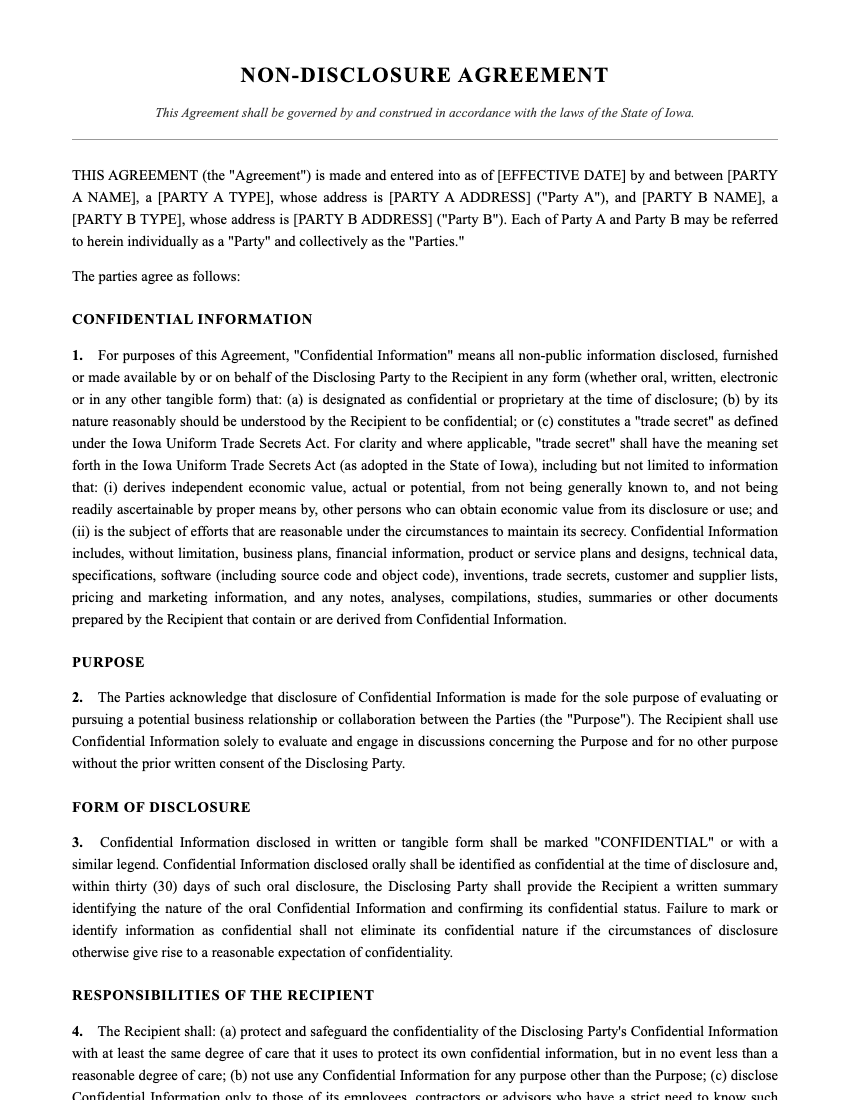
- Purpose clause: Narrows permitted use to a defined project or evaluation period, limiting open-ended obligations.
- Detailed definition of Confidential Information: Distinguishes general confidential business information (time-limited protection) from trade secrets (protected as long as secrecy is maintained). This helps courts analyze reasonable scope under Iowa precedent.
- Permitted disclosures and exclusions: Carve-outs for information already public, independently developed, or rightfully received from third parties.
- Non-use obligation vs. non-compete clarity: The NDA prohibits use of confidential information but does not impose broad employment restraints unless expressly negotiated and supported by consideration and reasonableness analysis.
- DTSA whistleblower notice: Language enabling disclosures to government officials and keeping whistleblower immunity intact for federal trade-secret remedies (18 U.S.C. §1833(b)).
- Remedies and injunctive relief: Iowa courts frequently grant injunctive relief for trade-secret misappropriation; the template sets out injunctive remedies alongside monetary remedies and a provision on the 10-year limitations context.
- Choice-of-law and forum: Tailored to Iowa where appropriate, but includes negotiation options for multi-state situations.
Mutual vs. Unilateral Options
- One-Way (Unilateral): For employers, startups sharing a pitch with vendors, or companies disclosing to contractors.
- Mutual (Two-Way): For M&A diligence, joint ventures, and early-stage partner conversations where both sides exchange information.
Choose mutual only when both sides will disclose; otherwise unilateral reduces unnecessary obligations.
Who Needs This Document?
- Tech startups (Des Moines/Cedar Rapids): Pitching to investors or contractors—protect source code and roadmaps.
- Manufacturers: Sharing drawings with suppliers—protect designs and supplier lists.
- Service providers and consultants: Protect client lists and pricing models while preserving ability to hire talent.
- Employers: Employee and contractor NDAs (paired with reasonable restrictive covenants where necessary and carefully drafted).
How to Execute a Valid Iowa NDA
- Pick the right type (one-way vs mutual) and define the Purpose narrowly. Broad language increases litigation risk in Iowa’s 10-year landscape.
- Mark and document secrecy efforts. Iowa courts expect reasonable protective steps (passwords, labeled documents, access restrictions) to treat information as trade secrets.
- Include DTSA notice if you may sue in federal court. Without it, you may forfeit enhanced damages and fee-shifting (18 U.S.C. §1833(b)).
- Sign before sharing. Treat electronic signatures as effective under federal E-SIGN (15 U.S.C. §7001) and state law; keep copies, signer metadata, and delivery records.
If you’re receiving an NDA, watch for overbroad non-use language that functions like a covenant not to compete, vague duration clauses, or clauses that waive statutory rights. Our an AI contract review tool tool flags risky provisions and compares them to Iowa law to speed negotiations.
Related NDA Templates
Get the Template
Sign up for our newsletter to receive the template.
Frequently Asked Questions

About Designer Content
Designer Content creates practical legal document resources for landlords, contractors, and small business owners. We simplify complex legal concepts into actionable guidance. Connect with us on LinkedIn.