
An Ireland Master Services Agreement (MSA) is a reusable contract that sets the core legal terms for ongoing services between a provider and a client, with each project governed by a short Statement of Work (SOW). If you sell consulting, marketing, software development, or managed services in Ireland, an Irish-law MSA helps you avoid renegotiating key clauses—like payment timing, liability limits, and IP ownership—every time you start a new project. It also helps prevent common cross-border template mistakes around worker status, restrictive covenants, and GDPR security duties.
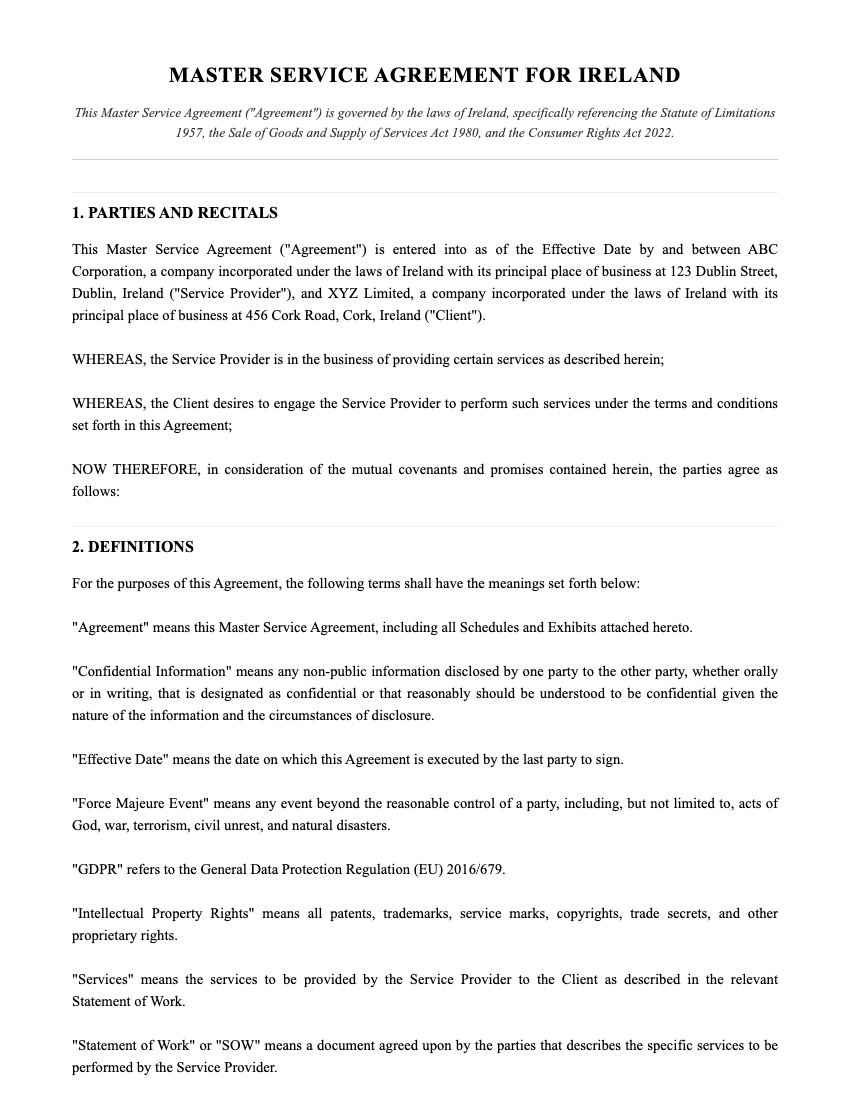
Definition: An Ireland Master Services Agreement (MSA) is a governing umbrella contract, drafted under Irish law, that establishes the baseline terms (fees, invoicing, intellectual property, confidentiality, liability, dispute resolution, and compliance) for a series of future service engagements. Instead of signing a full contract for every job, the parties sign the MSA once and then sign one or more Statements of Work (SOWs) that describe the specific deliverables, milestones, and pricing for each project. In Ireland, a good MSA should align with common-law contract principles, Irish limitation rules (Statute of Limitations 1957), supplier/customer obligations for services (Sale of Goods and Supply of Services Act 1980), and GDPR/data security duties (GDPR Article 32 and the Data Protection Act 2018).
Why You Cannot Use a Generic MSA in Ireland
Using a “one-size-fits-all” MSA (often written for US states, England & Wales, or a global audience) creates very real Irish-law problems. The risk is not only enforceability; it is also regulatory exposure and commercial leverage. Irish courts generally enforce clearly drafted commercial agreements, but they will interpret them through Irish common-law principles, Irish statutes on limitations and supply of services, and Ireland’s EU-law obligations (including GDPR). A generic template often misstates worker status rules, overreaches on non-competes, and mishandles IP ownership for commissioned work.
3a. Worker Classification Rules
Ireland does not use California’s “ABC test.” Instead, worker status is assessed under Irish common law and applied across tax and employment contexts using multiple factors, with a major focus on control, mutuality of obligation, integration, and whether the person is in business on their own account. In practice, Revenue and the courts consider the overall reality of the relationship, not just the label in your MSA. If you draft an MSA that looks like an employment contract (fixed hours, close supervision, exclusivity, “line management,” paid leave-like benefits), the “independent contractor” label may not save you.
For a comprehensive guide to structuring MSAs and SOWs that protect your business, see our Freelancer Contracts Guide.
A practical compliance point is that businesses operating PAYE must run correct payroll withholding for employees under the Taxes Consolidation Act 1997 regime (PAYE is administered through that framework), while contractors are typically responsible for their own tax. Misclassification can trigger Revenue compliance interventions and liabilities for unpaid tax, interest, and potential penalties. From an MSA drafting standpoint, you should include: (i) independent contractor status language consistent with actual working practices; (ii) a no-authority clause (contractor cannot bind the client); and (iii) clear deliverables-based SOWs (what is delivered, by when), rather than employee-like direction about how work must be performed.
Also,, your MSA should avoid copying foreign “employment-at-will” wording or US-style benefits language. Irish employment relationships arise from substance, and a poorly drafted MSA can become evidence that the client exercised employee-like control.
3b. Non-Compete Enforceability
Unlike California, non-compete clauses can be enforceable in Ireland, but only if they are reasonable and go no further than necessary to protect a legitimate business interest (such as trade secrets, confidential information, or customer connections). Irish common law is cautious with restraints of trade: a broad “you can’t work in this industry anywhere for 24 months” clause is likely to be challenged. The safer approach is to tailor restrictions by (i) duration (often months, not years), (ii) geographic scope (only where the client actually operates), and (iii) activity scope (only competitive activities that create real risk).
For B2B MSAs, the most enforceable protections are usually confidentiality, non-solicitation, and non-dealing clauses that focus on specific customers, prospects, or employees the service provider actually had contact with. Generic templates often import sweeping non-competes that are hard to justify. If you include any restrictive covenant, ensure the MSA connects it to a legitimate interest and that the scope matches the relationship described in the SOWs.
Separately, be careful if you try to “contract out” of statutory protections in a way that could affect consumers. If your client is a consumer (many MSAs are strictly B2B, but freelancers sometimes contract with individuals), consumer law constraints can apply, including the Consumer Rights Act 2022 (for consumer contracts). For most MSAs, you should state clearly that the agreement is intended for B2B services.
3c. IP/Work-for-Hire Considerations
Ireland does not use a US-style “work made for hire” concept in the same way for commissioned contractors. As a practical rule, if a contractor creates IP, ownership may not automatically transfer to the client unless the contract includes a clear assignment. Your Ireland MSA should include a present-tense assignment (e.g., “hereby assigns”) of deliverables and related IP upon payment, plus a licence for any pre-existing tools the provider retains.
You should also align service quality and skill obligations with Irish law. For services, the Sale of Goods and Supply of Services Act 1980, section 39 implies that a supplier will carry out the service with due skill, care, and diligence (subject to B2B contracting and any lawful exclusions/limitations). Drafting should reflect this baseline and then set appropriate limitations of liability.
What’s Included in This Template
Flexible SOW Structure
The template uses a two-layer structure: the MSA sets reusable legal terms, while each SOW defines scope, milestones, acceptance criteria, fees, and timelines. This prevents “scope creep” disputes because the SOW is the single source of truth for what is included, what is out of scope, and the rates for additional work.
Ireland-Specific Indemnification
The indemnity language is written for Irish commercial practice: it includes notice and conduct-of-claim procedures (so a party is not forced to pay without control), limits for indirect loss, and carve-outs for fraud, wilful misconduct, and data protection breaches. Where relevant, it ties security and processor obligations to GDPR Article 32 and Data Protection Act 2018, section 36 (Irish enforcement framework).
Dispute Resolution and Venue
Generic templates often default to Delaware, London arbitration, or “courts of California.” This template places governing law in Ireland and venue in the courts of Dublin, which is often commercially important for Irish SMEs who cannot litigate abroad.
Additional Ireland-specific provisions included (with citations):
- Late-payment interest and recovery costs aligned to the European Communities (Late Payment in Commercial Transactions) Regulations 2012 (S.I. No. 580/2012)
- Statute of limitations awareness aligned to the Statute of Limitations 1957, section 11
- Due skill and care baseline for services aligned to the Sale of Goods and Supply of Services Act 1980, section 39
- Security obligations aligned to GDPR Article 32
- Irish data protection framework reference aligned to the Data Protection Act 2018, section 36
Who Needs This Document?
| User Type | Relationship | Key Benefit |
|---|---|---|
| IT & Managed Service Providers | Ongoing support plus projects | Standardises SLAs, invoicing, and liability across many SOWs |
| Consultants (strategy, finance, ops) | Retainers and advisory | Defines scope boundaries and change-control for extra fees |
| Software developers & agencies | Build-and-deliver projects | Clear IP assignment and acceptance criteria tied to payment |
| Marketing and creative freelancers | Multiple campaigns per client | Reusable terms with SOW-based deliverables and approval flow |
How to Use This MSA Template
Step 1: Identify the parties correctly
Use each party’s registered legal name, CRO number if applicable, and Irish address for notices. If a party is non-Irish, confirm the contracting entity and signing authority.
Step 2: Set the term and termination
Choose an initial term (e.g., 12 months) with renewal mechanics, and specify termination for convenience vs. termination for cause. Make sure termination links to how in-flight SOWs will be completed or wound down.
Step 3: Attach the first SOW
Keep deliverables out of the MSA and place them in the SOW: scope, timeline, dependencies, pricing, and acceptance tests. This is where you prevent misunderstandings about “what’s included.”
Step 4: Sign once, then scale with new SOWs
After the MSA is signed, each new project should be a short SOW referencing the MSA. This speeds up sales cycles while keeping legal risk consistent.
Related MSA Templates
Get the Template
Sign up for our newsletter to receive the template.
Frequently Asked Questions

About Designer Content
Designer Content creates practical legal document resources for landlords, contractors, and small business owners. We simplify complex legal concepts into actionable guidance. Connect with us on LinkedIn.