
A Ireland Non-Disclosure Agreement (NDA) is a contract used to protect confidential business information, trade secrets and know‑how when parties share sensitive material. Because Irish law combines common-law restraint-of-trade principles with EU regulations (GDPR and the Trade Secrets Directive implemented here by S.I. No. 69/2018), an enforceable Irish NDA must do more than copy a generic template.
What is an Ireland NDA?
Definition: In Ireland an NDA is a contractual promise to keep identified information confidential and to limit its use to a specified purpose. Confidential information may be protected under (a) contract; (b) the tort of breach of confidence; and (c) statutory measures—chief among them the European Union (Protection of Trade Secrets) Regulations 2018 (S.I. No. 69/2018). NDAs must also respect data protection law (GDPR and the Data Protection Act 2018) and cannot lawfully prevent protected whistleblowing under the Protected Disclosures (Amendment) Act 2022.
Because Irish courts start from the common-law rule that restraints of trade are void unless reasonable and necessary to protect a legitimate business interest, NDAs should narrowly define what is protected and how it may be used.
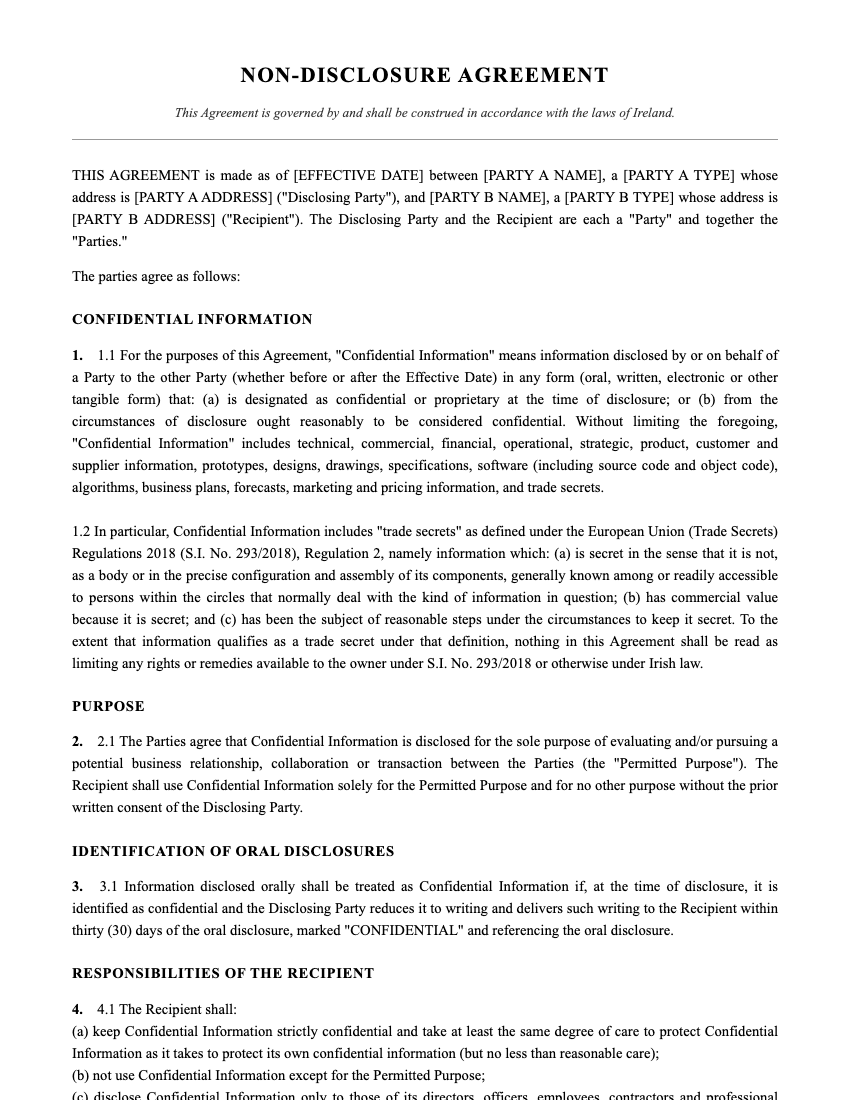
For a complete guide to NDA terms, duration, and standard exclusions, see our NDA Agreement Guide.
Why "Generic" NDAs Are Dangerous in Ireland
Many online NDA forms are written for other jurisdictions and miss critical Irish
traps:
- Protected Disclosures (whistleblowing) carve-outs — a paradigm-shifting insight
Ireland significantly updated its whistleblower framework with the Protected Disclosures (Amendment) Act 2022, implementing the EU Whistleblower Directive. Attempting to use an NDA to silence an employee or contractor from reporting wrongdoing to a competent authority is incompatible with the law. NDA clauses that impose sanctions, penalties or confidentiality obligations intended to prevent protected disclosures will be unenforceable and may attract regulatory scrutiny.
- GDPR and personal data wrapped inside NDAs
If the confidential material contains personal data (employee lists, client contact details), your NDA cannot override GDPR. You must identify lawful bases for processing, specify retention, and ensure data subjects' rights are respected. An NDA that requires unlimited secrecy without addressing data handling obligations exposes signatories to DPC enforcement.
- Overbroad restraints and the restraint-of-trade test
A clause that effectively prevents someone from working in their field can be struck down as an unreasonable restraint of trade. In Ireland, non-compete and similar post‑termination restraints will be enforced only to the extent necessary to protect legitimate business interests (clients, trade secrets) and for a reasonable duration and geography.
- Treating everything as a "trade secret"
The EU Trade Secrets Regulations set an evidentiary framework: a trade secret must (i) derive economic value from secrecy, (ii) not be generally known, and (iii) be subject to reasonable secrecy measures. Declaring all confidential material to be a trade secret without showing these factors risks losing protection entirely.
A recent legal development (real-world impact)
The Protected Disclosures (Amendment) Act 2022 (commonly referred to as the 2022 amendments) broadened protections for whistleblowers and clarified that confidentiality requirements cannot be used to prevent reporting to competent authorities: NDAs must therefore contain an explicit carve‑out for protected disclosures. Employers who relied on old-style "gagging" NDAs have had to update templates following the 2022 Act.
Key Clauses to Include (Ireland-adapted)
- Clear definition of Confidential Information: exclude public information, independently developed information and data known before disclosure.
- Purpose limitation: restrict use strictly to the stated business purpose (e.g., evaluating a proposed supply agreement for Project X).
- Trade secret standard: include an express trade-secret test mirroring S.I. No. 69/2018 (economic value from secrecy + reasonable efforts to maintain secrecy).
- Whistleblower carve-out: expressly permit disclosures protected by the Protected Disclosures Acts and disclosures to competent authorities.
- Data protection clause: identify lawful basis, responsibilities for controller/processor roles, retention periods and cross-border transfer compliance (GDPR / Data Protection Act 2018).
- Narrow restraint language: avoid clauses that look like non-competes; keep restrictions on use of information, not on employment.
- Remedies and injunctive relief: Irish courts can grant injunctions for misuse of trade secrets, but courts balance proportionality—specify liquidated damages only if reasonable.
- Electronic signatures: reference compliance with eIDAS (Regulation (EU) No 910/2014) for electronic execution.
Mutual vs Unilateral
- One‑Way (Unilateral): Use when only one party discloses (investor pitches, contractor onboarding). Simpler and lower risk.
- Mutual: Use where both sides exchange sensitive information (joint ventures, M&A due diligence). Include symmetrical obligations and care standards.
Who Needs This Document?
| User Persona | Usage Scenario | Key Benefit |
|---|---|---|
| Startups (Dublin tech) | Pitching to investors or hiring contractors | Protects code, roadmaps and customer lists while allowing lawful disclosures |
| Manufacturers | Sharing drawings with overseas suppliers | Limits use to manufacture under contract; aligns with GDPR for supplier data |
| Professional services | Client lists and pricing models | Protects client relationships where reasonable restraints are required |
| Employers | Confidential HR information | Combines confidentiality with GDPR-compliant processing rules |
| M&A teams | Due diligence exchanges | Enables staged disclosure and clear return/destruction obligations |
How to Execute a Valid Ireland NDA
- Choose the right type (One‑Way vs Mutual) and specify the narrow Purpose.
- Mark documents and implement reasonable security measures (passwords, access logs) to demonstrate secrecy efforts required by the Trade Secrets Regulations.
- Include a Protected Disclosures carve-out and a GDPR/data‑processing schedule for any personal data.
- Sign (electronic signatures recognised under eIDAS are acceptable) before sharing any confidential material.
Getting NDAs From Other Parties
When you receive an NDA, check for unlawful gagging language, missing whistleblower carve-outs, or ambiguous data protection obligations. If an incoming NDA imposes sweeping post‑termination restraints, negotiate to limit duration and scope or refuse to sign.
an AI contract review tool still helps: use it to scan incoming NDAs for Irish red flags—overbroad restraints, missing whistleblowing carve-outs, and GDPR gaps—so you can negotiate targeted revisions quickly.
Related NDA Templates
Get the Template
Sign up for our newsletter to receive the template.
Frequently Asked Questions

About Designer Content
Designer Content creates practical legal document resources for landlords, contractors, and small business owners. We simplify complex legal concepts into actionable guidance. Connect with us on LinkedIn.