
An Italian Master Services Agreement (MSA) is a master framework contract that pre-defines the collaboration rules between supplier and client for multiple projects, leaving to the individual Statement of Work (SOW) the operational definition of activities, timelines and prices. For SMEs, freelancers and consultants working in Italy, the MSA helps reduce repeated negotiations and manage typical risks (delays in payments, scope disputes, intellectual property and personal data). In the Italian context it is also essential to correctly set duration, termination, interest and liability under the Civil Code.
Definition: An Italian Master Services Agreement (MSA) is a framework agreement under the Civil Code contract logic (the contract as an agreement between parties: art. 1321 c.c.) that establishes general conditions valid for all future engagements between the same parties. The MSA defines roles, payments, change management, liability, intellectual property, confidentiality and data processing, while each specific project is detailed in an SOW attached (deliverables, milestones, rate, acceptance criteria). In this way you sign once the legal “framework” and accelerate operations, maintaining consistency and traceability.
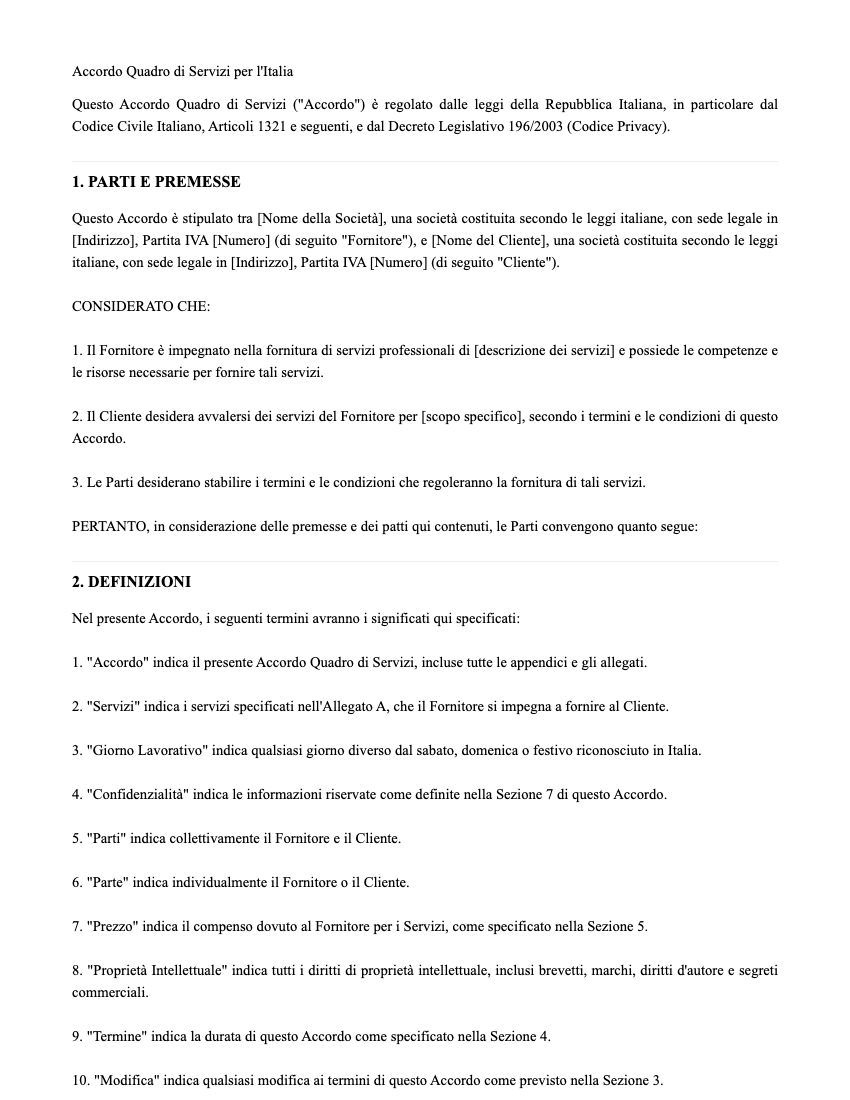
Why You Cannot Use a Generic MSA in Italy
Using a generic MSA (perhaps drafted for a common law jurisdiction) in Italy often creates two problems: (1) clauses that read correctly but are inapplicable or ineffective in our civil law system; (2) gaps on topics that, in Italy and the EU, have stringent rules (e.g., autonomous work vs subordinate employment, non-compete agreements, data processing and contractual liability). A good Italian template must be built around the Civil Code categories and the special rules, otherwise you risk ending up with a contractual framework that does not hold up when needed: disputes, payment delays, or damage claims.
3a. Worker Classification Rules
In Italy there is no “ABC test” as in some US states: the distinction is based primarily on subordination (hetero-direction and integration into the client’s organization). The general reference is the Civil Code: subordinate employment is described by art. 2094 c.c. (performance under dependency and under the direction of the entrepreneur), while autonomous work is regulated by art. 2222 c.c. (obligation to perform a work/service with predominantly one’s own labor and without subordination). Additionally, art. 2 of D.Lgs. 81/2015 extends many protections of subordinate work to “hetero-organized” collaborations (when the client organizes time and place).
For a comprehensive guide to structuring MSAs and SOWs that protect your business, see our Freelancer Contracts Guide.
Why it matters for the MSA? If a client controls hours, tools and methods, a “consultant” can be recharacterized as a subordinate worker or a collaboration subject to protections, with impacts on social contributions, pay differentials and penalties. A serious Italian template includes: statements on autonomous status, absence of exclusivity, organizational autonomy, ability to be substituted (if compatible) and an SOW that avoids typical subordinated language (shifts, time cards, hierarchy).
3b. Non-Compete Enforceability
In Italy non-compete covenants between businesses or between client and service provider can be valid, but you cannot “copy and paste” from an Anglo-Saxon model. If the relationship is between businesses/VAT entities, the governing rule is art. 2596 c.c., which allows restrictions on competition only if: (i) they are limited by subject matter, time and place; and (ii) do not exceed five years. A vague clause (“you will not work in the sector”) or too broad (Italy+Europe+world, for any service) risks being challenged for indefiniteness or excess.
If instead it concerns subordinate work, the non-compete clause is governed by art. 2125 c.c. and requires consideration and limits of subject matter/time/place (maximum duration: generally 3 years, 5 for executives). Even many freelancers end up signing clauses designed for employees: without consideration or without a precise perimeter, the clause may not hold.
In an Italian MSA template it is advisable to use alternatives that are often more sustainable: (a) robust confidentiality and post-contract survival; (b) protection of trade secrets (D.Lgs. 63/2018 implementing EU Directive 2016/943); (c) targeted bans on poaching personnel or clients, with reasonable limits. If a real non-compete is needed B2B, calibrate it to subject matter (specific services), territory (real market) and duration (e.g., 6–12 months), to be more defensible.
3c. IP/Work-for-Hire Considerations
Italy does not automatically apply a “work made for hire” concept as in other jurisdictions. Generally, for copyright the relevant regulation is the Law 22 April 1941, n. 633 (Diritto d’autore): economic rights can be transferred/licensed, but a clear clause must align with the scope of the assignment. In software, for example, art. 12-bis LDA assigns rights to the employer for programs created by the employee in the execution of duties; this does not automatically extend to an external consultant. For this reason, an Italian MSA should provide: (i) pre-existing IP ownership (background IP) that remains with the supplier; (ii) a limited license or transfer of rights in the deliverables, often conditioned on payment; (iii) management of open source components and third-party rights.
What's Included in This Template
Flexible SOW Structure
The template separates general terms and projects: the MSA governs recurring rules (payments, liability, IP, confidentiality), while each SOW defines scope, milestones, acceptance criteria and rate. This reduces “scope creep” and makes it easier to add new engagements without rewriting the contract.
Italy-Specific Indemnification
The indemnification/liability limitation section is crafted to stay compatible with the Civil Code limits: you cannot exclude liability indiscriminately. In particular, art. 1229 c.c. renders void any agreement that excludes liability for willful misconduct or gross negligence (or violations of public policy obligations). The template uses reasonable caps, carve-outs and insurance obligations (minimum coverage €1,000,000) to allocate risk in a realistic way.
Dispute Resolution and Venue
The model provides for the competent court in Italy (normally the defendant’s domicile, subject to applicable clauses) and a clause of Italian law to avoid referrals to foreign jurisdictions that complicate enforcement. It also includes a structured handling of disputes and cure periods before termination, with attention to duration and renewal.
Additional provisions included (with references):
- Duration, automatic renewal and termination set as a contract (art. 1321 c.c.) with clear withdrawal/termination mechanisms.
- Interest for late payments referencing the legal rate (art. 1284 c.c.) and a consistent late-payment interest clause.
- Limitation periods and complaint management with awareness of the ordinary ten-year term (art. 2946 c.c.).
- GDPR and appointment as Data Protection Officer if needed (art. 28 GDPR) and coordination with D.Lgs. 196/2003 (Codice Privacy).
Who Needs This Document?
| User Type | Relationship | Key Benefit |
|---|---|---|
| Marketing Agencies | Retainer + recurring campaigns | SOWs quickly and rules on revisions/extra-scope |
| IT consultants / developers | Milestone-based projects | Clear IP and deliverables conditioned on payment |
| Consulting firms | Ongoing advisory | Standardized terms for duration, termination and liability |
| Creative freelancers | Design/copy/video B2B | Copyright protection, portfolio and confidentiality |
How to Use This MSA Template
Step 1: Identify the parties correctly
Enter the legal entity name, VAT/Tax ID, registered office and representative. In Italy a proper heading reduces invoicing, signing and debt recovery issues.
Step 2: Set duration, renewal and exit
Decide whether the contract is fixed-term or “evergreen” with automatic renewal and notice. Specify termination triggers (breach, non-payment, privacy violations) and cure periods.
Step 3: Complete the first SOW with measurable criteria
In the SOW describe deliverables, deadlines, rates, client assumptions, acceptance criteria and change requests. The more measurable the SOW, the fewer disputes about “work completed.”
Step 4: Sign and manage attachments and orders
Have the MSA and SOW signed (even via e-signature) and maintain versions and attachments. For each new project, create a new SOW that references the MSA without rewriting everything.
Related MSA Templates
Get the Template
Sign up for our newsletter to receive the template.
Frequently Asked Questions

About Designer Content
Designer Content creates practical legal document resources for landlords, contractors, and small business owners. We simplify complex legal concepts into actionable guidance. Connect with us on LinkedIn.