
A Non‑Disclosure Agreement (NDA) in Italy is a contract that protects confidential information and trade secrets shared between parties while respecting Italian civil‑law limits on restraints and European data‑protection rules. Unlike some jurisdictions where boilerplate NDAs can be dropped in without change, Italian law requires attention to post‑employment restraints (Codice Civile Article 2125), data‑protection obligations (GDPR and D.Lgs. 196/2003), and the national implementation of the EU Trade Secrets Directive.
What is an Italy NDA?
Definition: An Italy NDA (accordo di riservatezza) is a contractual obligation to keep designated information confidential and to use it only for a specified commercial purpose. It can protect business know‑how, customer lists, technical designs, source code, pricing strategies, and other information that qualifies as a trade secret under the EU Trade Secrets Directive and its Italian implementing measures.
An NDA in Italy serves two connected functions: (1) to create contractual remedies for breaches, and (2) to evidence the “reasonable measures” the disclosing party took to keep information secret — a critical factor for court protection of trade secrets.
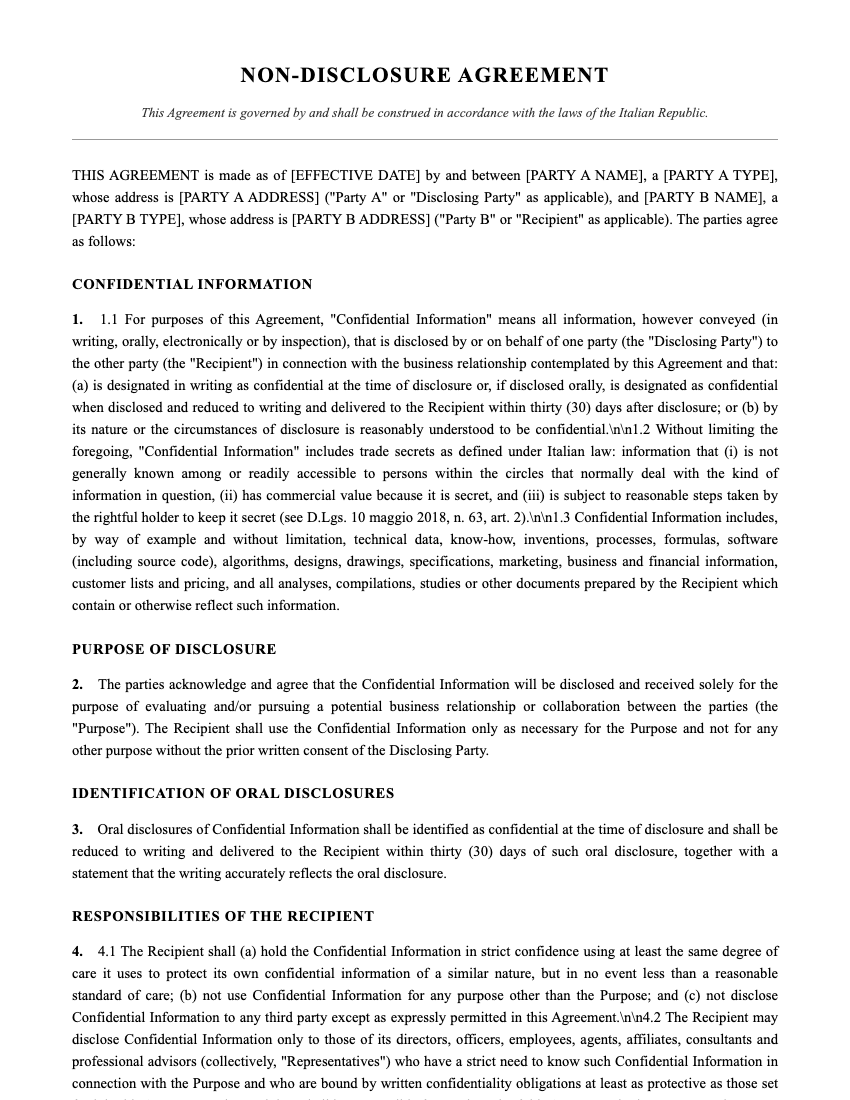
For a complete guide to NDA terms, duration, and standard exclusions, see our NDA Agreement Guide.
Why generic NDAs are dangerous in Italy
Using a generic, foreign NDA risks three Italian‑specific traps:
- Mandatory compensation for post‑employment restraints (Paradigm‑shifting insight). Under Codice Civile Article 2125, post‑employment non‑compete clauses for employees are enforceable only if they are limited in time and territory and accompanied by an adequate economic compensation. A one‑sided NDA that effectively restrains future work without compensation may be void or unenforceable.
- Privacy law conflicts. NDAs that require disclosure of personal data or transfer of data without regard to the GDPR (Regulation (EU) 2016/679) and Italy’s privacy code (D.Lgs. 196/2003 as amended) can expose parties to fines and invalidate contractual obligations that conflict with data‑subject rights. An NDA cannot lawfully prevent an employee from exercising GDPR rights (access, rectification, deletion) nor waive mandatory legal protections.
- Failure to document secrecy measures. The Italian approach to trade secrets follows the EU Trade Secrets Directive: protection hinges on (a) the information’s commercial value from secrecy, (b) reasonable steps to keep it secret, and (c) it not being generally known. Generic templates that never require marking, access controls, or confidentiality procedures weaken your claim that information is a protected trade secret.
Real, verifiable developments: Italy transposed the EU Trade Secrets Directive (Directive (EU) 2016/943) into national law — businesses must therefore demonstrate contractual and technical measures to preserve secrecy. Also note the settled civil practice that courts scrutinize restraints under Art. 2125 for proportionality and compensation.
Key clauses adapted for Italian practice
- Purpose and scope: narrowly define the evaluation purpose (e.g., "evaluation of a proposed supply agreement for Product X in Italy") so limits on use are enforceable.
- Definition of Confidential Information vs Trade Secrets: separate general confidential data (time‑limited protection) from information meeting the Directive’s trade‑secret criteria (potentially protected indefinitely while secret).
- Post‑termination restrictions: if you need a non‑competition element for an employee, include a clear compensation clause and time/territory limits to satisfy Art. 2125 CC. For contractors, tailor restraints to what is necessary to protect legitimate interests.
- Data protection clause: identify data controller/processor roles, lawful basis under GDPR, security measures, and cross‑border transfer mechanisms if applicable.
- Remedies and injunctive relief: Italian courts can grant interim injunctions; specify injunctive relief and liquidated damages but avoid penalties that conflict with public policy.
- Marking and security measures: require legends on documents, electronic watermarking, access lists, and a description of technical controls to show "reasonable steps."
- Electronic signature and formalities: state that electronic signatures compliant with eIDAS/Italian CAD (D.Lgs. 82/2005 and eIDAS Regulation (EU) No 910/2014) are acceptable.
Who needs this document?
| User Persona | Usage Scenario | Why this Italy NDA Template helps |
|---|---|---|
| Italian startups | Pitching to investors or negotiating distribution in Italy | Protects business plans while respecting GDPR and demonstrates secrecy measures for trade‑secret status |
| Employers | Hiring senior employees with access to commercial know‑how | Builds enforceable post‑employment restraints only if paired with compensation per Art. 2125 CC |
| Law firms & consultants | Sharing client‑sensitive materials with contractors | Assigns data‑controller roles and security obligations required by GDPR |
| Manufacturers | Sending prototypes to overseas factories | Requires technical and contractual steps to preserve trade‑secret protection under EU/Italian law |
How to execute a valid Italy NDA (practical steps)
- Choose the correct form: unilateral when only one side discloses; mutual when both exchange information.
- Be specific about the purpose and scope: tie the NDA to a concrete project; avoid open‑ended language.
- Demonstrate secrecy measures: mark documents, limit access, log disclosures, require password protection and encrypted transmission — courts look for these to find trade‑secret status.
- Sign with an accepted signature method: eIDAS‑compliant electronic signatures and registered PEC email records are commonly used in Italy; have the document executed before any disclosure.
Real‑world tip: compensation is not optional
If you intend to keep a former employee from competing, you must budget for compensation and make the restraint reasonable in scope. Many foreign templates omit this; in Italy that omission can make the restraint unenforceable and risk losing other remedies.
Cross‑sell: an AI contract review tool
If you receive NDAs from counterparties, use an AI contract review tool to flag Italian‑law red flags: unenforceable restraint language, GDPR conflicts, missing data‑controller clauses, or inadequate secrecy procedures—saving time and negotiation leverage.
Related NDA Templates
Get the Template
Sign up for our newsletter to receive the template.
Frequently Asked Questions

About Designer Content
Designer Content creates practical legal document resources for landlords, contractors, and small business owners. We simplify complex legal concepts into actionable guidance. Connect with us on LinkedIn.