
Definition: A Master Services Agreement (MSA) in Japan is a comprehensive agreement that sets “common rules” for transactions repeatedly and continuously conducted between the client and the vendor/freelancer, such as payment terms, intellectual property, confidentiality, limitation of liability, governing law, and dispute resolution. Individual deliverables, deadlines, inspection/acceptance methods, price, structure, and schedule are clarified in the SOW, and thereafter you can run the transactions simply by adding SOWs. The formation and validity of the contract are considered on the foundation of the Civil Code (e.g., Civil Code Article 89), and provisions are also designed to reflect mistake when concluded based on an erroneous premise (Civil Code Article 95) and interest in case of payment delay (Civil Code Article 404).
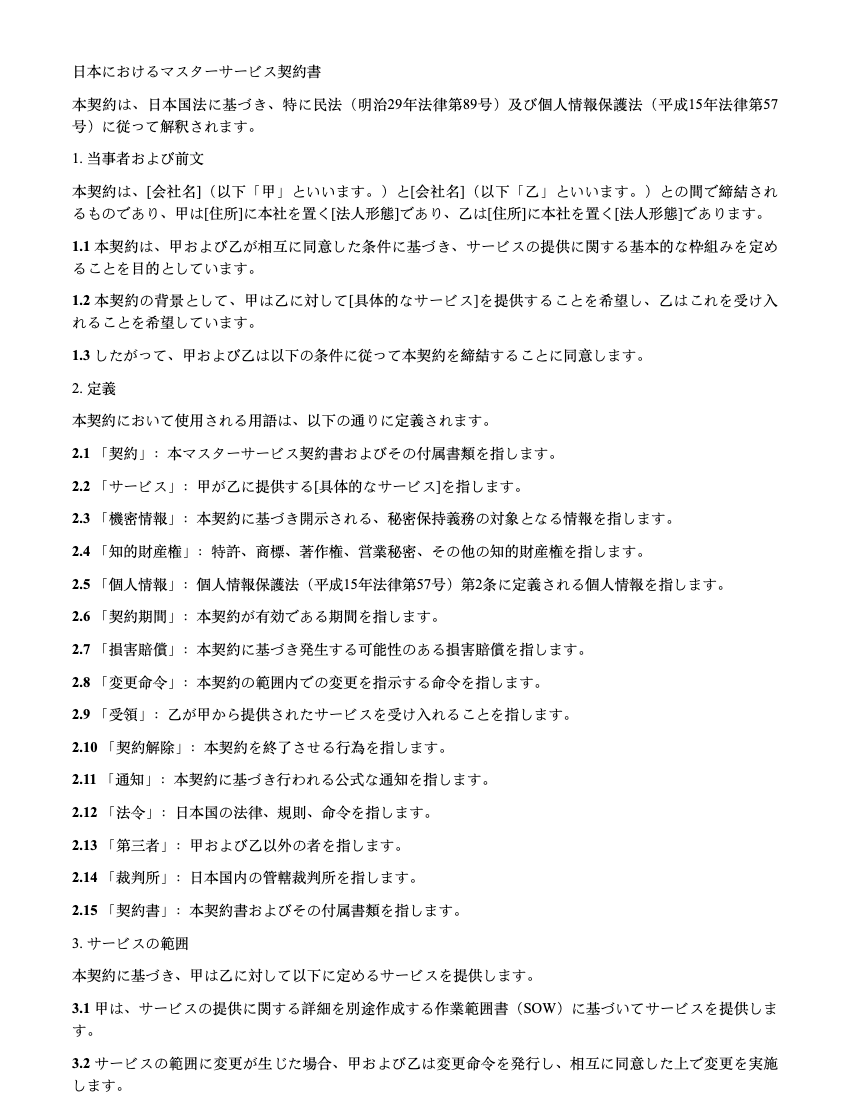
Why You Cannot Use a Generic MSA in Japan
If you apply an overseas template or a “general MSA” to Japan engagements as-is, three typical pitfalls can arise: (1) treating it as outsourcing even though the reality is closer to employment, (2) inserting an overly broad non-compete and bearing the risk of invalidity or unenforceability, and (3) ambiguity around IP ownership and the handling of moral rights, leading to disputes after delivery. In addition, in transactions that handle personal information or customer data, if there are provisions that do not align with the Act on the Protection of Personal Information (APPI) (such as vendor management, sub-processing, security measures, etc.), it is not uncommon in practice for the deal to “get stopped in an audit” or “be sent back by the counterparty’s legal team.” A Japanese MSA must be created on the premise of the Civil Code’s contract rules, while also, together with SOW operation, designing around the realities of labor provision, reasonable restrictions, and the structure of rights transfer for deliverables.
3a. Worker Classification Rules
In Japan, whether someone is an “independent contractor (sole proprietor/corporation)” or “substantively a worker (employment)” is determined primarily based on the actual circumstances, rather than by a single statutory test like the U.S. ABC test. Typically, factors are considered in totality, such as direction and supervision (whether you are giving detailed instructions on when/where/how to work), substitutability (whether the individual must personally perform, or can provide a substitute), the nature of compensation (whether it resembles an hourly wage or is consideration for deliverables/services), who bears equipment costs, exclusivity, and so on. If it is evaluated as employment, in addition to application of the Labor Standards Act (working hours, overtime premiums, etc.), additional costs and corrective measures may arise regarding workers’ accident compensation insurance, employment insurance, social insurance, withholding, and the like. For example, a business is regulated under Labor Standards Act Article 24 regarding methods of wage payment, and if it is deemed employment, “we intended it as a contract for services” will not be accepted. In an MSA, it is important to align the reality as outsourcing through the design of deliverable-based SOWs, discretion over work location and hours, whether re-outsourcing/substitution is permitted, and inspection/acceptance and defect handling.
For a comprehensive guide to structuring MSAs and SOWs that protect your business, see our Freelancer Contracts Guide.
3b. Non-Compete Enforceability
In Japan, a non-compete obligation is not “uniformly prohibited,” and it is possible to provide for it by contract; however, if the content is excessive, it may be deemed invalid as contrary to public policy and morals. The basis is Civil Code Article 90 (public policy and morals), and in judicial practice the enforceability of the restriction is determined by comprehensively considering whether there is a legitimate interest to be protected (trade secrets, customer relationships, know-how, etc.), whether the term/region/scope of business is reasonable, and whether there are compensatory measures (such as payment of consideration). In particular, provisions such as “indefinite term / nationwide / prohibition of all similar work” are likely to become disputes for freelancers and small businesses. In an MSA template, a practical design is: (1) limit the purpose to trade secret protection, (2) set a shorter term (e.g., 6–12 months), (3) narrow the prohibited acts to things like “direct solicitation of specific customers,” and (4) instead include strong confidentiality, data return, and access control clauses. Confidentiality is also the foundation of trade secret management, and in many cases is more effective in practice than an excessive non-compete.
3c. IP/Work-for-Hire Considerations
Under Japanese copyright law, copyrights in principle belong to the individual who created the work (the author), and a structure whereby they automatically vest in the client by a single contract sentence like the U.S. “work made for hire” does not apply as-is. There are exceptions such as works made by corporations (Copyright Act Article 15), but deliverables created by external contractors are usually addressed by clearly specifying the transfer of rights in an assignment clause. Also, moral rights cannot be assigned, so it is common to include a non-assertion covenant stating that they will not be exercised. In an MSA, it is necessary to align with the SOW regarding the scope of deliverables, treatment of existing assets (background IP), inclusion of third-party materials/OSS, and whether inspection/acceptance and completion of payment are conditions for the transfer of rights.
What's Included in This Template
Flexible SOW Structure
This MSA template is prepared on the premise that basic provisions are consolidated in the MSA, and the scope/structure/deadlines/fees/inspection criteria/change management (additional fees) for each engagement are finalized in the SOW. This shortens contract negotiations each time and prevents scope creep (the problem where work increases before you realize it).
Japan-Specific Indemnification
In Japanese transactions, the design of damages and limitation of liability is central to negotiations. The template is structured in a way that is easy to accept in practice, including exceptions based on the parties’ attribution of fault (intent/gross negligence), exclusion of indirect damages, and a liability cap (e.g., the total amount paid in the most recent 12 months). Statutory interest for late payment is clarified in light of Civil Code Article 404.
Dispute Resolution and Venue
The governing law is Japanese law, and the agreed jurisdiction is Japanese courts (e.g., the Tokyo District Court), eliminating the risk in overseas templates where foreign law/foreign arbitration tends to be mixed in. Even for contract disputes including mistake in manifestation of intent (Civil Code Article 95), matters become easier to organize within the Japanese-law framework.
Additional clauses to include (examples):
- Default interest for late payment: Civil Code Article 404
- Basics of contract validity/interpretation: Civil Code Article 89
- Organizing the risk of rescission due to mistake: Civil Code Article 95
- Definition and handling of personal data: Act on the Protection of Personal Information Article 2
- Caution when B2C is mixed in: Consumer Contract Act Article 61
Who Needs This Document?
| User Type | Relationship | Key Benefit |
|---|---|---|
| IT outsourcing/development company | Development/maintenance under continuous SOWs | Standardize rules for specification changes and additional fees |
| Designer/production company | Repetitive monthly operations/production | Clarify inspection/acceptance, number of revisions, and conditions for rights transfer |
| Consultant/professional services | Advisory/ongoing support | Clarify that there is no guaranteed outcome, and organize disclaimers and liability caps |
| Advertising/marketing agency | Ongoing campaign orders | Define responsibility for providing materials and allocation of third-party IP infringement risk |
How to Use This MSA Template
Step 1: Accurately write the party information
For corporations, state the trade name and head office address as shown in the corporate registry; for sole proprietors, clearly state the individual’s legal name rather than a trade name. Also standardize the billing address, contact information, and notice method.
Step 2: Finalize common rules in the MSA
Decide payment terms, inspection/acceptance, limitation of liability, confidentiality, personal information, subcontracting, governing law, and jurisdiction on the MSA side. If these vary by engagement, negotiation costs skyrocket, so as a rule they should be placed in the MSA.
Step 3: Attach the first SOW
Put deliverables, deadlines, structure, unit prices/amounts, milestones, inspection criteria, and change management into the SOW. Align the timing of rights transfer (after inspection/acceptance / after payment is received) with the SOW as well.
Step 4: Decide signature and operational rules
Execute the agreement in a way that fits internal operations, such as electronic signatures or signed/sealed execution. Thereafter, add an SOW for each new engagement, and the common provisions of the MSA will apply automatically.
Related MSA Templates
Get the Template
Sign up for our newsletter to receive the template.
Frequently Asked Questions

About Designer Content
Designer Content creates practical legal document resources for landlords, contractors, and small business owners. We simplify complex legal concepts into actionable guidance. Connect with us on LinkedIn.